
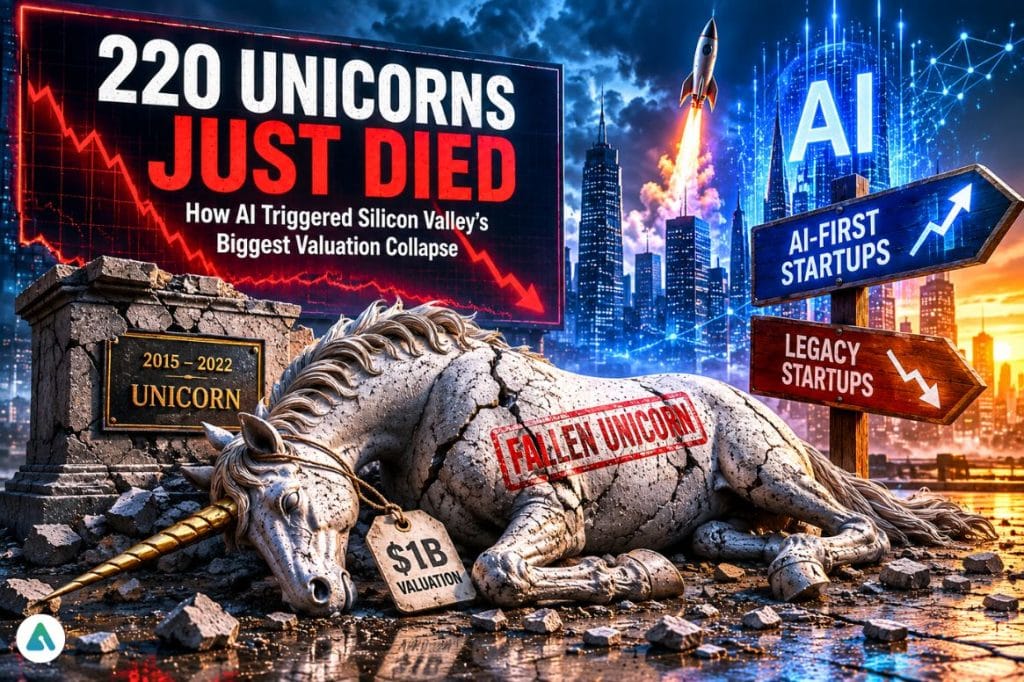
More than 220 startups have lost their unicorn status. The problem isn’t a venture capital slowdown. It’s that AI has changed what investors think software is worth.
For years, Silicon Valley treated billion-dollar valuations as milestones.
In 2026, they’re starting to look more like expiration dates.
According to PitchBook data highlighted by CNBC, more than 220 startups have lost their unicorn status, falling below the $1 billion valuation mark that once defined the elite tier of venture-backed companies. Nearly half of America’s unicorns haven’t raised fresh funding in at least three years, a warning sign that many of the companies crowned during the venture boom are struggling to adapt to a market now centered on artificial intelligence.
A few years ago, those numbers would have sparked fears of a startup crash.
But that’s not what investors are seeing.
At the same moment, hundreds of former unicorns are watching their valuations shrink, and AI startups are attracting capital at a historic pace. Billions of dollars continue flowing into foundation model companies, AI infrastructure providers, coding platforms, and agent startups, creating one of the most uneven funding environments the technology industry has experienced in decades.
The market isn’t abandoning technology.
It’s abandoning yesterday’s definition of it.
Silicon Valley Now Operates in Two Different Economies
Talk to founders, investors, or startup operators, and a pattern quickly emerges.
There are effectively two startup markets.
The first is the AI market.
The second is everything else.
Companies with a credible AI story can still command eye-watering valuations. Investors are willing to fund aggressive growth plans, overlook short-term losses, and bet on future dominance. In some cases, startups are reaching multibillion-dollar valuations within a fraction of the time it took previous generations of software companies.
For startups built before the ChatGPT era, the environment looks very different.
Fundraising rounds take longer. Investors ask tougher questions. Growth rates that once impressed venture firms no longer generate the same excitement. Many founders who raised money during the 2021 frenzy are discovering that the benchmarks used to value their businesses have changed dramatically.
The shift is subtle but important.
Investors are no longer asking whether a company is growing.
They’re asking whether the company still makes sense in an AI-first world.
SaaS Became Ground Zero
The pain is particularly visible in software.
PitchBook’s list of fallen unicorns includes dozens of Software-as-a-Service companies, making SaaS one of the largest casualty groups of the post-ChatGPT era.
That doesn’t mean software is dying.
Far from it.
The problem is that AI is changing how software is built, sold, and valued.
For more than a decade, software companies thrived by creating specialized tools for specific business functions. A startup could build an application for scheduling, customer support, marketing automation, analytics, documentation, or project management and eventually become a valuable standalone business.
Generative AI is disrupting that logic.
Features that once required dedicated products can increasingly be recreated inside larger AI platforms. Tasks that previously justified separate software subscriptions are being absorbed into AI-powered workflows.
Investors have noticed.
What looked like a durable product category in 2021 can suddenly look like a feature in 2026.
And features rarely deserve billion-dollar valuations.
The Real Threat Is the Collapse of the Per-Seat Model
Perhaps the biggest challenge facing legacy software companies isn’t competition from another startup.
It’s the business model itself.
The modern SaaS industry was built on per-seat pricing. The formula was simple: charge customers based on how many employees use the software.
As organizations hired more people, software revenue grew alongside them.
AI introduces a problem that few companies anticipated.
Many AI tools are designed to help businesses operate with fewer people.
If an AI agent can perform work that previously required multiple employees, companies may need fewer software seats rather than more. That creates pressure on a pricing model that has powered the software industry for years.
Investors are increasingly paying attention to that reality.
A company whose growth depends on expanding headcount now faces a future where many enterprises are actively trying to reduce it.
That’s not a temporary market cycle.
It’s a structural shift.
The Cap Table Trap
For many startups, the funding problem is becoming increasingly difficult to solve.
During the venture capital boom of 2021, companies raised enormous rounds at valuations that reflected near-perfect expectations for future growth. Those valuations looked reasonable when money was cheap, and investors were competing aggressively for deals.
Today’s environment is less forgiving.
Many startups would likely need to accept lower valuations if they attempted to raise money now. Doing so would trigger a down round, potentially hurting employee morale, reducing the value of stock options, and signaling weakness to the market.
As a result, a growing number of companies find themselves trapped.
They don’t want to raise at lower valuations.
But they may not be able to justify the old ones.
Instead, they’re cutting costs, extending runways, slowing hiring, and waiting for conditions to improve.
For some, that strategy may work.
For others, it simply delays a difficult conversation.
Investors Are Asking a New Question
The startup ecosystem spent years rewarding growth above everything else.
That era is ending.
The most important question in venture capital is no longer how quickly a company can acquire customers.
It’s whether the company’s advantage survives the arrival of AI.
Can the product become more valuable because of AI?
Or does AI make the product less necessary?
That distinction is now worth billions of dollars.
Some founders are successfully reinventing their businesses around AI-powered workflows, automation, and intelligent agents. Others are discovering that features they spent years building can now be replicated in weeks.
The technology hasn’t changed the rules equally.
It has rewritten them selectively.
This Isn’t a Bubble Story
The easiest comparison is the dot-com era.
It’s also the wrong one.
The internet boom was fueled by expectations of future adoption.
The AI boom is being fueled by actual adoption.
Businesses are deploying AI systems today. Developers are building products around large language models today. Enterprises are restructuring workflows around AI today.
The demand is real.
What investors are debating is which companies will capture that demand.
The answer increasingly appears to favor businesses built for the AI era rather than those trying to retrofit themselves into it.
That’s why the story of 220 fallen unicorns matters.
It’s not simply a tale of shrinking valuations.
It’s an early signal that Silicon Valley has begun separating companies into two categories: those benefiting from the AI transition and those being disrupted by it.
For the startup class of 2021, that distinction may determine who survives the decade—and who becomes a case study in how quickly technology can redefine value.
Related: The AI Job Crisis Isn’t Future News — It’s the “Transition Gap” Already Breaking Careers in 2026
