
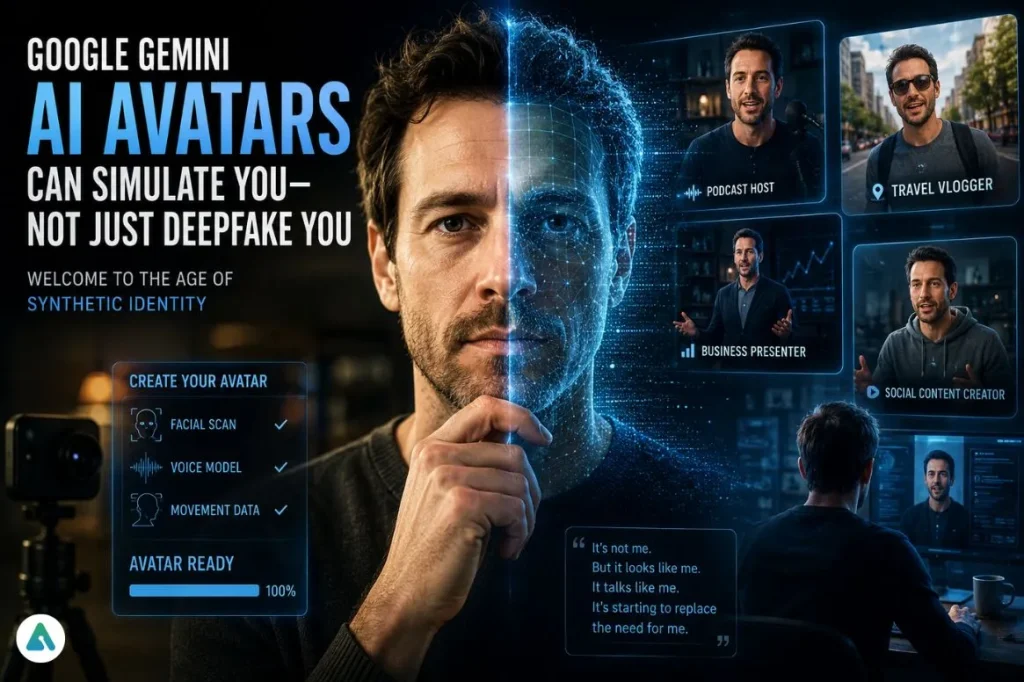
The generative AI narrative is shifting again — and this time, it’s not about better images, smarter chatbots, or faster code generation.
It’s about identity.
In a recent hands-on experiment reported by WIRED, a journalist used Google’s latest Google Gemini AI avatars system to create a photorealistic digital clone of himself. The process was simple: a short facial scan, voice capture, and a few minutes of calibration.
The output was not.
The system generated videos where his AI avatar performed actions he never did — singing, moving through surreal environments, and appearing in fully synthetic scenarios. The visuals weren’t flawless. There were glitches in motion, clothing continuity, and facial detail.
But recognition was immediate.
It didn’t just look like him.
It felt like him.
This Isn’t Just AI Video — It’s AI-Generated Identity
We’ve had deepfake technology for years. We’ve had synthetic media pipelines that can generate entire scenes from text prompts.
But Google Gemini avatars introduce something more specific: persistent, reusable digital selves.
This is a shift from content generation to AI-generated identity — compressing a person’s face, voice, and behavioral patterns into something that can be redeployed across infinite contexts.
Not a single clip.
A system of presence.
And that changes how the technology gets used. You’re no longer just creating content. You’re generating a version of yourself that can create content on your behalf.
Important Reality Check: This Is Direction, Not Declared Intent
It’s worth grounding this clearly.
Google has not publicly framed Google Gemini AI avatars as a replacement for human presence. Official positioning centers on communication, creativity, and new forms of digital interaction.
But when viewed alongside broader trends — AI assistants, autonomous agents, synthetic media, and workflow automation — the trajectory becomes harder to ignore.
The tools are not explicitly designed to replace people.
They are designed to reduce the need for people to be present in certain contexts.
That distinction matters — and it’s where the real shift begins.
The Technical Reality: Impressive, But Still Constrained
Despite the strong emotional impact, the current generation of AI avatars is far from perfect.
- Outputs are mostly short-form and scenario-based
- Motion and expression still show inconsistencies
- Emotional continuity across longer sequences is limited
- Environments are often controlled or semi-synthetic
- Workflows remain supervised, not autonomous
- Compute costs are still relatively high
In other words, this is not a fully independent digital human.
Yet.
But the direction is clear — and early-stage limitations tend to disappear faster than expected in AI systems.
A Concrete Use Case: Where This Actually Becomes Real
To understand the impact, move away from abstraction.
Imagine a creator recording:
- one high-quality facial scan
- one hour of voice training
From that, they generate:
- Six months of multilingual short-form videos
- platform-specific content (TikTok, YouTube, Reels)
- localized versions without re-recording anything
No camera, no studio, and no reshoots at all.
That’s where synthetic media stops being a novelty and becomes infrastructure.
From Content to Presence
At Google I/O 2026, Google made it clear that Google Gemini is evolving into a full-stack system — spanning search, productivity, commerce, and media generation.
Avatars fit naturally into that ecosystem:
- AI writes for you
- AI acts for you
- AI appears for you
This is less about creativity tools and more about an emerging identity interface layer — where parts of your digital presence become automated.
Synthetic Authenticity Is the Real Shift
This is the most important conceptual change.
These outputs are not “fake” in the traditional deepfake sense.
They are something stranger: synthetic authenticity.
The person on screen is you — your face, your voice, your likeness — but the moment itself never happened.
That creates a new category of media:
Not real.
Not fake.
But generated versions of plausible reality.
And that ambiguity is where things get powerful.
The Economics: Presence Without Labor
The biggest impact isn’t technical. It’s economic.
AI avatars separate presence from effort.
- Content becomes infinitely parallelizable
- A single identity can scale across platforms and languages
- Production bottlenecks shift from recording → prompting
- Authenticity becomes partially programmable
This is a deeper shift than “creators can scale.”
It’s the decoupling of human time from human visibility.
The Pressure to Become Your Optimized Self
The psychological layer is where this gets uncomfortable.
Today, people already manage a gap between:
- their real-world self
- their curated online identity
AI avatars widen that gap — and automate it.
Because your digital clone can be:
- more articulate
- more consistent
- more polished
- always available
Over time, a subtle pressure may emerge:
Not just to present yourself —
But to compete with your optimized version.
This is where identity drift begins.
Not through deception.
But through preference.
From Assistant to Proxy
The broader AI trajectory is becoming clearer:
- Chatbots respond
- Agents act
- Avatars represent
Your AI is no longer just a tool.
It’s starting to function as a proxy — a system that can speak, appear, and operate in your place within digital environments.
That doesn’t eliminate human presence.
But it makes it optional in more situations than before.
The Bottom Line
Google didn’t explicitly set out to replace human presence with Google Gemini AI avatars.
But it is building systems that make presence increasingly flexible — and in some cases, unnecessary.
The unsettling part isn’t that AI can imitate you.
It’s that, in specific contexts, it can stand in for you — convincingly enough that the distinction starts to blur.
And once that happens, the internet stops being a place where people show up.
It becomes a place where versions of them do.
Related: How Can Generative AI Be Used in Cybersecurity? AI vs AI Threats Explained (2026)
