
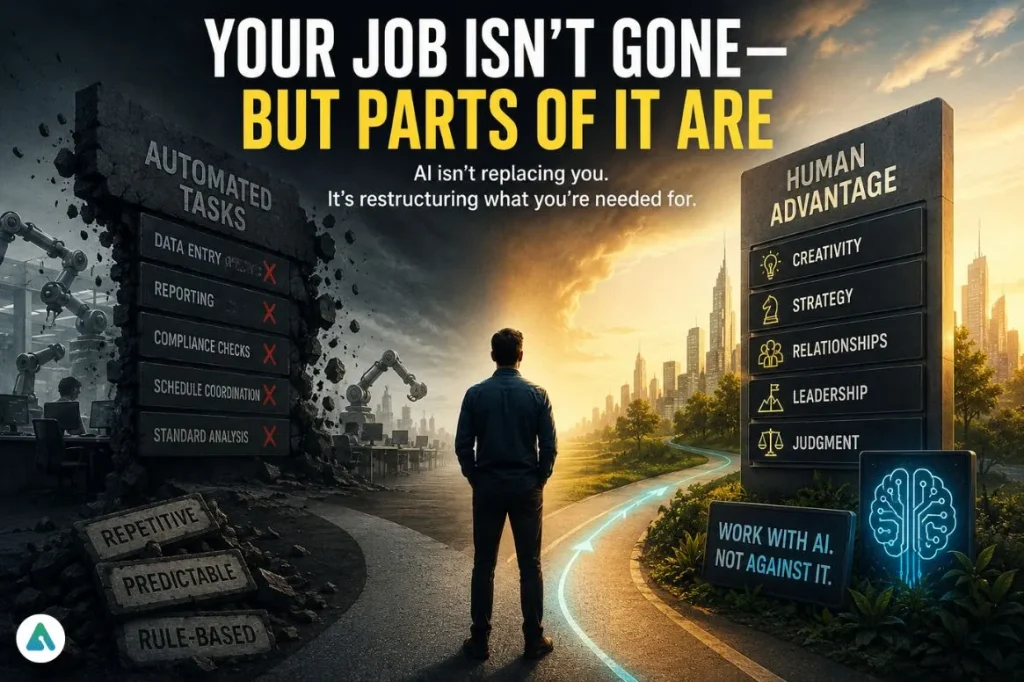
AI isn’t replacing you. It’s quietly restructuring what you’re needed for.
Let’s skip the suspense.
Meta. Nike. Intuit. UPS.
Layoffs keep coming. And AI keeps appearing in the explanation—sometimes directly, sometimes buried in corporate language like “efficiency” or “realignment.”
But the real shift is deeper than job cuts.
AI isn’t just reducing headcount. It’s restructuring how companies are built.
Recent 2026 data from Goldman Sachs shows AI has already reduced monthly U.S. payroll growth by roughly 16,000 jobs—even as it creates new ones through augmentation.
At the same time, companies like Cloudflare are cutting large portions of their workforce despite strong revenue growth.
That combination tells you everything:
This isn’t cost-cutting. It’s architectural change.
AI Isn’t Eating Jobs. It’s Reorganizing Them
The popular line is that AI eats tasks, not jobs.
That’s true—but incomplete.
What’s actually happening is this:
AI is reorganizing which humans are needed around those tasks.
Companies are no longer asking:
“How do we make employees more efficient?”
They’re asking:
“If this task is automated, do we still need this role to exist at all?”
That’s a fundamentally different question.
The Uncomfortable Truth About “Safe” Careers
For years, the assumption was simple:
High-skill, white-collar jobs were protected.
That assumption is now under pressure.
Research from Imperial College London highlights that many high-income professions—law, finance, software—are highly exposed.
Not because they lack skill.
But because they contain repeatable cognitive patterns:
- Contract review
- Financial modeling
- Standardized coding
- Reporting and analysis
These tasks run on structured logic.
And structured logic is exactly what modern AI excels at.
But here’s the critical nuance:
AI targets the middle layer first.
Entry-level execution gets automated.
Senior-level judgment remains.
Everything in between gets compressed.
The Rise of the “Measurer” Problem
After its 2026 restructuring, leadership at Cloudflare framed the shift using a classic idea:
Builders and sellers stay. Measurers shrink.
Translated into modern terms:
Roles focused on tracking, validating, and reporting are under the most pressure.
That includes large parts of:
- Middle management
- Compliance
- Audit
- Operations
But there’s a missing piece most analyses ignore:
If humans are removed, what replaces them?
You can’t just eliminate oversight in regulated environments.
The answer is emerging fast:
Automated institutional backstops.
Platforms like Workiva and AuditBoard are stepping in to replace human verification layers with:
- Continuous monitoring systems
- AI-driven compliance checks
- Real-time reporting pipelines
So the role doesn’t disappear.
It gets absorbed into infrastructure.
From SaaS to Agents: The Real Technology Shift
Most people still think in terms of software tools.
That model is already outdated.
We’re moving from deterministic SaaS workflows to probabilistic agentic systems.
Old model:
- You click
- You input
- Software responds
New model:
- Systems observe
- Agents decide
- Actions happen automatically
These AI agents can:
- Pull data from multiple systems
- Generate insights
- Trigger workflows
- Communicate outcomes
All without step-by-step human input.
This is why entire task clusters—not just tasks—are starting to disappear.
Step One: Audit Your Job Like It’s a System
Forget your title.
Break your job into tasks.
Then ask:
Is this predictable?
If it is, it’s automatable.
Most people won’t be replaced entirely.
But they will experience something more subtle:
Their job will shrink before it disappears.
That’s where most careers are now—inside partial automation.
Step Two: Double Down on Human Leverage
AI has clear limits.
It struggles with:
- Trust
- Persuasion
- Social dynamics
- Ambiguity
In practical terms:
- Closing deals
- Leading teams
- Navigating politics
- Building relationships
Still belong to humans.
For now.
The person who can influence outcomes still outranks the system that generates options.
Step Three: Learn to Direct, Not Compete
Avoiding AI is no longer viable.
But simply “using AI tools” isn’t enough either.
The real advantage comes from:
This is the emerging middle ground:
Not coding from scratch.
Not just prompting.
But connecting systems:
- APIs
- Data pipelines
- AI models
- Agent workflows
The winners aren’t just technical.
They understand how to make systems work together.
Step Four: Reposition Your Output
Most people try to protect their role.
That’s the wrong move.
Expand what you deliver instead.
With AI:
- Analysts become decision-support systems
- Marketers become growth operators
- Developers become architects
Value shifts from execution → definition.
Winners vs. Losers in the AI Restructuring
| Role Type | Core Function | AI Risk | Future Position |
|---|---|---|---|
| Builders | Create products, systems, and code | Low (augmented) | Move toward architecture & system design |
| Sellers | Relationships, trust, negotiation | Very Low | Use AI to enhance insight & personalization |
| Measurers | Track, validate, report | High | Transition into system oversight & rule-setting |
The dividing line is simple:
Winners direct systems.
Losers feed them.
The Timeline Nobody Tells You
Now (0–2 years) — Contextual Augmentation
AI copilots increase individual output. Headcount stays stable, but expectations rise.
Next (2–5 years) — Agentic Consolidation
Multi-agent systems automate entire workflows. Middle layers compress.
Later (5–10 years) — Structural Redesign
Organizations operate with smaller human cores overseeing scalable AI systems.
The Long Game
Even at Anthropic, engineers don’t just write code anymore.
They review, refine, and guide AI-generated output.
The work didn’t vanish.
It changed.
That’s the pattern:
- Tasks disappear
- Roles shift
- New combinations emerge
But none of that happens automatically for individuals.
The Only Question That Matters
Are you safe?
The honest answer:
Your job title might survive.
Your task list won’t.
So the move isn’t panic.
It’s precision.
- Audit what you actually do
- Identify what can be automated
- Strengthen what cannot
- Learn to direct the systems, replacing your old workflow
Because this isn’t just a trend.
It’s a restructuring.
And it’s already underway.
Related: AI-Native Pods Explained: How 3-Person Teams Are Replacing Entire Departments
