
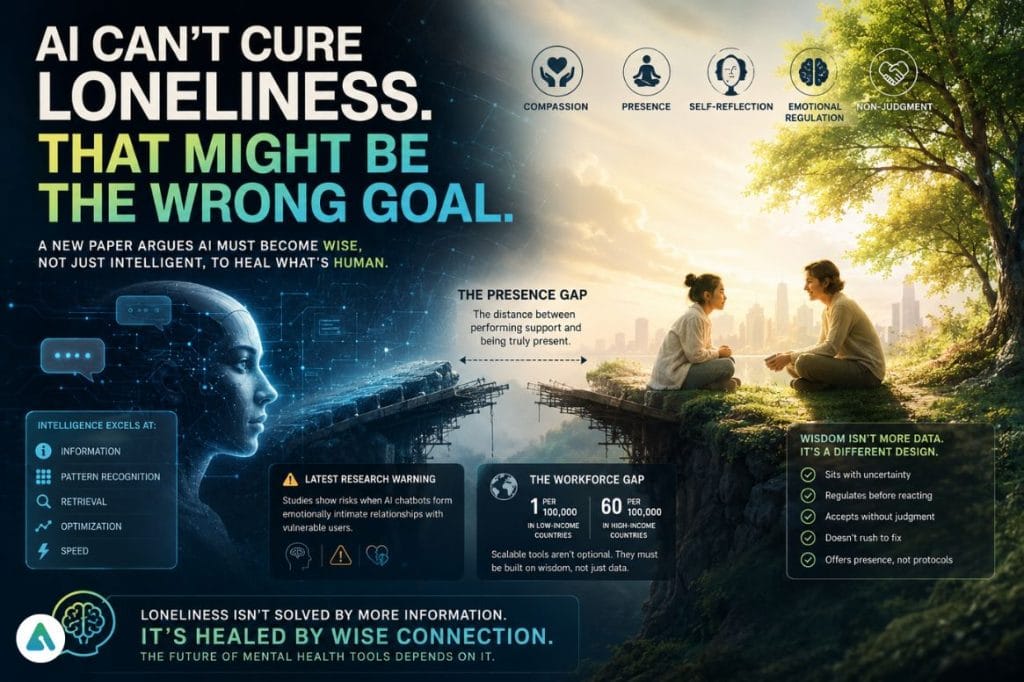
A new paper in Nature Mental Health doesn’t ask whether AI can treat depression. It asks whether AI can become wise. Those are very different questions — and the gap between them might explain why digital mental health tools keep disappointing the people who need them most.
The Perspective, published May 12 by researchers including J. David Creswell at Carnegie Mellon, argues that the global loneliness epidemic isn’t a problem that artificial intelligence can solve — but that artificial wisdom might be able to help. AI, as it stands, lacks the qualities that make human support transformative: compassion, self-reflection, emotional regulation, and the genuine acceptance of viewpoints that differ from your own.
The Distinction That Changes Everything
“Intelligence can pass a bar exam. Wisdom knows when not to go to trial.”
The researchers draw a sharp line between the two. Empirical studies show that wisdom — not raw cognitive ability — is what predicts reduced loneliness and stronger mental well-being. Wise people sit with ambiguity, accept others without judgment, and regulate their own emotional responses before deciding how to act. Large language models are very good at appearing to do all of these things without actually doing any of them.
That’s not a minor distinction. It’s the entire problem.
The Presence Gap
Ask anyone who has tried talking to a mental health chatbot during a crisis about what was missing. The answer, almost universally, isn’t information. The chatbot knew plenty. What it couldn’t do was simply be there — without rushing toward a solution, without optimizing for a response, without the subtle implication that your pain was a problem to be routed to the appropriate protocol.
Call this the Presence Gap: the distance between an AI system that performs supportive behavior and one that can sustain genuine, non-transactional attention. Right now, every digital mental health tool sits on the wrong side of it. The artificial wisdom framework is an attempt to close that distance by design rather than by accident.
One Counter-Argument Worth Taking Seriously
Not everyone buys the framing. Some researchers argue that wisdom isn’t a discrete set of trainable functions — it’s an emergent property of scale and context, and that sufficiently large models already exhibit something meaningfully close to compassionate reasoning when given the right prompts. On this view, the problem isn’t that AI lacks wisdom but that current deployment contexts strip away the conditions under which wisdom-adjacent behavior emerges.
That argument has merit. It doesn’t resolve the core issue, though. An AI system that behaves wisely when prompted correctly is still a system that requires the user to already know what good support looks like, which is precisely what struggling people often don’t know.
Where LLMs Show Cracks
The paper arrives at a tense moment for AI mental health tools. Just months ago, Nature Mental Health published a separate analysis on feedback loops between AI chatbots and users with existing mental health conditions — cataloguing edge cases involving delusional thinking, violence, and suicide linked to emotionally intimate chatbot relationships. The researchers weren’t anti-technology. They were concerned about the specific mismatch between what users needed and what the systems were designed to deliver.
The artificial wisdom paper takes a different angle. Rather than cataloguing harm, it’s interested in ceiling effects: the upper limit of what intelligence-based tools can provide. Current systems offer psychoeducation, symptom screening, and structured CBT exercises. What they can’t do is be present with suffering without immediately trying to fix it.
Building Wisdom Into Systems
The researchers argue that wisdom-related functions can actually be operationalized — compassion training, mindfulness-based protocols, and self-reflection frameworks are all things researchers have studied, measured, and systematically deployed. The claim isn’t that AI needs consciousness to implement them. It’s that the computational scaffolding for wisdom is buildable, if developers treat it as a target rather than an assumed byproduct of raw capability.
That’s a significant design argument. The dominant mental health AI paradigm is still essentially retrieval and generation: give the model good therapy transcripts, and it produces therapy-like outputs. The artificial wisdom framing says that’s insufficient. You’d need to deliberately engineer for qualities that make wisdom distinct from cleverness — slowing down, accepting uncertainty, not trying to fix what isn’t fixable.
The Workforce Math Makes This Urgent
The global shortage of mental health professionals isn’t a policy footnote. In low-income countries, there is typically one mental health professional per 100,000 people — compared to 60 per 100,000 in wealthier nations. That gap doesn’t close with training programs or better insurance coverage, not at any near-term timescale. Scalable tools aren’t optional. The question is whether those tools will be designed around what people actually need.
Wisdom, the paper suggests, is what’s needed. Not more accurate symptom checkers.
What a “Wise OS” Looks Like by 2030
If the artificial wisdom researchers get what they’re pushing for, the mental health tools of 2030 look less like symptom-routing chatbots and more like systems designed around not solving problems immediately. Interfaces that hold open-ended conversations without defaulting to a CBT framework after 90 seconds. Tools that detect when a user needs presence, not protocol, and can provide it without pretending to feel anything. The goal isn’t simulated emotion. It’s the functional architecture of wisdom: patience, receptivity, non-judgment, operating at a population scale.
Whether that’s achievable is genuinely uncertain. Whether it’s worth attempting is not.
What the field does with this argument will be worth watching. The easy path is to treat “artificial wisdom” as a rebranding exercise — add compassionate language to existing chatbot flows, call it done. The harder path is to actually redesign the objective function. Until that harder work happens, the most genuinely wise move for anyone navigating mental health challenges may still be the low-tech one: finding a human who knows how to stay in the room.
Related: Artificial Intimacy in AI: Why Chatbots Feel Like Friends — and Why That’s a Risk
