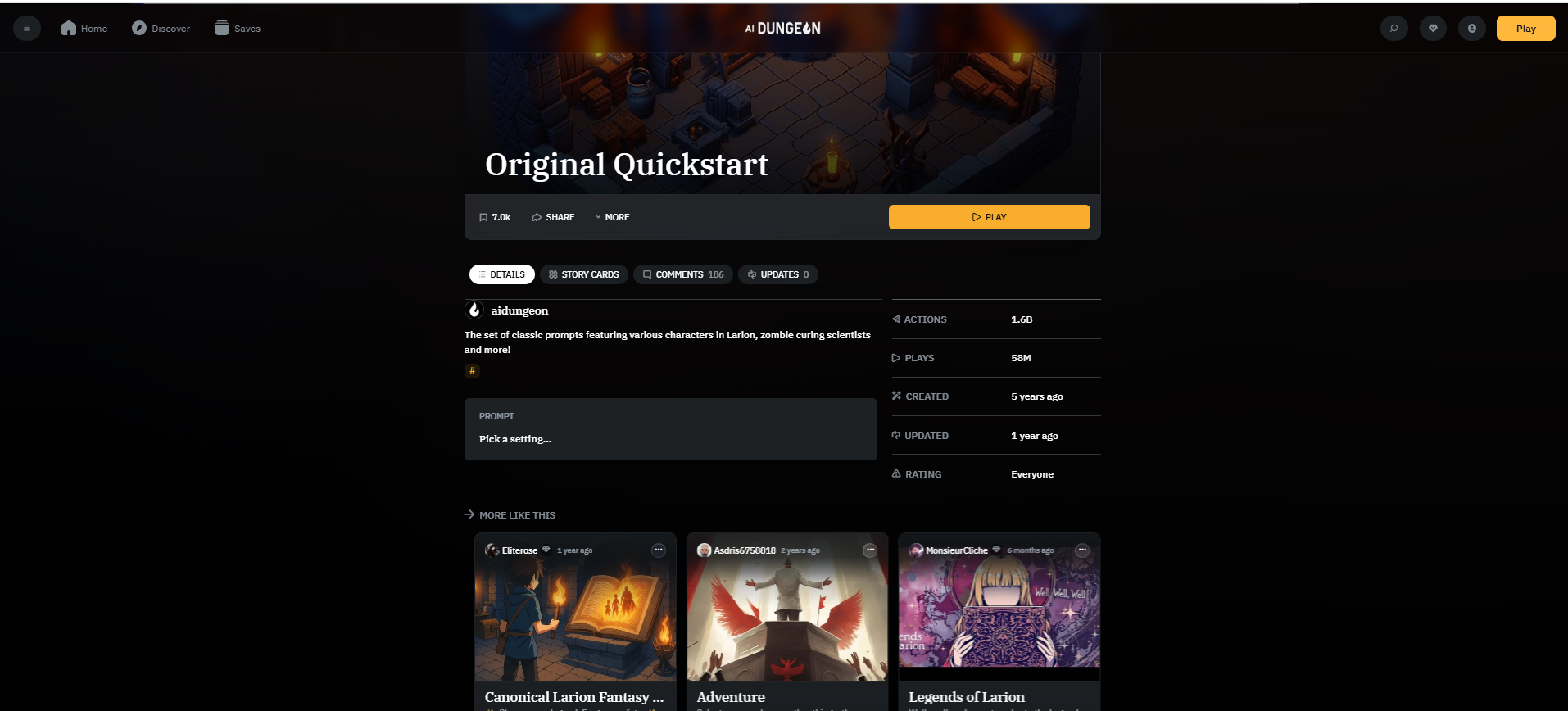
One AI Dungeon scenario, the Original Quickstart, shows 58 million plays and 1.6 billion actions on its page. That number tells you people still play. It doesn’t tell you if you should.
So I went back in. I played the free tier without an account, ran a custom story, poked at every button, compared all five plans, and read Latitude’s own privacy pages. This review shares what I found, where AI Dungeon shines, where it stumbles, and which alternative fits you better if it misses.
My short answer: AI Dungeon isn’t a novelist. It’s a fast co-writer that rewards you for editing.
Quick verdict
Best for
Open-ended AI storytelling in any genre
Free?
Yes, with unlimited actions on free models
Best free picks
Muse for characters, Wayfarer Small 2 for danger
Biggest strength
Total creative freedom
Biggest weakness
Continuity in long stories
Privacy
Not end-to-end private (details below)
Score
8/10
If you want D&D mechanics like dice, HP, and character sheets, this isn’t it. AI Dungeon is an open-ended storytelling engine.
What Is AI Dungeon?
AI Dungeon is a text adventure game where you type what your character does or says, and an AI language model writes what happens next. It has no fixed plot, no win condition, and no genre limit. Latitude, a US studio, builds and runs it.
The first version launched in May 2019. AI Dungeon 2 followed that December and went viral. Within six weeks, it passed 1 million players.
Think of it as a dungeon master who never sleeps. It will run a cyberpunk heist, a zombie outbreak or a quiet hospital drama with the same energy.
Where Can You Play AI Dungeon?
You can play AI Dungeon in a browser or download the official mobile app. No download is required for web play.
The official AI Dungeon help center also confirms that the game can be played through a mobile browser if you don’t want to install the app.
You can play as a guest. A sign-up lets you save stories and unlock daily premium actions.
I Tested AI Dungeon: Here’s What Happened
On the free tier, AI Dungeon wrote grounded, emotional prose, but it needed a light hand on the wheel.
The nurse scenario
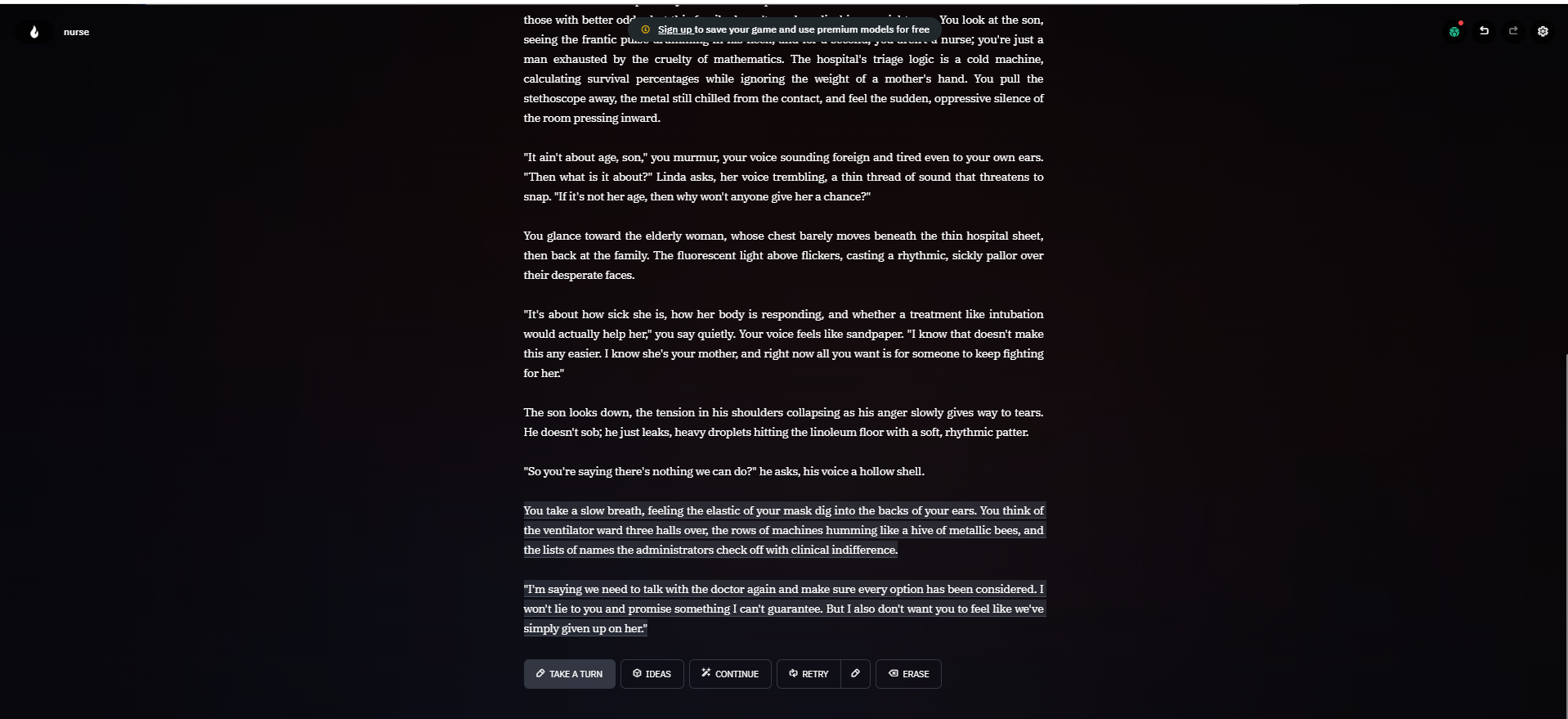
I skipped the dragons and played an exhausted hospital nurse. Within a few turns, the AI built a hard scene on its own. A frightened son demanded to know why his elderly mother wasn’t getting a ventilator.
The AI handled it with restraint. My character explained that the call rested on how sick she was, not her age. The son’s anger slowly turned to quiet tears. Small details sold the moment: a flickering light, a mask strap digging into the ears, a ventilator ward “three halls over.”
Then the AI pushed further. It described my character as “just a man exhausted by the cruelty of mathematics,” a line that hit harder than I expected. When the son asked, “So you’re saying there’s nothing we can do?” I wrote a careful reply. My nurse refused to promise a miracle but vowed to bring the doctor back and check every option. The AI matched that tone. No melodrama, no sudden cure. Just a quiet room and a family holding on.
The flaws showed up too:
It leaned on heavy metaphors, like “a hive of metallic bees.”
It repeated the “cold machine” idea twice in a short stretch.
A banner kept nudging me to sign up.
One Retry and one quick Edit fixed both writing issues in under a minute. The pattern held all session: I got the best scenes when I directed the AI instead of letting it run unattended.
How AI Dungeon Works
AI Dungeon runs a turn-based loop: you write an action, the AI writes the next passage, and the story grows from both. Before each reply, the game packs a bundle of text into the model’s context. That bundle holds your AI Instructions, Story Summary, Plot Essentials, Author’s Note, triggered Story Cards, retrieved memories, and recent story history.
So context isn’t just “recent story.” It’s everything that fits inside the model’s limit. Latitude’s memory system post explains how it handles overflow: the game trims older story text and can drop Story Cards to stay within the limit.
Do, Say, Story and See
Mode
What it does
Example
Do
Your character acts
Do: Pick the lock on the archive door
Say
Your character speaks
Say: "Who sent you?"
Story
You narrate like the author
Story: The storm knocks out every light.
See
Generates an image of the scene
See: the flooded throne room
Story mode is the secret weapon. When the AI drifts, don’t argue with it. Write what happens.
The controls under every turn
Take a Turn: write your next input
Ideas: get suggested actions
Continue: let the AI write more on its own
Retry: roll a fresh reply
Edit: rewrite any AI text by hand
Erase: remove the last turn
Story Cards vs Memory Bank
People mix these up, but they do different jobs.
Story Cards
Memory Bank
Who writes it
You
The AI
What it holds
Characters, places, rules
AI-written summaries of past events
When it loads
When a keyword appears
When it matches the current scene
Best for
Facts that must never change
Events you’d otherwise lose
Story Cards work much like lorebooks on AI companion apps. The Memory Bank stores AI-written memories, each built from six actions, and pulls back the most relevant ones. A separate Auto Summarization feature updates a running Story Summary every 15 actions to track the bigger plot. When the bank fills, the game drops the least-used memories. Free accounts hold 25 memories; Ultimate holds 800.
Scripting for power users
Scenario creators can attach JavaScript scripts to Simple Start and Character Creator scenarios. Community scripts add things like auto-generated Story Cards, stat tracking, and inventory logic. It’s the closest AI Dungeon gets to real game mechanics.
Multiplayer
AI Dungeon also supportsmultiplayer stories. Each player controls a character and takes turns in one shared adventure.
Which AI Dungeon Models Matter?
AI Dungeon offers a rotating menu of story models instead of one fixed narrator. Free players get a solid set, and paid tiers unlock bigger models and longer context. The roster changes often, so treat the in-game model picker as the final word. The table below shows the picks worth knowing as of October 2026.
Pick
Model
Built on
Why it stands out
Best free for characters
Muse
Mistral NeMo 12B
Emotional, relationship-driven scenes
Best free for danger
Wayfarer Small 2
Mistral NeMo 12B
Real stakes; your character can fail
Easiest free start
Dynamic Small
Rotates free models
Cuts repetition with zero setup
Best free cozy option
Hearthfire
Mistral Small 3.2
Slice-of-life scenes that take their time
Best paid prose
DeepSeek family
DeepSeek
Sharp dialogue and novel-like scenes
Best paid adventure
Wayfarer Large / Harbinger
Llama 3.3 70B / Mistral Small 3.1
Harsh consequences, tight combat
The early days ran on OpenAI’s GPT-2 and then GPT-3. Today the core lineup leans on Latitude’s own fine-tunes plus third-party models such as DeepSeek, GLM, and Google’s Gemma. Latitude also shares some of its model work publicly.
AI Dungeon Pricing: Free vs Paid
AI Dungeon is free to play with unlimited actions on free models. Paid plans run from $14.99 to $99.99 a month and mainly buy longer context, a bigger Memory Bank, and monthly credits.
Actual context varies by model. Muse gets 16K on Journey, while premium models like Wayfarer Large and DeepSeek start at 4K there. DeepSeek V4 Flash gives free players just 2K. Every plan, Free included, gets 10 image generators. Monthly credits pay for images and for temporary extra context on some models. They aren’t a turn allowance, so it’s hard to translate a plan into hours of play. Latitude also sells higher “Shadow Tiers” above Ultimate. Some newer models add an Optimized Context toggle that frees extra room but disables certain scripting features.
What You Get for Free
Guest play in the browser, no account needed
Custom stories plus the full community scenario library
Unlimited actions on free models such as Muse, Wayfarer Small 2, Hearthfire and Dynamic Small
Up to 4K context (some free models cap at 2K)
25 memories, Story Cards, Plot Essentials and Auto Summarization
10 image generators
A small daily batch of premium actions once you sign up
The paywall covers bigger models, longer context, a larger Memory Bank and monthly credits.
Which plan fits you?
Free: short stories, first-timers, casual play
Journey: regular players who want DeepSeek and more context
Legend: long campaigns where continuity matters
Mythic: heavy players who burn through premium credits
Ultimate: creators running huge worlds
Play free for a week first. If memory problems keep biting, Journey is the sensible next step. It doubles the free context ceiling and quadruples your Memory Bank for $14.99, and it comes with a one-week trial. Legend only makes sense when long-campaign continuity is your main problem.
Is AI Dungeon Private and Safe?
Private? Mostly. End-to-end private? No. Latitude doesn’t routinely moderate private single-player stories, but your text still passes through its servers and AI providers.
Latitude encrypts stories, but it keeps the keys on its servers. The AI can’t read encrypted text, so the game decrypts your story before sending it to the model. That design lets you recover stories on a new device. Latitude says its team doesn’t read unpublished content. Staff only see your inputs when you give permission for support or submit feedback through Improve the AI.
The one filter that still runs
One narrow, AI-run filter still applies to private play. It blocks sexual content involving minors, known as SCIM. Latitude says humans never review cases where the AI hits this boundary. If the pop-up appears by mistake, you can choose to continue, and Latitude’s safety page says that choice sends the story anonymously for review to improve the filter.
Cloud AI tools differ widely in who can read your prompts. For AI Dungeon, the safe habit is simple: write fiction, and keep real names, addresses, and passwords out.
Is AI Dungeon safe for kids?
I wouldn’t treat it as a children’s game. The library mixes Everyone, Teen, Mature, and Unrated content. As of October 2026, players pick from three AI Safety Settings: Safe, Moderate, and Mature. Mature requires confirming you’re 18 or older. The same rules that protect teens from AI chatbots apply here, so parents should lock the setting to Safe and stay involved.
What happened in 2021?
AI Dungeon didn’t fail, but 2021 badly hurt player trust. Three problems stacked up:
A clumsy filter: under pressure from OpenAI, its model provider then, Latitude rolled out a filter that flagged harmless stories and triggered unfair bans.
Human review: players learned that moderators could read flagged private stories.
The Taskup leak: in May 2021, around 100 story clippings appeared on 4chan. Latitude’s own incident report says a contractor at an OpenAI data-labeling vendor posted them. Latitude later admitted it waited too long to tell players.
Latitude has since owned its mistakes, moved away from OpenAI as its main provider and dropped routine moderation of private play.
AI Dungeon Alternatives: NovelAI, DreamGen, KoboldCpp, Friends & Fables, Character.AI and SillyTavern
The right AI Dungeon alternative depends on what you miss: writing tools, privacy, real RPG rules, or character chat.
Tool
Why switch from AI Dungeon
Free option
Main trade-off
NovelAI
A writing-first workflow for long fiction
Trial only
Paid for long-term use
DreamGen
More steering control in long roleplay
Yes, limited
Long context needs a paid plan
KoboldCpp
Fully local, no cloud, no filter
Yes, open source
Needs a decent GPU and setup
Friends & Fables
Real dice, stats, and rules
Limited
Less freeform
Character.AI
Conversation is the whole point
Yes
Chat-first, not story-first
SillyTavern
Bring your own models and settings
Yes, open source
Steep learning curve
Pick NovelAI if you want writing-first tools for long fiction. DreamGen suits multi-chapter roleplay, with steering controls built for long stories. KoboldCpp keeps every story on your own PC, so it fits writers who want no cloud and no filter. Friends & Fables adds dice, stats, and a rules-driven AI game master. Character.AI suits people who’d rather chat than build a plot, while SillyTavern gives tinkerers full control through AI character cards and almost any model. Stay with AI Dungeon if you want the easiest free story sandbox.
Bonus: How to Fix AI Dungeon When It Breaks
My nurse story only worked because I kept steering it. These are the fixes I leaned on during testing, plus a few from Latitude’s own tips. I call it the “Director’s Chair” approach: treat the AI like an actor you direct, not a vending machine.
Problem
Fix
The AI misreads the scene
Name your character, setting, tone, and goal in the first prompt
Characters vanish or change
Build 3–5 Story Cards before turn ten
The AI plays your character
Use Story mode or edit the reply
Prose turns repetitive
Hit Retry or switch models
The plot loses its thread
Update Plot Essentials and keep the Memory System on
One-word inputs fall flat
Write a full action: “Do: I swing the lantern and run for the stairs”
You want to upgrade on day one
Test the free tier for a week first
Every reply you keep becomes part of the story context for the next turn. So clean up weak text early, before the AI copies it.
Final Verdict: Should You Play AI Dungeon in 2026?
AI Dungeon remains the easiest door into AI storytelling. My test showed a free tier that writes real scenes, not filler. It also showed a tool that needs your editing hand.
It costs nothing to start, in a browser or on mobile.
Paid plans mostly buy context and memory, so upgrade only when continuity bugs you.
Story Cards, Retry, and Edit matter more than your plan.
It’s an interactive novel, not a rules-based RPG.
Writers who want zero filtering will do better with a local setup.
Open the Original Quickstart, pick a free model, add three Story Cards, and play for twenty minutes. You’ll know fast if AI Dungeon fits you.
FAQs
Q. Is AI Dungeon free?
Yes. Free-model play has no action limit; paid plans add context and memory.
Q. Is AI Dungeon safe?
For adults, yes. Teens should play with the Safe setting locked on.
Q. Is AI Dungeon private?
Mostly. Latitude doesn’t routinely moderate private stories, but it doesn’t use end-to-end encryption.
Q. Does AI Dungeon use ChatGPT?
No. Early versions used OpenAI’s GPT-2 and GPT-3, but today’s lineup doesn’t rely on ChatGPT.
Q. Why did AI Dungeon get criticized in 2021?
A buggy filter, human review of flagged stories, and a data leak cost it player trust. The game is still active.
Q. Is AI Dungeon better than NovelAI?
For free, game-like play, yes. For long-form writing, NovelAI has the edge.
Q. Can you play AI Dungeon without downloading it?
Yes. It runs in any modern browser at aidungeon.com.
Q. What was AI Dungeon 2?
The December 2019 version, built on GPT-2, that made the game go viral.
Disclaimer: This is an independent AI Dungeon review based on hands-on testing and public information. We are not affiliated with or sponsored by AI Dungeon or Latitude. Pricing, features, and policies may change.
Tags:
Zyra Lane
Zyra Lane is a technology analyst and AI storyteller exploring the forces shaping the future of business and innovation. She turns complex trends into clear, actionable insights, helping readers see what’s next in a rapidly evolving digital world.