

Cal AI is free to download and free to use as a manual food logger. The camera feature that every ad shows off sits behind a paid subscription. No subscription, no photo scanning.
This guide covers the real pricing, the 3-day trial’s fine print, and two 2026 events most pricing roundups skip entirely: an April App Store removal and a March data breach. Both matter if you’re about to hand this app your card.
Cal AI at a Glance
| Detail | Info |
|---|---|
| Developer | Viral Development LLC |
| Launched | May 2024 |
| Platforms | iOS (4.8★, 362,000+ ratings) and Android (4.6★, 272,000+ reviews) |
| Owned by | MyFitnessPal, since March 2026 |
| Free | Manual logging, barcode scanning, your account |
| Paid | AI photo scanning, after a 3-day trial |
A few other apps borrow the “Cal” name Cal Fit Pro, Cal Pal, Calite AI, Cal GPT. Make sure you’re comparing prices for App ID 6480417616, not one of the lookalikes.
What Can You Use Without Paying?
Manual food search costs nothing. Type in what you ate, pick a serving size, save it. Barcode scanning works the same way — no charge, no clock running.

Cal AI doesn’t publish a cap on either one. Cook the same handful of meals most weeks, and you can track for months without paying a cent.
What you can’t do for free is point your camera at a plate and get an instant answer. Cal AI says it outright in its own app description: “Food scanning analysis results require a subscription.” That one line explains the whole business model — nearly every app in this category gates the camera feature the same way.
One caveat: feature limits shift between app updates. Free today doesn’t guarantee free next year.
How Much Does Cal AI Cost?
Cal AI won’t tell you the price until you’re deep into the app. Download it, finish the onboarding quiz, and only then does the paywall show you a number — and it might not be the same number your friend sees.
Here’s what the App Store actually lists right now: $2.99, $5.99, $9.99, $19.99, and $29.99, plus a $0.99 “streak restore” purchase. Every single one is labeled just “Unlimited.” No billing period. No explanation. You’re left to guess.
Other guides have sorted these into rough periods:
| Billing period | Price you’ll likely see |
|---|---|
| Weekly | $2.99 |
| Monthly | $5.99–$19.99 (most often $9.99) |
| Yearly | $19.99–$29.99 |
Treat that table as a best guess, not a receipt. Cal AI runs constant A/B and regional price tests. A second regional App Store listing checked for this guide turned up $4.99, $14.99, and $49.99 too — none of which show up on the U.S. listing.
On the “Family Plan”: you’ll see a $59.99/year Family Plan quoted around the web. Neither the U.S. listing nor a second regional listing checked here shows one. What does exist is standard Apple and Google Family Sharing one subscription, shared with your household. If you spot a real Family Plan somewhere, it’s probably a regional test this check didn’t catch.
On Android: Google Play hides the price just as well as Apple does. One Play Store reviewer put it plainly: pricing only showed up “after I’ve entered all my info and created an account.” Expect a similar range to the table above, adjusted for your local currency.
How Does the 3-Day Free Trial Work?
Cal AI gives you 3 days to try the photo scanner free. You still need to hand over a payment method first there’s no trial without one.
Miss the cancellation window, and your card gets charged automatically for whatever plan you picked.
Canceling on iPhone:
- Open Settings → your name → Subscriptions.
- Tap Cal AI, then Cancel Subscription (or Cancel Free Trial).
- You keep access until the trial’s listed end date.
Canceling on Android:
- Open Google Play Store → your profile icon → Payments & subscriptions → Subscriptions.
- Tap Cal AI, then Cancel subscription.
Deleting the app skips both of these steps. It does not cancel your subscription. That single mix-up causes more billing complaints than the price itself.
Quick tip: canceling through your phone’s official subscription settings also sidesteps something a lot of apps do a last-second “wait, are you sure?” screen designed to talk you out of leaving. Apple and Google’s cancellation flow doesn’t have that step built in.
Why Was Cal AI Removed From the App Store?
Apple pulled Cal AI in April 2026. Briefly, but for real reasons, not a vague policy note. MacRumors laid out exactly what Apple flagged:
- Cal AI sent some payments through Stripe, skipping Apple’s required purchase system entirely.
- It showed the weekly-equivalent price in big text while billing a bigger lump sum.
- Its free-trial toggle didn’t make automatic renewal clear.
- It re-asked users who’d already said no, using a different pitch the second time.
Cal AI fixed the issues. Apple put it back. It’s live on both stores today.
Keep that four-point list in your back pocket for any app’s paywall, not just this one. Is the price you see the price you’ll pay? Does “no” actually mean no?
What Happened in the 2026 Cal AI Data Breach?
Someone posted a 14.59 GB data dump on Breach Forums on March 9, 2026. Cybernews pulled the data and checked it themselves their word was that it “appears legitimate.” Roughly 3 million records: emails, names, birth dates, gender, height and weight, meal logs, subscription details, linked social accounts.
Kiteworks put the number a little higher, at 3.2 million, and added a detail nobody else caught: exposed 4-digit account PINs, plus at least one record belonging to a child born in 2014. Worth knowing since Cal AI’s own Google Play listing rates the app for ages 3 and up.
Here’s the part that matters for how you read this: the cause — an unsecured Firebase database, no rate limit on login attempts — comes from the attacker’s own claims. Two outlets reported it. Neither independently proved it. And Cal AI hasn’t confirmed the breach happened at all.
Health and wellness apps are turning into the same kind of target that hospitals and clinics have dealt with for years check how ransomware has been hitting AI-driven healthcare systems in 2026 for the wider pattern. A calorie-tracking app holding weight, meal, and PIN data is a smaller target, but the same weak points apply.
If you used Cal AI before March 2026, do this now:
- Change your Cal AI PIN. Change it anywhere else you reused those same 4 digits.
- Run your email through a breach-checking tool.
- Unlink any social account you connected and no longer use.
- Be suspicious of any message that name-drops your real weight goal or meal history. Breached data makes phishing look convincing.
Getting bought by MyFitnessPal afterward doesn’t erase what leaked. It also doesn’t tell you anything about how secure the app is today — that’s a separate question entirely.
How Accurate Is Cal AI?


Cal AI’s own website says the app runs “about 80% accurate.” That’s the company’s number, not an independent one, so treat it as a claim, not a verdict.
Outside testing tells a more split story. Simple, separated foods — an apple, a plain chicken breast — tend to come back close. Mixed dishes, hidden oils, restaurant plates? That’s where the estimate drifts.
You’ll see a 2024 University of Sydney study cited everywhere in Cal AI reviews, usually with numbers like a 49% overestimate on beef pho and a 76% underestimate on a bubble-tea drink. Real numbers. Sydney’s own release confirms them. But the study tested 18 apps in general. It never names Cal AI. People just keep attaching it to this app anyway.
It’s not just cameras estimating calories that struggle with real-world accuracy — the same gap shows up in consumer hardware, like cuffless blood pressure monitors that promise clinical-grade readings from a wrist strap. Convenient, but worth the same skepticism.
Bottom line on accuracy: treat every estimate as a starting point, not a verdict. If you’re tracking for a medical reason, run it past a dietitian instead of outsourcing the health decision to an app.
Who Owns Cal AI Now?
Four people built Cal AI in May 2024, not the “two teenagers” you’ll read everywhere. TechCrunch’s original profile names all four: Zach Yadegari and Henry Langmack, both 18 at launch, plus Blake Anderson (24) and Jake Castillo (28), who ran things as COO.
MyFitnessPal bought the company in March 2026. TechCrunch’s acquisition report put Cal AI at over 15 million downloads and tens of millions in yearly revenue by then. Cal AI kept its own app, its own pricing, its own name. MyFitnessPal bought the company in March 2026. TechCrunch’s acquisition report put Cal AI at over 15 million downloads and tens of millions in yearly revenue by then — the kind of numbers that keep fueling the broader business case for AI in healthcare and wellness. Cal AI kept its own app, its own pricing, its own name. MyFitnessPal folded its huge food database in behind the scenes, which should help food matching over time. It hasn’t touched what’s free and what’s paid.
Is Cal AI Worth Paying For?
Good fit: you eat mostly simple, repeatable meals. Typing a food search kills your tracking habit. You’ll actually cancel a trial you don’t want.
Not a good fit: you eat out a lot, or cook mixed dishes that need fixing by hand anyway. You’re watching your budget. Trial deadlines slip your mind easily.
Check two or more boxes in the first group, and the $9.99/month or $29.99/year price is fair for what you get. Check more boxes in the second group, and a free manual tracker will probably get you just as far.
Cal AI Alternatives
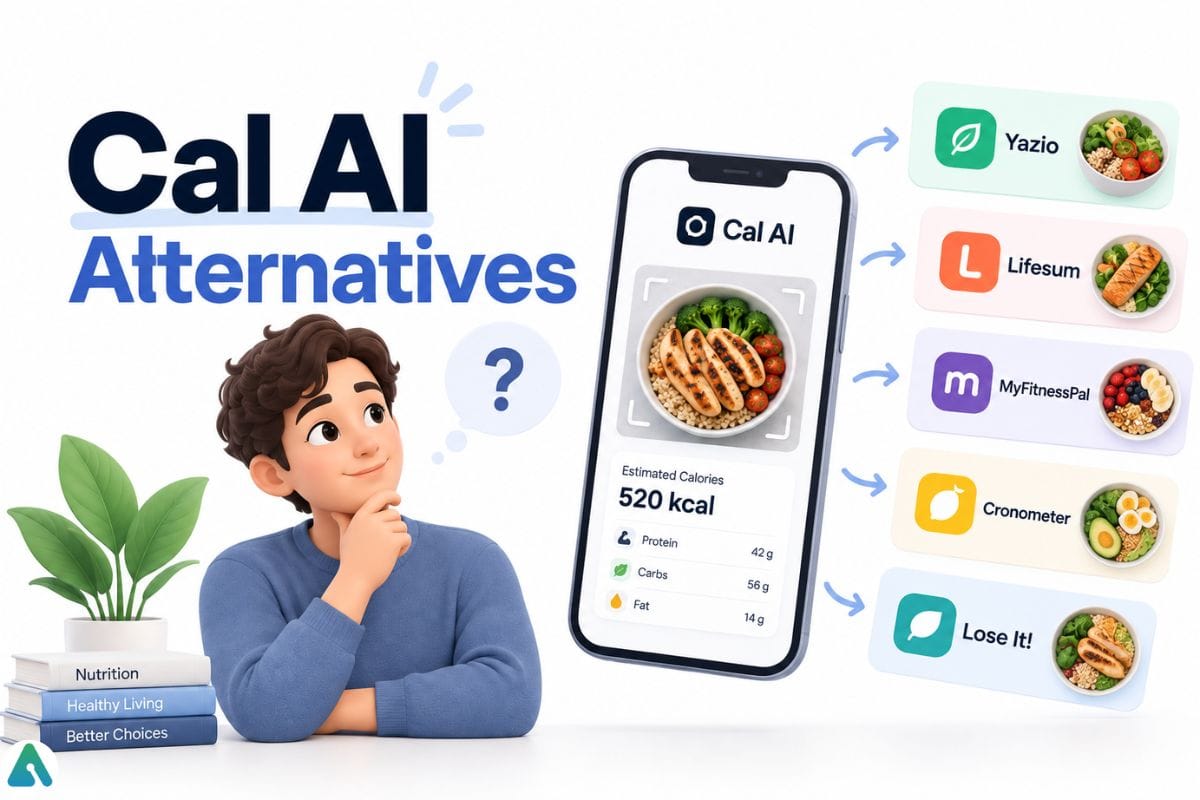

Don’t want to subscribe at all? MyFitnessPal and Cronometer both run free tiers with big food databases and unlimited manual logging. Their own camera features cost money too, so don’t expect a free photo scanner there either.
Eat mostly packaged food? Barcode scanning alone covers most of your day, and it never asks for a card.
New apps promising free AI photo scans pop up constantly in this space. Most add limits within months. Check whatever “free alternative” list you’re reading against the app’s current listing — not a review from six months ago — before you switch.
Frequently Asked Questions
Q. Is Cal AI free?
Yes, for the app itself, manual logging, and barcode scanning. The photo scanner needs a paid plan after a 3-day trial. Stick to manual and barcode logging, and you’ll never pay a dollar.
Q. How much does Cal AI cost?
Between $2.99 and $29.99 depending on billing period, per the current App Store listing. $9.99/month gets reported most often. Your price may land somewhere else entirely.
Q. Is there a free alternative to Cal AI?
Not one that matches free, unlimited AI photo scanning long term. For unlimited free tracking overall, MyFitnessPal and Cronometer both work well.
Q. Was Cal AI removed from the App Store?
Yes, briefly, in April 2026 — over a payment-flow bypass and a misleading price display, among other issues. Apple reinstated it once Cal AI fixed them.
Q. What did the 2026 breach expose?
Two outlets independently confirmed roughly 3 million exposed records: emails, names, physical stats, meal logs, subscription info. Change any PIN you’ve reused elsewhere if you used the app before March 2026.
Q. Is Cal AI or MyFitnessPal better?
They’re sibling apps now. MyFitnessPal wins on manual tracking depth and a longer free-tier history. Cal AI wins on speed — that’s also the part you pay for.
Q. Is Cal AI accurate?
The company claims about 80% accuracy. Independent testing backs that up for simple foods and pokes holes in it for mixed or restaurant meals.
Q. Is Cal AI worth it?
For simple, repeatable meals, most people find the price fair. For frequent restaurant meals or mixed dishes, a free tracker gets you nearly the same result for
Related: CES 2026 Health Tech: Practical Gadgets That Improve Everyday Life
| Disclaimer: Pricing, features, and availability can change by region or app update. This guide reflects information available in 2026 and is not affiliated with Cal AI or MyFitnessPal. Always check the official app listing before subscribing. |
