

The conversation around artificial intelligence has shifted—from models and benchmarks to power, distribution, and control.
What once looked like a technology cycle now resembles the early stages of an economic rewrite.
At the center of that shift is Sam Altman and a policy framework from OpenAI titled Industrial Policy for the Intelligence Age.
This is no longer a thought experiment.
It’s a structured attempt to answer a destabilizing question:
What happens when intelligence becomes the primary economic resource?
The Core Thesis: AI Breaks the Link Between Work and Wealth
Modern economies rely on a simple exchange:
Labor → Production → Wages
AI disrupts that chain.
When machines perform cognitive work at scale, productivity detaches from human effort. And once that happens, wages stop being the primary way value is distributed.
The OpenAI blueprint acknowledges the consequence:
Without intervention, AI could concentrate wealth more aggressively than any previous technological shift.
The “AI New Deal”: Five Pillars Reshaping the System
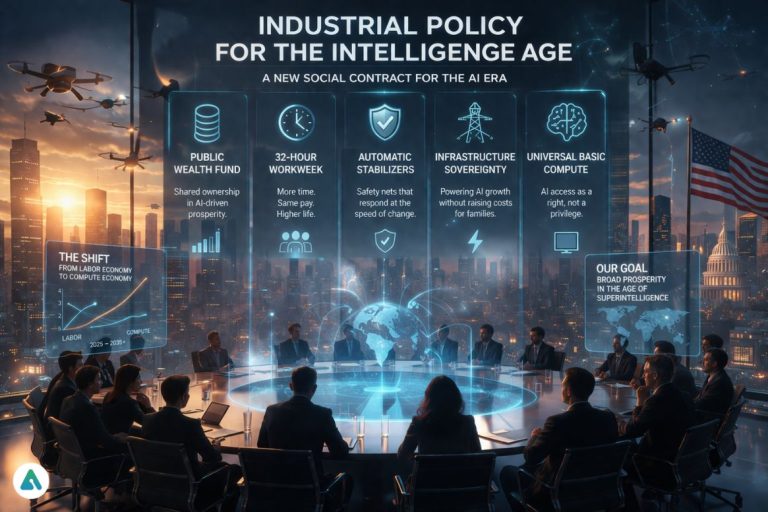
Echoing the scale of the New Deal, the framework outlines five structural mechanisms:
1. Public Wealth Fund
A national fund seeded by AI company equity and taxes on automated labor—redistributing dividends directly to citizens.
2. The 32-Hour Workweek
Reducing standard work hours while maintaining pay, based on AI-driven productivity gains.
3. Automatic Stabilizers
Economic safety nets that activate instantly when AI displacement crosses predefined thresholds.
4. Infrastructure Sovereignty
Large-scale energy investment and computing systems to ensure AI growth doesn’t raise public costs.
5. Universal Basic Compute
Treating access to AI as a fundamental utility—on par with electricity or literacy.
The Structural Shift: From Labor Economy to Compute Economy
| Policy Pillar | Current System (2026) | Intelligence Age (Proposed) |
|---|---|---|
| Core Input | Human labor | Machine intelligence (compute) |
| Tax Base | Wages/payroll | AI output/capital |
| Wealth Distribution | Private shareholders | Public + shared mechanisms |
| Work Model | 40 hours / 5 days | 32 hours / flexible |
| Access | Uneven | Universal AI access |
This is not policy evolution.
It’s a redefinition of what the economy is built on.
The Unique Fault Line: Compute vs. Cash
This is where the blueprint becomes genuinely radical—and where most coverage falls short.
The real question isn’t just how much value is redistributed.
It’s what form that value takes.
Two Competing Models
1. Cash-Based Redistribution
- Direct payments (dividends, UBI-style transfers)
- High flexibility and personal autonomy
- Works within existing economic systems
2. Compute-Based Redistribution
- Access to AI systems is the primary benefit
- Increases productivity and opportunity
- Turns intelligence into a shared resource
Why This Debate Matters More Than Any Tax Policy
At first glance, Compute looks superior. It doesn’t just give people money—it gives them capability.
But that advantage comes with a structural risk:
Cash is neutral. Compute is governed.
Access to AI depends on:
- Platform infrastructure
- Usage limits
- Policy controls
- Provider incentives
This creates a new kind of dependency.
If your ability to earn, learn, or compete depends on access to AI systems controlled by a handful of entities, the system shifts:
From capitalism → compute-mediated participation
Or more bluntly:
From financial inequality → access inequality
The Real Risk: From Redistribution to Dependency
A compute-first system could unintentionally create:
- Soft centralization: Power concentrated in AI providers
- Programmable economics: Access can be throttled, priced, or restricted
- Platform lock-in: Switching costs become systemic, not optional
This is the paradox at the heart of the proposal:
The same mechanism designed to democratize intelligence could also gatekeep it.
And that’s why the “compute vs. cash” debate is likely to define the next decade of policy—not just AI regulation.
The Skeptic’s View: Safety Framework or Strategic Moat?
The blueprint emphasizes openness and broad access.
But it also requires:
- Massive infrastructure investment
- Complex compliance systems
- Deep integration with governments
These conditions favor organizations already operating at scale—like OpenAI.
This raises a legitimate concern:
Are these policies designed to protect society—or to make competition nearly impossible?
This is the regulatory capture dilemma, reframed for the AI era.
What This Looks Like in Reality
Uneven Workforce Impact
A knowledge worker becomes more productive with AI.
A routine task worker may be replaced entirely.
Same system. Different outcomes.
Global Inequality
Countries with computing infrastructure accelerate.
Others become dependent consumers of AI.
The divide shifts from industrial capacity → intelligence capacity.
Energy and Infrastructure Pressure
AI systems require enormous energy.
Without expansion, the cost of intelligence could spill into everyday life—raising electricity prices and infrastructure strain.
Historical Context—With One Key Difference
The comparison to the New Deal is directionally correct.
But there’s a critical distinction:
The New Deal responded to the collapse.
This framework anticipates disruption before it fully materializes.
That signals something deeper:
The builders of AI believe the current system won’t hold up to what’s coming.
The Second-Order Effects No One Is Pricing In
If this framework takes hold, expect:
- AI Tax Havens: Nations competing for compute capital
- Platform States: AI providers acting as economic infrastructure
- Redefined Work: Value shifting to creativity, oversight, and coordination
- Policy Lag: Governments struggling to match AI’s pace
These are not edge cases.
They are the next phase of the transformation.
The Bottom Line
Industrial Policy for the Intelligence Age is not just a policy document.
It’s an early draft of a new social contract—written by the same actors building the systems that may force it into existence.
But the defining question isn’t whether the system needs to change.
It’s who controls the redesign.
Because when intelligence becomes infrastructure, and access becomes power—
The future of the economy won’t just be shaped by innovation.
It will be shaped by control over who gets to use it.
