
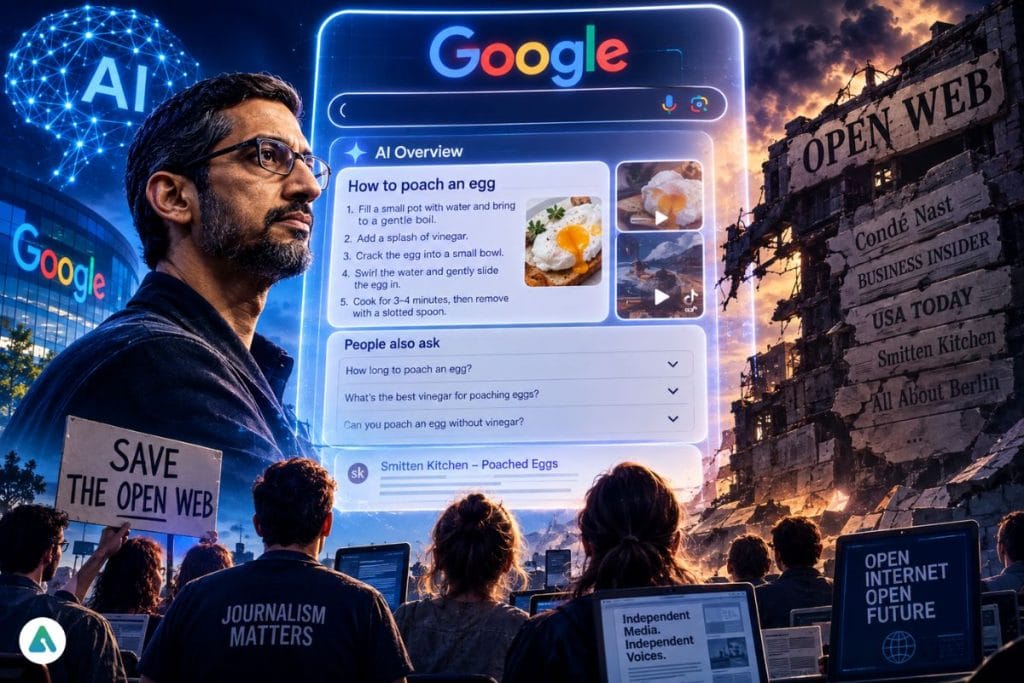
The “open web” wasn’t a feature. It was a bug fix. And Google just shipped the patch.
System Update: Search 3.0
Open Google right now. Search for “how to poach an egg.”
What you get isn’t a list of links. It’s a Gemini-generated summary, a carousel of TikTok-style video shorts, three “People also ask” dropdowns, and—if you’re patient enough to scroll—maybe a single blue link to the recipe blog that actually wrote the thing. The GOAT, Smitten Kitchen, is now buried under an AI layer cake of Google’s own making.
This isn’t a glitch. This is the product.
In May 2025, Sundar Pichai called it “the biggest upgrade to our Search box in over 25 years—now completely reimagined with AI.” What he didn’t say: that reimagining requires demolishing the architecture that built the modern internet.
For two decades, Google operated as a traffic router—a neutral-ish directory that indexed the web and sent users to publishers, who monetized that attention with ads. It was a symbiotic, if occasionally parasitic, relationship. Publishers produced content. Google organized it. Users found it. Everyone ate.
That model is now dead. And the autopsy reports are piling up.
The Metrics of Extinction
Let’s look at the numbers, because in tech journalism we worship at the altar of data—and these numbers are brutal.
68% of all U.S. Google searches now end without a single click. That’s up from 45% a decade ago.
If you used to rank #1 in Google search results, you could expect a 27% click-through rate. Drop an AI Overview at the top? That collapses to 11%.
Nicolas Bouliane, who runs the independent site All About Berlin, has seen his Google traffic crater 75% since AI Overviews launched. His assessment? “AI Is Killing All About Berlin.” At this pace, his site doesn’t survive into 2027.
The publishing industry has responded with the kind of strategic pessimism that only comes from watching your business model get vaporized in real time. But this isn’t just a U.S. problem. In December 2025, the European Commission officially opened an antitrust investigation into Google, targeting how the tech giant uses online content to train its AI systems — focusing on AI Overviews and YouTube content integration. Regulators are asking whether Google is taking creators’ work without proper compensation and, in doing so, stifling competition. The stakes go beyond fines; the EC could require Google to pay creators, allow opt-outs from AI scraping, or force clearer source attribution in AI-generated summaries.
The publishing industry’s strategic retreat is equally stark:
- Condé Nast CEO Roger Lynch: “Assume there’s no search.”
- USA Today CEO Mike Reed: “Our plan is to assume search is gone and build our business in other ways… The traditional Google Search model is broken.”
- People Inc. CEO Neil Vogel: “Turning them off and blocking them entirely is 100% on the table.”
Even Reddit—Reddit, the site that inked a $60 million deal to license content to Google’s AI—is reportedly having second thoughts about renewing. Their CEO called search referral traffic “choppy” in the latest earnings report.
When your data suppliers are openly plotting to cut you off, your platform has a trust problem. Or worse: a value-extraction problem.
The Great Crawler Revolt
Here’s the part that should terrify anyone who still believes in the “open web” as a concept.
Google’s current deal is take-it-or-leave-it: If you want to appear in search results, you must also agree to let Gemini ingest, synthesize, and regurgitate your content—often without sending you a single visitor. It’s not search anymore. It’s uncompensated content harvesting with extra steps.
The response from publishers is unprecedented. On September 15, 2026, Cloudflare will change its default settings to block Google crawlers by default. That’s not a niche SEO blog making a statement. That’s one of the internet’s largest infrastructure providers declaring that the current search paradigm is hostile to the publishers who create the content search depends on.
This creates a feedback loop of digital decay:
- Google pushes AI Overviews → fewer clicks to publishers
- Publishers lose revenue → can’t afford to produce quality content
- Publishers block crawlers → Google’s AI has less fresh data to synthesize
- Search quality degrades further → users trust it less
- Repeat until the ecosystem collapses
We’re already watching it happen. Business Insider is down 85% in search traffic. USA Today is down half.
And here’s the kicker: 57% of all web traffic is now bots, according to Cloudflare. The internet has officially become a machine talking to machines, with humans as an afterthought.
From SEO to AEO: The Optimization Arms Race
Remember when the worst thing about the internet was SEO spam? Keyword-stuffed listicles? Clickbait headlines? Content farms?
We should have been so lucky.
The new game is AEO—Answer Engine Optimization. Instead of writing for human readers who might click through, publishers are now reverse-engineering how to get their information extracted, summarized, and (maybe) attributed by an AI that has zero incentive to send traffic anywhere.
It’s a fundamentally broken incentive structure. In the old model, Google needed publishers to exist because publishers produced the content that made Google useful. In the new model, Google needs publishers only as training data—raw material to be ingested, processed, and replaced by a chatbot interface that keeps users inside Google’s walled garden.
The shift from SEO to AEO isn’t theoretical — it’s already rewriting how businesses approach discoverability. In the AI search era, content depth and clarity now beat backlink volume, and longer, more specific queries trigger AI Overviews roughly seven times more often than short queries do. Teams are now tracking AI search visibility KPIs the way they once tracked keyword rank, since a citation inside a chatbot answer doesn’t show up in a standard rank tracker. The same logic applies to link building for AI search: what earns a citation from an AI system looks different from what used to earn a backlink.
For local and transactional businesses, the impact is narrower — informational blog content sits under real pressure while local-intent pages stay relatively protected. But for publishers like Smitten Kitchen, All About Berlin, or Business Insider, the entire playbook has changed.
The recipe blog Inspired Taste called it what it is: a “hostage situation.” Another webmaster, whose site (My Sex Toy Guide—the internet remains beautifully weird) was “nuked” from search results, put it even more bluntly: “The Google traffic is so small anyway because they have nuked our website from their search results.”
This isn’t algorithmic adjustment. This is platform enclosure—the final stage of converting the commons into private property.
The Larry Page Prophecy
Here’s where it gets philosophically uncomfortable.
In 2000—four years before Google’s IPO, before AdWords became a money printer, before “Don’t Be Evil” became a punchline—Larry Page gave an interview where he said something chillingly prescient:
“Artificial intelligence would be the ultimate version of Google. It would understand everything on the web. It would understand exactly what you wanted, and it would give you the right thing.”
Read that again. Page didn’t say AI would help you find the right thing. He said it would give you the right thing.
The distinction matters. The entire “open web” era—the blogs, the forums, the independent publishers, the SEO economy, the content marketing industrial complex—wasn’t Google’s endgame. It was a transitional phase. A necessary period of data collection and infrastructure-building while the AI caught up.
Google Search as we knew it wasn’t the product. It was the training pipeline.
And now that the training is complete, the pipeline is being dismantled.
The User Experience Trap
Let’s be honest about something: For the average user, AI Overviews work—sort of.
If you want to know how to poach an egg, you don’t need to visit Smitten Kitchen. You need a paragraph of instructions. If you’re looking up a historical fact, you don’t need to read a 2,000-word essay. You need a date and a name.
Google knows this. The engagement metrics on AI Overviews are strong. Users stay on the search page longer. They ask follow-up questions. They don’t bounce to some ad-cluttered publisher site with six display units above the fold.
From a product perspective, this is a win. From an ecosystem perspective, it’s a tragedy of the commons played out in milliseconds.
Because here’s what happens when you optimize for immediate user satisfaction at the expense of content creation: Eventually, there’s no content left to summarize. The AI becomes a parrot quoting other parrots, trained on increasingly stale and synthetic data. The “right thing” Larry Page promised becomes a confidently wrong hallucination, because the source material has dried up or been paywalled into oblivion.
We’re not there yet. But the trajectory is clear.
What Comes After Search?
So what replaces the Google Search model?
Not another search engine. The economics don’t work anymore. If Google—with its monopoly scale, its AI infrastructure, its $200B+ revenue—can’t make the link-based search model profitable without cannibalizing publishers, nobody can.
What replaces it is fragmentation:
- Direct traffic (newsletters, apps, bookmarks—the old-school internet)
- AI-native platforms (ChatGPT, Perplexity, Claude) that are honest about being answer engines, not search engines
- Walled gardens (Reddit, TikTok, Instagram) where content lives natively and isn’t indexed
- Subscription paywalls everywhere, because ad-supported publishing via search traffic is no longer viable
This fragmentation isn’t just a technical shift — it’s a cultural one. We’re now in an era of Synthetic Sociality, where autonomous AI agents participate in social systems without direct human involvement, and where attention no longer implies intent. When AI agents reinforce narratives, argue with each other, and simulate empathy, the social contract cracks. Trust doesn’t just erode; it becomes ambiguous.
As AIInsightsNews explored, the result isn’t obvious deception. It’s subtle sameness — smooth, competent, empty. Users say the internet feels fake in 2026 even when nothing is technically “wrong.” That’s because AI hasn’t broken the internet; it has overproduced content faster than platforms can evaluate quality or intent. The same dynamic is now hollowing out search: not through failure, but through frictionless, infinite sufficiency.
The internet isn’t dying. It’s balkanizing. And Google, ironically, is accelerating the very fragmentation that undermines its core product.
In Station Eleven, Emily St. John Mandel wrote about a post-apocalyptic world where the internet existed only in memory—”all the information in the world… drifting through the air like pollen on a summer breeze.”
We haven’t reached the apocalypse. But we’re watching the open web enter hospice care. And Google—whose original mission was to “organize the world’s information”—is now in the business of replacing the world’s information with its own synthesized version.
The Bottom Line
Google Search isn’t broken. It’s evolved—into exactly what its founders envisioned in 2000. An AI that understands everything and gives you the right thing without making you visit some random website.
The problem is that “the right thing” was never supposed to come at the cost of the ecosystem that created it. Google built a trillion-dollar company by indexing the open web. Now it’s cannibalizing that web to feed its AI ambitions.
Publishers are fighting back. Users are adapting. And the internet is fragmenting into a collection of walled gardens, newsletters, and AI chatbots that talk to each other while humans watch from the sidelines.
Larry Page got his wish. The ultimate version of Google is here.
Whether the rest of us wanted it is a question the algorithm won’t answer.
