

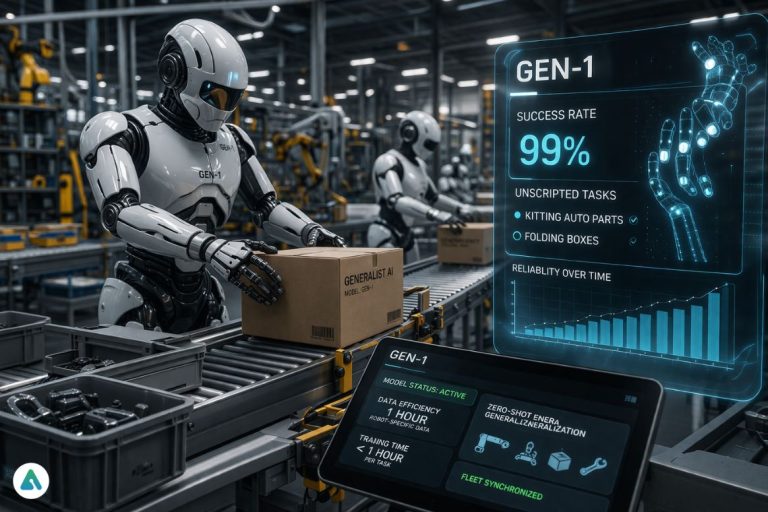
On April 2, 2026, Generalist AI released GEN-1, the first embodied model to publicly document something the industry has chased for decades: ~99% success rates on unscripted physical tasks.
Not scripted demos. Not lab-optimized routines.
Real tasks—kitting auto parts, folding boxes, handling slight variations—executed with consistency that crosses the line from “impressive” to deployable.
In my analysis of the “GEN-1: Scaling Embodied Foundation Models to Mastery” report, the number itself isn’t the most important part.
It’s how they got there.
Because the leap from ~60–80% (typical of 2025-era GEN-0 systems) to ~99% isn’t a linear improvement.
It’s a phase change.
What Observers Miss About the 95% → 99% Gap
Most coverage treats this like a performance upgrade.
It’s not.
That last 4–5% has historically been the “dark matter” of robotics—the unpredictable edge cases:
- Slightly deformed objects
- Misaligned placements
- Lighting changes
- Unexpected resistance
At 95%, robots fail just often enough to require constant human supervision.
At 99%, something subtle but critical happens:
- Failures become rare
- Recovery becomes autonomous
- Trust becomes economically viable
This is the same plateau we saw with autonomous driving.
Level 5 wasn’t blocked by intelligence—it was blocked by edge cases.
Robotics just cleared its first real version of that barrier.
The Architecture Shift: From VLA to Embodied Foundation Models
Earlier systems used Vision-Language-Action (VLA) models.
GEN-1 moves beyond that into something more consequential:
Embodied Foundation Models with “physical commonsense.”
That means the model doesn’t just see and act—it intuits:
- Friction
- Gravity
- Object permanence
- Tool affordances
A robot doesn’t need to be told how to use a new object.
It can infer it.
This is where zero-shot generalization becomes real in the physical world:
A robot sees a tool it has never encountered—and still uses it correctly.
No retraining. No new code and teleoperation.
The Hidden Breakthrough: Data Efficiency
GEN-1 reaches 99% reliability with <1 hour of robot-specific data per task.
Compare that to 2025 systems:
- Thousands of hours of teleoperation
- Weeks or months of task-specific tuning
This flips the entire cost structure of robotics.
Training is no longer the bottleneck.
Deployment is.
The “Model-as-a-Worker” Shift
What’s emerging is not just better automation—it’s a new abstraction layer:
The model is the worker.
A single weights update can:
- Improve dexterity
- Fix failure modes
- Expand capabilities
Across:
- Humanoids
- Cobots
- Industrial arms
Simultaneously.
This is what “software-defined labor” actually means in practice.
Not metaphorically.
Operationally.
The Infrastructure Layer No One Talks About
This leap doesn’t happen in isolation.
Behind GEN-1 is a new class of compute infrastructure:
- High-throughput training on clusters built around chips like Nvidia Thor
- Specialized inference stacks optimized for real-time physical feedback loops
- Distributed training pipelines that fuse simulation + real-world correction
These are effectively “compute islands for the physical world”—purpose-built to train models that don’t just predict text, but control matter.
Without this layer, the model doesn’t scale.
The Part That Still Breaks
The 99% number is real—but it’s not universal.
There are still failure domains:
- Transparent or reflective objects
- Liquids and deformable materials
- Highly chaotic environments
This is the remaining “dark matter.”
And it matters—because in many industries, that final 1% still defines feasibility.
The difference now is that these are known limitations, not systemic ones.
The Competitive Landscape Is Shifting Fast
The race is no longer about who can build a robot.
It’s about who can:
- Train the best embodied foundation model
- Achieve the highest data efficiency
- Deploy across the widest hardware base
This is why generalist systems are pulling ahead.
They compound.
Specialized systems don’t.
The Inflection Point, Quantified
| Metric | Legacy Robotics (2020–2024) | Generalist AI (2026) |
|---|---|---|
| Success Rate | 80–92% (scripted) | 99%+ (unscripted) |
| Training Time | Weeks/months per task | <1 hour per task |
| Adaptability | Task-specific | Zero-shot capable |
| Error Handling | Hard resets | Autonomous recovery |
| Hardware | Fixed-purpose | Hardware-agnostic |
Strategic Forecast: Who Flips First?
Not all industries benefit equally from 99%.
The first to fully cross the adoption threshold will be:
1. Electronics Assembly
- Structured environments
- High repetition with slight variation
- Massive ROI from consistency
2. Industrial Kitting
- Semi-predictable tasks
- High labor costs
- Immediate benefit from generalization
Warehousing comes later.
It’s too chaotic—for now.
The Real Takeaway
This isn’t about robots becoming human-like.
It’s about them becoming reliable enough to be invisible.
Because once a system can:
- Generalize across tasks
- Learn with minimal data
- Recover from failure autonomously
The limiting factor is no longer intelligence.
It’s rollout speed.
And rollout, unlike research, compounds fast.
What GEN-1 proves isn’t that robotics is improving.
It proves that the scaling phase of embodied AI has officially begun.
Related: Humanoid Robots in 2026: Why AI Is Ready—but the Bodies Still Aren’t
