What Is Doppl AI and How Does Its Virtual Try-On Work?
Doppl AI refers to two different clothing try-on products. One was Google’s experimental mobile app, which shut down on April 30, 2026. The other is a browser tool at doppl.art that pairs your photo with a garment image to show how the look might appear. Mixing them up can cost you money. The website sells credit-based plans, and neither its homepage nor its terms mention Google. A familiar Google model name in its menu, Nano Banana Pro, doesn’t establish any ownership link. Doppl.art, a separate browser tool, may help you preview styles, but treat it as a short paid experiment rather than proof of fit.
At a glance
Doppl.art
Format
Browser workspace
Entry price
$4.99 a week for 400 credits
Google link
Homepage and terms disclose none
Main catch
Disliking a result generally won’t earn a refund
A “doppl ai” search can surface two clothing try-on products: Google’s retired experiment and a website at doppl.art. Confusing them could send your money or photos to a company you didn’t intend to choose. Here’s how they differ, followed by real costs, refund terms, sizing limits, photo privacy and alternatives suited to different goals.
What Happened to Google’s Doppl AI?
Google shut down its standalone Doppl app on April 30, 2026, less than a year after launch. It left both mobile stores, and users lost access to their saved data. In its place, Google points shoppers to virtual try-on inside product listings and image results.
Google Labsintroduced the experiment on June 26, 2025, free for U.S. users on iOS and Android. It worked from outfit photos or screenshots and could turn a still look into AI video. Even then, Google cautioned: “Fit, appearance and clothing details may not always be accurate.”
Can You Still Get the Doppl App or APK?
No, Google no longer offers an official working route to its app. An APK, Android’s installation file, might still place an icon on your phone, but an old copy is unlikely to restore features that relied on Google’s servers. Treat any page advertising a revived or “unlocked” version as a red flag.
Unofficial files also leave a basic security question open: who built or altered them? If you already installed one, remove it and review the permissions you granted. If you typed your Google password into an unfamiliar form, change it right away.
Doppl.art’s homepage shows no mobile store links, so ask its support team to verify any app using that name.
What Is the Doppl Website and How Does It Work?
Doppl.art is a browser-based virtual fitting room. You add one photo of a person and another of a garment, then describe the pose, background, or lighting. The tool generates an outfit image to save or share. Its maker frames results as shopping help, not a physical fitting.
The three-step panel has an odd flaw: its artwork displays “MV Agent” and “Bizmuse” menus, which appear to belong to music or video software. Follow the written instructions instead.
Before generation, the screen has a 1:1 frame, 2K, and Nano Banana Pro, Google DeepMind’s image model, selected. That menu choice proves no Google ownership. An 18 sits beside the credit icon, while the sidebar reads 5. If 5 is your balance, you’d need more credits.
The try-on workspace, ready for a first request.
The sample prompt requests a whole casual-smart outfit, with the Product slot still empty. That works for style ideas but tells you little about a specific item on sale. For a purchase check, upload that piece and narrow your request:
Dress the person in the uploaded garment. Keep the face, body shape, pose and background unchanged. Preserve the item’s color, neckline, sleeve length, hem, pattern and buttons. Add no accessories.
The AI may still ignore parts of this, but you’ll know which changes to look for.
Who is it for?
In practice, that could mean a buyer comparing looks, a creator sketching concepts or a store team exploring visuals.
Promotional audience panel, not tested output.
How Much Does the Doppl Website Cost?
The doppl.art website starts at $4.99 a week for 400 credits. Yearly billing prices Pro at $372, Ultimate at $888, and Creator at $1,668, equal to $31, $74, and $139 a month. Credits, rather than a fixed outfit count, drive spending, so your model and settings matter.
Plan cards in the annual view.
These U.S. dollar rates come from the live plan page on November 27, 2026.
The larger tiers cross out $39, $99, and $199. Their advertised savings of $96, $300, and $720 fit those figures as month-to-month rates, while Weekly strikes through $6.99. Monthly credit allowances remain unconfirmed.
Plan
Charge
Listed credits
Cost per 100 credits
Estimated 18-credit run
Weekly
$4.99 per week
400 per week
$1.25
$0.22
Pro annual
$372 per year
37,200 per year
$1.00
$0.18
Ultimate annual
$888 per year
92,400 per year
$0.96
$0.17
Creator annual
$1,668 per year
$175,200 per year
$0.95
$0.17
These estimates assume you use every credit on the screenshot’s 18-credit setup. Unused credits raise your real cost. Other options differ: standard Nano Banana lists at 4 credits per image.
How Do Doppl AI Credits Work?
At 18 credits each, one Weekly allowance covers 22 generations. Retries raise the price of every image you keep:
Hypothetical attempts per keeper
Credits
Weekly-plan cost
1
18
$0.22
2
36
$0.45
3
54
$0.67
5
90
$1.12
10
180
$2.25
Annual plans also list “Unlimited Relax Gens” on select models. For Nano Banana Pro and Nano Banana 2, the ceiling is 1K on Pro, 2K on Ultimate, and 4K on Creator. These runs could lower your annual cost per image, so ask about wait times and limits.
Fifty-two Weekly payments total $259.48 for 20,800 credits. Annual Pro costs $112.52 more for 16,400 extra credits plus relaxed runs, worthwhile only with regular use. Creator barely beats Ultimate per credit; choose it for volume, 4K relaxed runs, or 10 simultaneous tasks instead of 4. The plan page text showed no one-time pack prices.
Paid downloads carry no watermark, with caps of 720p for Weekly and 1080p for larger tiers. Since the site also mentions higher resolutions, ask which size your file will keep. The homepage’s free trial states no size or length.
Can you cancel or get a refund?
Plans auto-renew until you cancel in account settings. Under the terms of service, access continues through the paid period unless checkout says otherwise. Using a purchase’s credits or benefits generally rules out a refund, unless law or checkout terms differ. Failed or canceled tasks can return credits where the workflow supports it.
The catch: an image you dislike doesn’t count as a failed task. Subscription credits follow checkout and billing-cycle rules, separately from packs. Credits carry no cash value, and transfers need Doppl’s express permission. Neither the terms nor the plan page explains expiry, rollover, or leftover balances after cancellation, so get written answers.
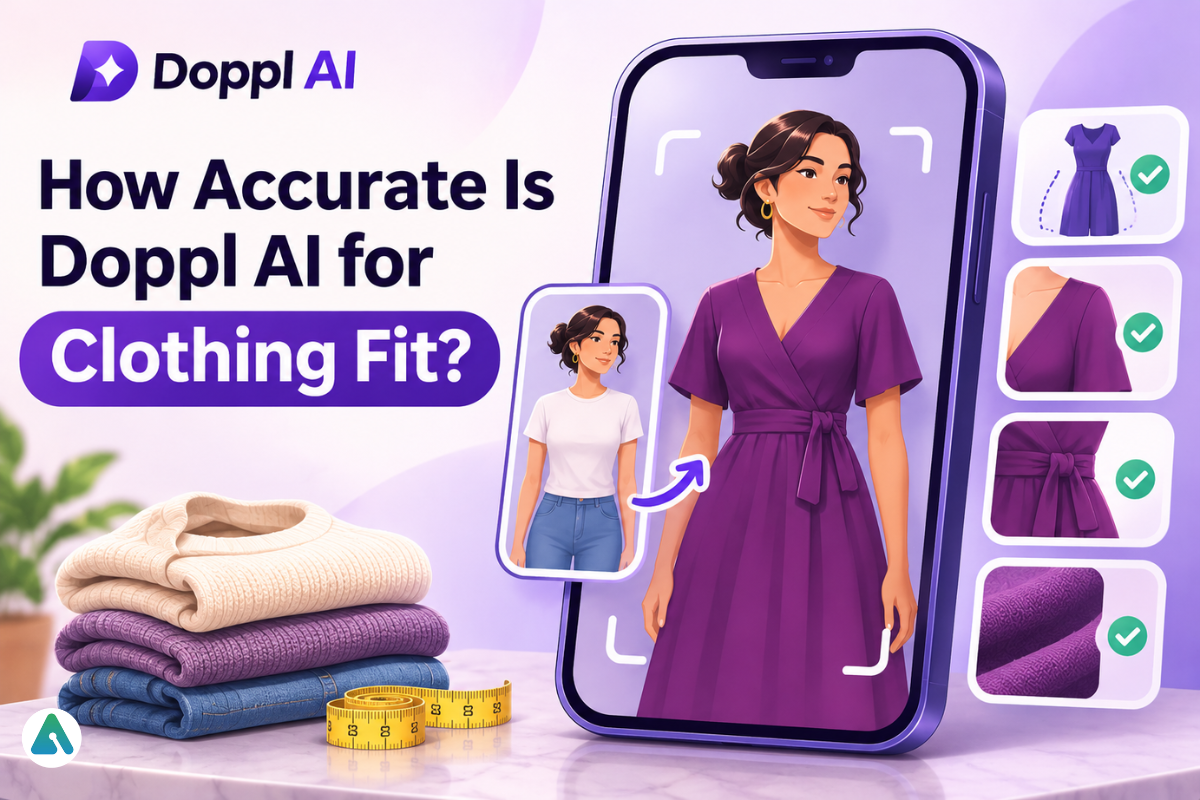
How Accurate Is Doppl AI for Clothing Fit?
Doppl AI can’t confirm clothing fit, so treat its pictures as style guidance. An image may suggest how a color or silhouette suits you, but it can’t judge comfort or show how fabric behaves on your body. Before ordering, compare garment measurements with yours and read the return policy.
A jacket might close neatly on screen yet pinch your real shoulders. Lighting, drape, and camera angle also limit virtual try-ons in fashion.
Details: Did the neckline, print, seams, pockets, or buttons change?
Length: Do hems and sleeves match the description?
Identity: Did your face, proportions, or posture shift?
Invented areas: Did AI add unseen shoes, legs, or rear views?
For better inputs, use a well-lit, front-facing shot of one unobstructed person and a sharp image of the entire item.
Is Doppl AI Safe for Your Photos?
Doppl AI offers some photo protections, but they have limits. Doppl.art pledges not to train its own models on private uploads without your permission. Outside AI, hosting and storage providers may still process your files, and deleting an asset or account may not immediately erase every retained copy.
The privacy policy dated July 27, 2026 allows the company to keep inputs and results for delivery, history, support, or abuse prevention. Logs, backups, and caches have no stated deadline. AI vendors and payment systems may also hold certain records under their own terms.
So the training pledge doesn’t promise zero retention or bind every outside model. A document review also can’t verify daily practice.
The policy names no legal entity or postal address. Before sharing a face or full-body shot, email support@doppl.art to ask who processes your chosen model and how long they store files. The same address handles deletion requests.
Use only images you have permission to share, and crop out documents, school logos, addresses, and bystanders. The service doesn’t target children under 13, or under a higher local age limit, and paying users must be adults.
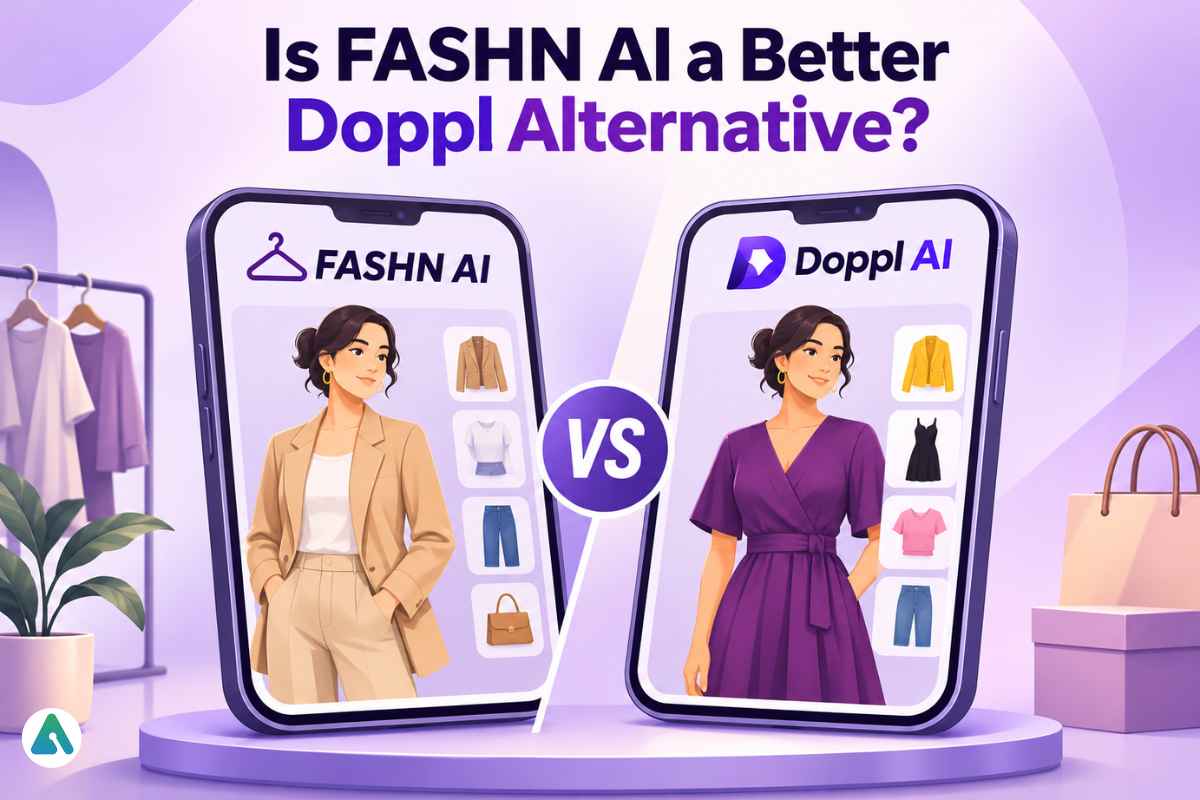
Is FASHN AI a Better Doppl Alternative?
It depends on your job. FASHN AI makes more sense for apparel brands that need catalog imagery, team seats, or developer integration. Its app starts at $19 monthly, and new accounts receive 10 free credits without a card. Someone checking one dress may not need that business-oriented toolkit.
FASHN’s price list gives Basic 200 monthly credits, drops its price to $16 a month on yearly billing and offers developers an API. An announced update lifts Basic to 250 credits at the same price during the week of December 14, 2026.
Because credit systems differ, compare usable results per dollar with the same garment. This review ran no such test.
Which alternative suits casual shoppers?
FitRoom targets a simpler starting point. Its plan page lists 10 free monthly credits with watermarked results, plus links to iOS and Android apps. Yearly paid tiers remove the watermark and roll over unused credits while you subscribe. Verify paid prices and privacy terms first, since this review didn’t assess its output or data handling.
Can Google Try-On Replace the Old Doppl App?
Only partly. Google Try-On previews supported tops, bottoms, and dresses from Search, Shopping or Images, so it works from eligible listings rather than any screenshot you bring. You also need to live in a covered country, be at least 18, and sign in with the required settings switched on.
Google’s help article lists these supported markets: Argentina, Australia, Brazil, Canada, Chile, Colombia, Hong Kong, India, Indonesia, Japan, Malaysia, Mexico, New Zealand, the Philippines, Singapore, South Korea, the UK, and the U.S. Those settings are Search Services History and personalized recommendations.
Choose a qualifying product, select Try it on, and add a photo. U.S. shoppers can instead start with a selfie and usual size; Nano Banana, Google’s Gemini 2.5 Flash Image model, then creates full-body choices. Google hasn’t tied that detail to any Doppl migration in the pages reviewed. Lingerie, swimwear, accessories, and Shopping Ads don’t qualify.
Google says it doesn’t use your try-on photo to train AI, although human reviewers may assess generated images using data disconnected from your account. You can replace or delete your saved photo. Keep the training promise within its scope. TechCrunch reported in July 2026 that Google’s update effectively opted users into AI training on media saved from Search services, with a way to opt out. Since Try-On requires Search Services History, review its Save Media option too. Broader AI data collection defaults deserve the same attention.
Your goal
Option to consider
Main trade-off
Preview a supported store listing
Google Try-On
Limited markets and categories
Upload your own garment screenshot
Doppl website
Credits, renewal and provider-data questions
Produce brand imagery or integrate try-on
FASHN AI
Business-focused plans and separate credit rules
Try casual outfits on a free monthly tier
FitRoom
Watermark on free results
Is the Doppl AI Website Worth Using?
Doppl.art deserves a cautious trial if you want to test clothing images from different sources and accept credit billing. Skip the yearly commitment until it handles items you’d actually buy. Choose another tool if you need a clearly identified company or a money-back guarantee for results you dislike.
Test a plain top, patterned dress, and layered jacket. Apply the checklist above and count the credits behind each keeper. If the tool can’t help you rule out unflattering styles, keep your money.
Frequently Asked Questions
Q. Which Doppl website is official?
Google’s app lives at labs.google/doppl. Doppl.art runs separately, so don’t treat it as Google’s official site.
Q. Can I recover my old Google Doppl looks?
Google’s shutdown guidance offers no recovery route. Before the deadline, it urged people to download or screenshot their favorites.
Q. Is Doppl AI the same as Dopple AI?
No. “Dopple AI,” with an extra E at the end, commonly refers to a character-chat service.
Q. Can I use Doppl.art images commercially?
The Weekly and Pro feature lists name a commercial license, and the terms say Doppl doesn’t claim your results. Confirm Ultimate or Creator coverage in writing. A platform license also can’t clear third-party intellectual property: you still need rights to retailer photos, brand assets, and people’s likenesses. Model terms, local law, and publishing rules apply.
Q. Is Doppl AI legit or a scam?
The reviewed documents prove neither. The privacy policy’s missing company name and address raise a transparency concern, but they don’t prove fraud. Before paying, ask who runs the service.
Disclaimer: This review is based on publicly available vendor documentation and independent research only for informational purposes, not hands-on testing. Pricing, features, credit system, and available features may change over time. We are not affiliated with Doppl AI.
Tags:
Maliha Irfan
Maliha Irfan is an AI and technology writer specializing in AI tools, AI agents, automation, and emerging software. Her work explores how AI technologies perform in real-world scenarios, what features they offer, and where their limitations lie. She focuses on practical reviews, hands-on testing, and evidence-based insights to help readers understand AI products, compare available solutions, and make informed decisions about adopting new technologies.