
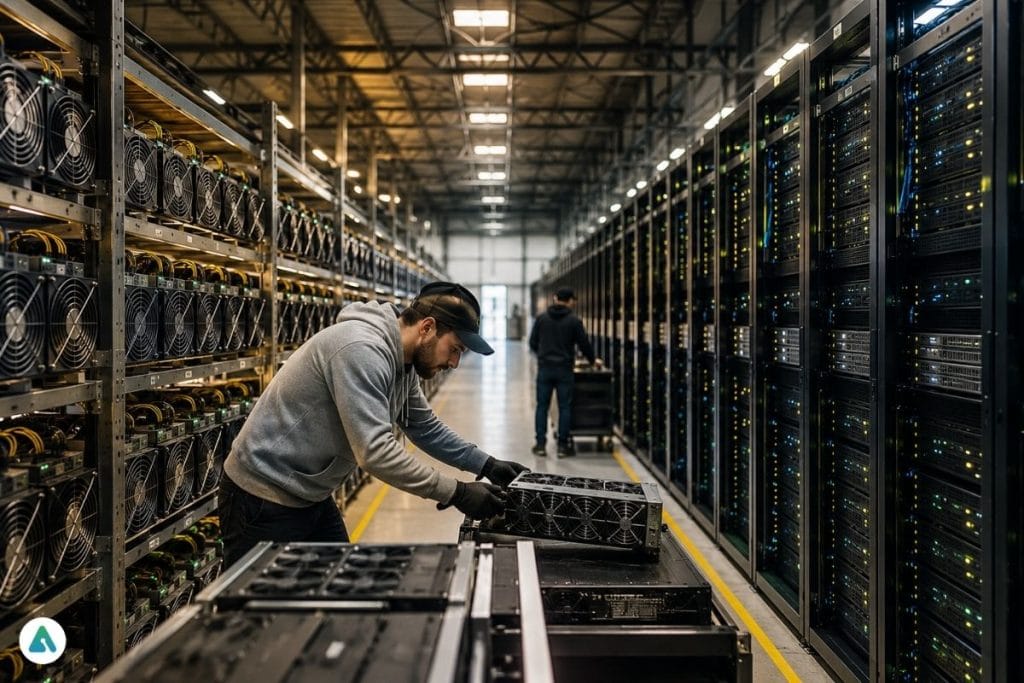
A rack of ASICs and a rack of GPUs want the same three things: cheap power, heavy cooling, and a substation that won’t blink. That overlap is quietly reshaping the Bitcoin mining industry, and hosting operators like ValueHash are already fielding client questions about whether their facilities could run both workloads.
Since the April 2024 halving cut block rewards in half, mining margins have been squeezed hard. Rather than fold, a growing number of public miners have pointed their infrastructure at a different customer: AI companies desperate for compute.
Why Bitcoin’s Power Infrastructure Became an AI Asset
Bitcoin mining has always been, at its core, a power business with a crypto revenue line attached. Operators spend years securing land, substations, transmission capacity, and cooling systems — the expensive, slow parts of building a data center.
AI labs need exactly that same infrastructure to run GPU clusters, and building it from scratch takes years. Repurposing an existing mining site is faster and dramatically cheaper — which matters because, as Nvidia’s own energy leadership has pointed out, the real bottleneck in scaling AI infrastructure isn’t chips anymore; it’s power access.
That framing puts Bitcoin’s energy footprint in a new light. The University of Cambridge’s Cambridge Centre for Alternative Finance has tracked Bitcoin’s global electricity draw for years precisely because miners already sit on some of the largest independently metered power loads in the world — the same category of asset AI operators are now racing to secure.
The math behind the shift is stark. HIVE Digital Technologies has estimated that 10 megawatts of Nvidia H100 GPUs can generate revenue comparable to 100 megawatts of Bitcoin mining. Iris Energy has reported that a relatively modest GPU deployment grew into roughly 10% of corporate earnings, delivering a 3x to 4x economic uplift versus mining on the same power.
That kind of gap is hard for any operator to ignore, especially with mining hashprice under sustained pressure.
The Scale of the Pivot Is No Longer Small
What started as a side experiment has turned into one of the defining infrastructure stories of 2025 and 2026.
| Company | AI/HPC Move |
|---|---|
| IREN | Five-year Microsoft partnership projected at $1.94B in annualized revenue, ~85% project-level EBITDA margin |
| CoreWeave | $11.9B, five-year compute supply deal with OpenAI |
| TeraWulf & Hut 8 | Large-scale power paired with investment-grade counterparty contracts |
| Hut 8 | 15-year, $7B colocation lease with Fluidstack |
| Bitfarms | Liquidating its entire Bitcoin treasury to fund an AI infrastructure pivot |
CoinShares research cited in late 2024 put listed miners’ disclosed AI and HPC contracts above $43 billion. By early 2026, market estimates placed that figure above $70 billion. Industry analysts now expect AI and HPC to account for roughly 70% of revenue at transformed miners by the end of 2026, up from about 30% in Q4 2025.
The market has already priced some of this in. A tracked basket of crypto mining equities climbed 56% year-to-date in 2026 even as Bitcoin itself fell around 17% over the same stretch — a divergence that would have been unthinkable three years ago, when miner stocks moved almost entirely with BTC price.
What This Says About Bitcoin’s Network, Not Just Its Miners
None of this means Bitcoin mining is disappearing. It means the infrastructure underneath it has options it didn’t have before, and that’s arguably a sign of health rather than retreat.
Bitcoin’s global hashrate has repeatedly set new all-time highs through 2025 and into 2026, briefly crossing 1 zettahash per second in January 2026 before short-term weather-related curtailment pulled it back. Hashrate now sits in the 850–920 EH/s range on most trackers — still an order of magnitude above where it stood five years ago.
That distinction matters when evaluating operator strategy: companies chasing better margins per megawatt through AI hosting are a business decision, not a referendum on Bitcoin’s underlying security or survival. The network’s proof-of-work difficulty still recalibrates every 2,016 blocks regardless of who’s plugging GPUs into which substation. Research groups studying GPU clusters as flexible grid assets have started making a similar argument from the AI side — that power-hungry compute sites, whether mining rigs or GPU racks, can be managed as demand-response resources rather than fixed liabilities on the grid.
For operators building or scaling their own facilities, this dual-revenue reality is becoming a standard part of infrastructure planning rather than a side note.
Practical Implications for Miners and Operators
The pivot changes what “smart infrastructure” looks like for anyone in this space.
- Power contracts now need to support multiple workload types. A site locked into pure ASIC design has less optionality than one built with flexible cooling and rack density.
- Contract-based AI revenue behaves differently than mining revenue. It’s dollar-denominated and longer-term, which smooths out some of the volatility that mining alone can’t avoid.
- Not every site qualifies. GPU hosting has stricter latency, redundancy, and connectivity requirements than Bitcoin mining does, so the pivot isn’t universal or automatic.
For miners weighing where their own operation fits into this shift, ValueHash’s hosting model is built around that same flexibility — fixed costs, scalable infrastructure, and the ability to adapt as the underlying economics change.
The Bigger Picture
The Bitcoin miner-to-AI-data-center trend is a reminder that the most valuable part of a mining operation was never just the ASICs. It was always the power, the land, and the substations underneath them — and that infrastructure just found a second customer.
Operators evaluating whether their own site is positioned for this shift, or simply looking for a more resilient hosting setup for 2026, can schedule a consultation with the ValueHash team to map out the options.
Related: AI Agent Caught Mining Crypto During Training — The ROME Incident Explained
