

The model worked perfectly.
The demo impressed everyone.
The board approved the rollout.
And then… everything stalled.
Legal stepped in. Compliance raised flags. IT listed risks nobody had mapped. Teams started quietly downloading their own tools on the side. Within months, what looked like a breakthrough AI initiative had quietly become another “pilot that never scaled.”
That’s not a technology problem. That’s a governance problem.
And in 2026, it’s the most common story in enterprise AI — not failed models, but failed decision-making around them. The bottleneck isn’t building AI anymore. It’s about deciding who controls it, what risk is acceptable, and how quickly decisions can be made without breaking what matters.
AI Transformation Isn’t Failing — It’s Getting Stuck
Most teams don’t struggle to build AI in 2026. The tools are accessible, the talent exists, and the business case usually writes itself. What breaks down is the journey from working demo to production system.
Here’s what actually happens behind the scenes in most organizations:
The AI team pushes for deployment. Compliance slows things down, waiting for documentation that nobody agreed needed to exist. Leadership wants results but fears liability. Employees — practical people trying to do their jobs — start using tools the organization doesn’t know about.
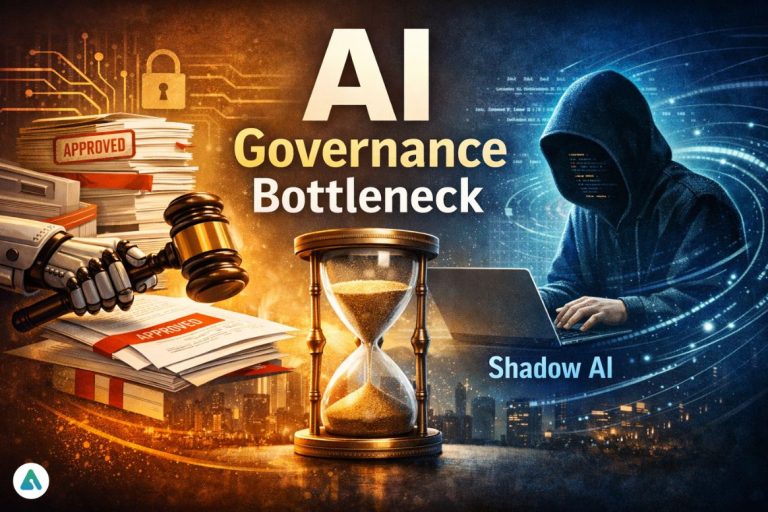
Suddenly, two parallel systems are running in the same company. The official AI: slow, controlled, and largely underused. And the shadow version: fast, untracked, and spreading.
That split is the real governance failure. Not a security incident. Not a rogue employee. A system that made the unauthorized path easier than the sanctioned one.
When Governance Becomes the Bottleneck
Here’s the uncomfortable truth that most governance frameworks are designed to avoid: governance itself is often the reason AI stalls.
In theory, good governance should reduce risk, improve decision quality, and increase organizational trust in the systems being built. In practice, it frequently produces approval bottlenecks with unclear ownership, review cycles that outlast the relevance of what’s being reviewed, and accountability structures so diffuse that nobody can actually make a call.
When that happens, people route around it. Not because they’re reckless — because they’re trying to get work done.
This is why Shadow AI isn’t primarily a security issue. It’s a diagnostic signal. It tells leadership that the official governance system has created more friction than value, and employees have responded rationally.
The organizations getting this right in 2026 are the ones that redesigned their governance frameworks to enable speed, not just enforce caution. The ones still struggling are the ones treating governance as a compliance exercise rather than an operational one.
A Story You’ll Recognize: Model Drift in the Real World
A fintech company deployed a machine learning credit risk model. At launch, performance was strong — default predictions were accurate, approval rates looked healthy, and the business case was validated quickly.
Six months later, something shifted.
Approval rates started drifting in ways nobody had planned for. Certain customer segments were being rejected at higher rates than the training data would have predicted. The model hadn’t been changed. The business hadn’t changed its criteria. But the outputs had quietly moved.
By the time the drift surfaced in a compliance review, regulatory scrutiny had already begun. The company faced not just a technical remediation problem but a documentation problem — they couldn’t fully reconstruct why the model had made the decisions it made over the previous six months.
The model wasn’t the problem. The absence of governance around it was.
No continuous monitoring and human-in-the-loop checkpoints at defined intervals. No clear ownership of model behavior post-deployment. These weren’t oversights in the traditional sense — they were gaps that the governance framework simply hadn’t anticipated, because the framework had been designed to approve systems, not to run alongside them.
This is “governance debt” in action. Unlike technical debt — which slows down future development — governance debt accumulates legal exposure and reputational damage. It’s significantly harder to pay back, because fixing it requires not just engineering work but regulatory disclosure, audit trails, and in some cases, public accountability. Organizations that skip governance steps early rarely appreciate how expensive catching up becomes.
The 5-Layer AI Governance Model
Most companies focus governance attention on model performance and treat everything else as secondary. That’s precisely why systems break at scale. A more complete framework covers five distinct layers, each with its own failure modes.

Layer 1: Strategic — Why AI Exists Here
This is where organizational priorities get set and where most AI initiatives quietly die. If AI systems aren’t explicitly tied to measurable business outcomes, they become expensive demonstrations. The strategic layer defines not just what AI should do, but what success looks like and who is accountable for it. Without this, every downstream governance question becomes harder to answer.
Layer 2: Data — What AI Learns From
Bad data poisons good models invisibly. The data layer covers ownership, quality standards, lineage documentation, and compliance with data use agreements. This layer matters especially as AI regulation tightens globally — the EU AI Act, for instance, requires organizations to document training data provenance for high-risk systems. Companies that treated data governance as a technical problem, rather than a legal and organizational one, are discovering that gap the hard way.
Layer 3: Model — How AI Behaves
Validation, bias detection, and drift monitoring all live here. This is the layer most teams over-invest in relative to the others — partly because it’s the most visible, and partly because it’s the easiest to measure. The mistake is treating it as sufficient on its own. A perfectly performing model sitting inside a broken operational framework will still produce bad outcomes.
Layer 4: Operational — How AI Actually Gets Used
Workflows, approval paths, escalation logic, and human override mechanisms. This layer determines whether AI gets genuinely integrated into how work gets done, or whether it becomes a tool people nominally use while making decisions the old way. Poor operational governance is the primary driver of the “official AI vs. shadow AI” split described above.
Layer 5: Ethical — What AI Must Not Do
Boundaries, guardrails, and the trust framework that keep systems from becoming liabilities. This layer is frequently either underdeveloped (treated as a box-checking exercise) or over-formalized (producing documents nobody reads). The organizations doing this well in 2026 are embedding ethical constraints at the model and operational layers, not just articulating them in policy documents.
Miss any one of these layers and the system becomes unstable — not immediately, but eventually, and usually at the worst possible moment.
The Shadow AI Problem Nobody Wants to Name
Walk into most mid-to-large organizations today, and it’s there. Employees running prompts through public LLMs. Browser extensions connecting to AI services that the IT department has never reviewed. Automation workflows built on tools that weren’t approved and aren’t monitored.
None of it is malicious. Most of it is invisible.
The instinct is to treat this as a security problem — to add it to the list of things the acceptable use policy should prohibit. But prohibition without addressing the underlying cause doesn’t reduce shadow AI. It just pushes it further underground.
Shadow AI expands when official systems create too much friction. When the approved tool requires three approval layers to access a basic capability that a free browser extension provides in thirty seconds, the outcome is predictable. People take the path that lets them do their job.
The risks of unmanaged AI use in enterprise settings are real — data leakage, compliance exposure, outputs that can’t be audited or attributed. But addressing those risks through governance means designing systems that employees actually want to use, not systems that drive them toward alternatives.
Agentic AI Just Raised the Stakes Considerably

The governance conversation shifted significantly in 2025 and accelerated into 2026. AI is no longer primarily generating text for humans to review. It’s taking actions.
Placing orders. Triggering workflows. Sending communications. Making decisions in real time, often faster than any human oversight loop could catch.
Consider a concrete scenario: an autonomous procurement agent misreads pricing data during a high-volume period and executes purchase orders worth $2M in excess inventory. The error is discovered 72 hours later. The question that follows — “who approved that action?” — turns out to have no clean answer, because the governance framework was designed for AI that generates recommendations, not AI that executes decisions.
This is the new frontier of AI governance, and most frameworks aren’t built for it. Agentic AI systems require a fundamentally different approach: not output-checking after the fact, but action-authorization before the fact. Every autonomous action needs a defined authorization boundary, an escalation path, and a human override mechanism that actually works at operational speed.
Organizations that haven’t updated their governance frameworks since the pre-agentic era are carrying significant unacknowledged risk.
The Rise of Autonomous Governance: AI Watching AI
Manual oversight doesn’t scale with agentic systems. There aren’t enough humans, and the speed mismatch is too significant. The response emerging in leading organizations is using AI to govern AI — layered systems where smaller, specialized models monitor the behavior of larger ones in real time.
This looks like guardrail models checking outputs before they’re acted on. Anomaly detection systems flag unusual decision patterns. Prompt monitoring, identifying inputs that fall outside defined parameters. A smaller, constrained model watching a larger, more capable one — not to replace human judgment, but to extend its reach.
It’s a meaningful conceptual shift. Control in 2026 doesn’t come primarily from more people reviewing more outputs. It comes from better systems catching problems earlier, at machine speed, and surfacing only the cases that genuinely require human judgment.
The organizations building this infrastructure now are the ones that will be able to scale AI responsibly. The ones waiting are accumulating governance debt that will eventually surface as incidents.
The Concept Missing From Most Governance Frameworks: The Agentic Audit Trail
Aviation has had flight data recorders since the 1950s. The reasoning is straightforward: when something goes wrong, you need to reconstruct exactly what happened, in what sequence, and why — without relying on memory or incomplete documentation.
AI systems operating at scale need the equivalent. Call it the Agentic Audit Trail.
A properly designed audit trail captures every decision point, every data input that influenced an output, every API call made by an autonomous agent, and every action taken on behalf of the system. Not as a theoretical log, but as a practically queryable record that can answer the questions that matter when something goes wrong: What happened? Why did the system choose that path? Who — or what — was accountable for that action?
Without this, governance becomes retrospective guesswork. With it, organizations can actually identify drift, detect misuse, satisfy regulatory requests, and build the kind of trust in AI systems that enables continued investment rather than periodic crises of confidence.
The EU AI Act’s transparency requirements are pushing this direction explicitly for high-risk applications. But the organizations benefiting most from audit trail infrastructure are the ones that built it for operational reasons — because they needed to understand their systems — rather than as a compliance response.
Who Actually Owns AI Governance?
This is the question that exposes governance failures faster than any other.
Governance without clear ownership is theater. It produces documents, committees, and review cycles that don’t translate into actual accountability when something goes wrong. And when something goes wrong with an AI system, the first question regulators, boards, and customers ask is: Who was responsible for this?
In 2026, the organizations with mature AI governance are defining ownership explicitly. The Chief AI Officer (CAIO) has emerged as a genuine C-suite function in mid-to-large enterprises — not a rebranded CTO or CDO, but a role with a specific mandate over AI strategy, risk, and accountability. Alongside that, AI Ethics Boards provide oversight with defined escalation authority (not advisory-only mandates that can be ignored), and Model Risk Teams maintain ongoing accountability for deployed systems rather than just pre-deployment approval.
The keyword in all of this is accountability. Not responsibility in the diffuse sense of “everyone is responsible for AI outcomes,” but specific, named, auditable accountability for specific systems and decisions. Without that, governance frameworks are aspirational documents. With it, they’re operational infrastructure.
What Bad Governance Actually Costs

The costs are real, measurable, and often larger than the cost of building governance infrastructure would have been.
Failed AI rollouts at enterprise scale typically cost millions in sunk development costs, change management investment, and productivity loss during the gap between “pilot approved” and “pilot abandoned.” These numbers rarely appear in public reporting but surface consistently in post-mortems.
Regulatory exposure is escalating. EU AI Act enforcement is moving from phased implementation into active compliance requirements in 2026, with fines structured as percentages of global revenue for serious violations — the same model that made GDPR enforcement consequential. Organizations that treated AI governance as a future concern are discovering it’s a present one.
The hardest cost to quantify is trust. When an AI system fails visibly — a biased output, an unauthorized action, a decision that can’t be explained — the damage extends beyond the incident itself. Teams stop trusting AI tools. Leaders become risk-averse in ways that affect investment decisions. The psychological relationship between humans and AI systems is more fragile than the technology’s capabilities suggest, and governance failures are the primary driver of that fragility at an organizational level.
And when organizational trust in AI collapses, transformation doesn’t pause. It dies quietly, one shelved initiative at a time.
A Reality Check Before Scaling
Four questions worth asking before the next AI initiative moves from pilot to production:
Does the organization know who owns AI decisions?
Not in the sense of who built the system, but who is accountable for what it does after deployment.
Can the team trace how a specific AI output was generated?
If an output is questioned by a regulator, a customer, or an internal audit, can the organization reconstruct the decision path?
Are employees using AI tools that the organization doesn’t control?
Not as a theoretical possibility, but as a present reality. The answer at most companies is yes, and acknowledging it is the starting point for addressing it.
Is there real-time monitoring in place for deployed systems?
Not quarterly reviews. Continuous monitoring that would catch the kind of drift that hit the fintech company described earlier.
If the answer to any of these is unclear, what exists isn’t AI transformation. It’s an unmanaged risk running at AI speed.
Frequently Asked Questions
Q. Should I be worried about employees using ChatGPT or other AI tools without approval?
Yes — but not primarily for the reasons most IT policies focus on. The security concerns are real, but the more significant issue is that widespread shadow AI use signals a governance failure. Employees are routing around official systems because those systems create more friction than value. The fix isn’t better enforcement; it’s better governance design.
Q. What does “AI transformation is a problem of governance” actually mean in practice?
It means the companies that fall behind on AI in 2026 won’t be the ones that couldn’t build the technology. They’ll be the ones who couldn’t make decisions about it fast enough, clearly enough, or with sufficient accountability to keep moving. Governance is the operational infrastructure of AI transformation — not a compliance overlay on top of it.
Q. What is agentic AI, and why does it change the governance conversation?
Agentic AI refers to systems that take autonomous actions — not just generating outputs for humans to review, but executing decisions, triggering workflows, and operating without step-by-step human approval. This changes governance requirements fundamentally: the focus shifts from reviewing what AI produces to authorizing what AI is permitted to do before it acts.
Q. What is Shadow AI, and how does it actually start?
Shadow AI is the use of AI tools by employees without organizational knowledge or approval. It almost always starts the same way: official systems are too slow, too restricted, or too complicated, and a free or consumer-grade alternative is faster and easier. It’s a symptom of governance friction, not employee recklessness.
Q. What is the Agentic Audit Trail?
It’s the AI equivalent of an airplane’s flight data recorder — a system that captures every decision, data input, action, and API call made by an AI system, in a format that can be queried and reconstructed after the fact. It’s the infrastructure that makes post-incident investigation possible and regulatory transparency achievable.
Q. What is governance debt and why is it worse than technical debt?
Governance debt is the accumulated risk created by skipping governance steps during AI development and deployment. Unlike technical debt — which slows future development — governance debt creates legal exposure, audit vulnerabilities, and reputational risk that can’t be resolved through engineering alone. Paying it back requires regulatory disclosure, documentation reconstruction, and sometimes public accountability. Organizations that skip governance early rarely appreciate the full cost of catching up.
Q. Who should actually own AI governance inside a company?
Increasingly, a Chief AI Officer (CAIO) at the C-suite level, supported by an AI Ethics Board with real escalation authority and Model Risk Teams with ongoing deployment accountability. The critical factor isn’t the specific titles — it’s that accountability is named, specific, and auditable rather than distributed across everyone in a way that effectively means nobody.
Final Thoughts
The organizations that lead on AI in the next three years won’t necessarily be the ones with the most sophisticated models. They’ll be the ones that figured out how to make decisions about AI clearly and quickly — who controls it, what it’s permitted to do, and who answers when something goes wrong. That’s not a technology problem. It never was. It’s a governance problem, and in 2026, the gap between companies that have solved it and companies that haven’t is starting to show up in results.
Related:
