
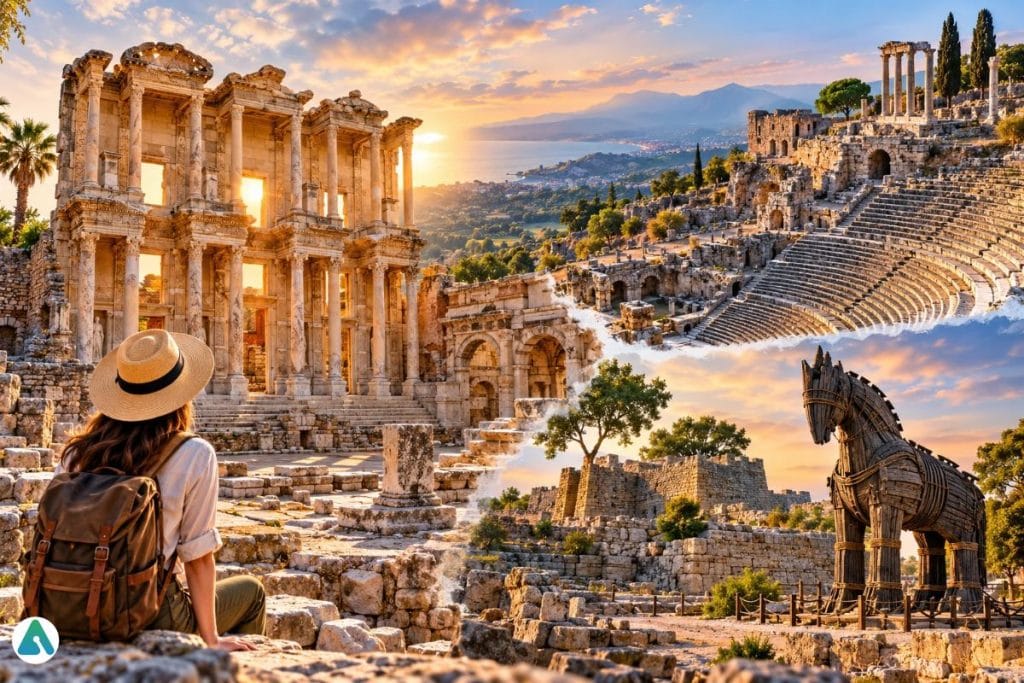
A traveler types “best historical tours in Turkey” into an AI planner. Seconds later, a seven-day itinerary appears. Ephesus on Monday, Pergamon on Tuesday, Troy on Wednesday, and three extra sites squeezed in between.
It looks efficient. It rarely works.
Western Turkey rewards slow attention. Greek cities, Roman streets, Hellenistic hilltops, and Bronze Age settlements share one landscape. Travelers who want an archaeological route from Ephesus to Troy now use AI at every step: research, planning, and even on-site interpretation.
That shift changes what a good tour looks like.
Why Does the Route From Ephesus to Troy Make Sense?
Ephesus, Pergamon, and Troy work as individual attractions. Together, they tell a bigger story about how cities changed as rulers, religions, and trade routes shifted.
| Stop | Main Story | Why It Earns Your Time |
|---|---|---|
| Ephesus | Greek, Roman, and early Christian history | Streets and public buildings make ancient urban life easy to picture |
| Pergamon | Hellenistic and Roman power | A hilltop city where architecture and landscape work together |
| Troy | Bronze Age settlement and later history | Layered cities connect archaeological evidence with ancient legend |
Each stop answers a different question. Ephesus shows how people lived in a major city. Pergamon shows how geography and architecture project power. Troy shows how one place holds thousands of years of settlement.
Travel north from Ephesus to Pergamon, then on to Troy. The geography stays simple, and the history moves forward without backtracking.
How Are Travelers Using AI to Plan Historical Tours in Turkey?
Planning used to mean guidebooks and forum threads. Now it starts with a chatbot.
Allianz’s Global Travel Confidence Index, polled by Ipsos, found that 37% of Americans planning summer 2026 trips used AI to help plan them, according to Hotel Dive’s July 2026 coverage. Search itself is shifting too. Google’s AI Overviews can answer a question like “is Troy worth visiting?” before a traveler opens a single website.
Speed brings flaws. Reviewers who test AI trip planners keep hitting the same two problems: outdated information and invented details. An Afar reviewer caught one planner insisting that the trip dates had already passed. A Seven Corners tester received an itinerary that stacked a zoo and a major museum into one day.
Archaeological sites magnify those errors. Ephesus, Pergamon, and Troy demand hours of walking over stone paths, slopes, and uneven ground. A planner sees three dots on a map. It doesn’t feel the climb.
Constraints fix most of this. Negative prompting works well here. Tell the model what to avoid: more than one major site per day, rushed museum visits, back-to-back long drives.
Here is the counterintuitive part. The best AI-assisted itinerary usually has fewer stops than the first draft.
Why Is Ephesus the Best Place to Start a Historical Tour?
Ephesus doesn’t feel like one monument surrounded by empty ground. Roads lead to public buildings, entertainment spaces, religious areas, fountains, homes, and commercial districts.
That layout makes one point clear: people lived here.
The city grew into a major Roman center. Its position near Aegean routes tied it to trade and travel. Its religious importance drew visitors long before most of the Roman buildings you see today.
Researchers now use that readable layout for digital work. A 2024 paper in the Athens Journal rebuilt the destroyed city in a virtual environment. Users walk its digital streets and question AI avatars about places like the Temple of Artemis.
What Is the Library of Celsus?
The Library of Celsus honored Tiberius Julius Celsus Polemaeanus, a high-ranking Roman official. It served as a library and as his memorial.
That mix says a lot about Roman public life. Wealth, education, status, and architecture met in one building. A donor could support a public institution and keep his name in the city at the same time.
The library also stood inside a busy urban setting. People passed it while running everyday errands.
Look for these details:
- the decorated facade and column arrangement
- its position within the wider city
- the link between public learning and personal status
- its closeness to civic and commercial spaces
Why Does the Great Theatre Matter?
The Great Theatre changes the scale of the visit. Standing inside a large gathering space, you can picture Ephesus full of people instead of silent ruins.
The library shows where learning and reputation met. The theatre shows where crowds gathered. The roads show how people moved. The religious areas show what communities believed.
Monuments stop being separate stops. The city starts to work as a system.
What Remains of the Temple of Artemis?
Ephesus mattered long before the Romans. The Temple of Artemis ranked among the Seven Wonders of the Ancient World and drew worshippers from across the Mediterranean.
Only limited remains survive. It looks modest next to the Library of Celsus. Historically, it matters more, because it proves religion shaped Ephesus before its famous Roman period. Christianity later added another chapter.
What Makes Pergamon Different From Ephesus?
Travel north, and the feel changes right away.
Pergamon’s acropolis rises above the plain near modern Bergama. The setting isn’t scenery. It’s the argument. Pergamon became the capital of the Hellenistic Attalid dynasty and grew into a major political and cultural center. Later Roman and Byzantine layers followed.
At Ephesus, walking the streets explains the city. At Pergamon, looking up and out matters just as much.
How Did the Acropolis Project Power?
Temples, public spaces, and cultural buildings wrapped around the sloping terrain. The effect served practical needs and made a visual statement.
A city high above the plain sends a different message than one on flat ground. Height supported defense. It also made political and religious buildings look larger.
Pay attention to:
- how high the settlement sits above the plain
- where the important public buildings stand
- how the structures follow the slope
- the views across the surrounding land
A 2025 paper from Istanbul Bilgi University shows why this matters. The team built a virtual Pergamon in Unreal Engine, with 3D models of the Temple of Athena, the Altar of Zeus, and the theatre. They added AI avatars that answer visitor questions in real time. The digital version needed the hill’s terrain data to feel right. The landscape carried the meaning.
Why Does the Pergamon Theatre Stand Out?
The seating follows the steep hillside. Builders worked with the slope instead of fighting it.
Stop here. Look past the stone rows to the land below. The setting explains why the ruin still feels dramatic. Architecture and geography explain each other.
What Was the Asclepieion?
Pergamon wasn’t only about kings and monuments. Its Asclepieion served as a healing center tied to Asclepius.
People arrived with illness and pain. Ancient treatment mixed practical methods with religious belief. The sanctuary shows that ancient cities needed places for health as well as politics.
Why Does Troy Have So Many Archaeological Layers?
Most visitors arrive at Troy already knowing the name. Achilles, Hector, Helen, and the Trojan Horse have kept the city alive in literature for centuries.
That fame creates a wrong expectation. Troy isn’t the remains of one city destroyed in one war.
Communities kept building new towns over old ones. Populations grew. Walls went up again. Houses vanished under later construction. Fire, conflict, and political change reshaped the site, one layer on top of another.
Expect to find:
- defensive walls and gates
- foundations from different settlement periods
- changes in the size and layout of the city
- later Greek structures
- later Roman development
Not every wall belongs to the same moment. Once you accept that, the site gets easier to follow. You stop hunting for one famous event and start reading how people kept returning to a valuable spot near the Dardanelles.
Where Does the Trojan War Fit?
Homer’s Iliad made the conflict famous across the ancient world. Archaeology works differently. Troy is a real site with a long history, including a major Bronze Age settlement. That doesn’t mean archaeologists can confirm every character or conversation in the epic.
Keep the two ideas apart, and the visit improves. You can study physical evidence of real communities and still think about how the place became tied to one of history’s most influential stories.
Can You Trust AI Reconstructions of Ancient Sites?
Trust them the way you trust a hypothesis. A polished AI image of “Troy” often shows one tidy city. The site shows several.
Confident visuals create a trust paradox. The cleaner the render, the more certain it feels, and the less certain the evidence usually is.
AI works best when it reads evidence instead of filling gaps. In June 2026, the Vesuvius Challenge announced that it had virtually unwrapped and read an entire Herculaneum scroll, PHerc. 1667, without opening it. Machine-learning models detected ink nearly invisible against carbonized papyrus. Papyrologists then checked and transcribed each reading. The models found the text. Human experts confirmed it.
Use the same rule on your trip. Let AI point you toward evidence. Let a good guide tell you what the evidence proves.
What Connects Ephesus, Pergamon, and Troy?
| Shared Theme | Ephesus | Pergamon | Troy |
|---|---|---|---|
| Geography | Aegean trade routes | Commanding hilltop | Near the Dardanelles |
| Change over time | Greek, Roman, Christian layers | Hellenistic, Roman, later phases | Repeated settlement over thousands of years |
| Main lesson | How a major city functioned | How landscape supported power | How one place got rebuilt repeatedly |
How Should You Plan a Historical Tour From Ephesus to Troy?
The biggest mistake is turning an archaeology trip into a race. Large sites need time to walk, look, and connect their areas. More names on the itinerary don’t make it better if every stop feels rushed.
Check these points before you book:
- Time at each site. Ephesus, Pergamon, and Troy deserve more than a photo stop.
- Driving time. Compare hours on the road with hours on foot.
- Guide expertise. A good guide explains why a site matters, not only when it dates from.
- Museums. Site museums add objects that ruined buildings can’t show.
- Entrance fees. Confirm what the tour price includes.
- Walking difficulty. Expect stone paths, slopes, stairs, and uneven ground.
- Daily pace. A little free time makes a history trip far more enjoyable.
Then run your AI-built draft through one filter. Ask whether a human could actually walk it. Cut any day that packs more than one major site.
A tour covering eight sites doesn’t beat one covering five. A slower schedule leaves more in your memory.
FAQs
Q. Is Ephesus worth visiting if you like history?
Yes. Ephesus preserves streets, public buildings, religious areas, and a theatre that show how a major ancient city functioned.
Q. Can you visit Ephesus, Pergamon, and Troy on one trip?
Yes. The three sites form a logical route through western Turkey. Give each site enough time, and plan for the drives between them.
Q. What is the main difference between Ephesus and Troy?
Ephesus explains Greek and Roman urban life. Troy stands out for its long sequence of settlement, its Bronze Age history, and the later Trojan War tradition.
Q. Is Troy worth visiting beyond the Trojan War story?
Yes. Its value comes from thousands of years of settlement and the evidence different communities left behind, not only from Homer.
Q. Why add Pergamon between Ephesus and Troy?
Pergamon adds the Hellenistic chapter. It shows how architecture, political power, learning, healing, and a dramatic hilltop shaped an ancient city.
Q. Can AI plan a historical tour of Turkey?
AI can draft a route fast, but it often misjudges pacing, dates, and walking effort. Use it for a first draft, then cut stops and verify details before you book.
Good tours don’t collect the most ruins. They explain why each place mattered and how its story leads to the next. AI can shorten the planning. It can’t walk the slope at Pergamon for you.
Related: Why AI Shopping Assistants Are Asking Questions Before They Recommend Products
