

Nobody owns artificial intelligence. But ownership, control, and dependency are three different things, and in 2026 they point to very different companies.
Microsoft owns roughly a quarter of OpenAI and can’t appoint a single board member. Anthropic’s co-founders reportedly hold small stakes, yet they’re lining up extra voting power. And Nvidia, which controls neither lab, sits underneath both.
Most “who owns AI” articles hand you a list of companies and brands. This one follows the paperwork. I went through OpenAI’s structure disclosures, the SpaceX–xAI deal coverage, Anthropic’s governance reporting, the 2026 Stanford AI Index, and the key copyright rulings. One question drove the review: who holds the equity, who makes the call, and who can squeeze whom?
Every changing figure below carries a date and a source. This market moves weekly.
Who Owns Artificial Intelligence?
Artificial intelligence is a scientific field, and no person, company, or government owns it. Companies own specific AI assets: trained models, datasets, software, chips, data centers, and the products built on them.
The core methods are public. Neural networks, backpropagation, and the transformer architecture all live in open research papers.
A working frontier model is not public. Training one takes billions of dollars in chips, memory, electricity, and data, and very few organizations can afford it. The ideas are open. The factory isn’t.
Four Questions That Separate Ownership From Power
AI power splits into four separate questions: ownership, control, dependency, and leverage. Keeping them apart is the only way to get an accurate answer, because in AI they rarely land on the same company.
| Question | What It Means | 2026 Example |
|---|---|---|
| Ownership | Who holds the economic interest? | Microsoft holds about 27% of OpenAI Group |
| Control | Who has legal or voting authority? | OpenAI’s nonprofit Foundation appoints the whole board |
| Dependency | Whose resources are required to operate? | Frontier labs rely on outside chips, memory, and cloud |
| Leverage | Who can materially change another party’s options? | A government export rule can pause a model without owning the company |
The last row is easy to overlook, so here’s a concrete case. On June 12, 2026, Anthropic suspended access to its Claude Fable 5 and Claude Mythos 5 models to comply with U.S. Department of Commerce export controls. The Department lifted those controls on June 30, and Anthropic restored access on July 1.
The U.S. government owns no part of Anthropic, yet for about three weeks it decided who could use those models. That’s leverage without ownership.
The AI Supply Chain: Where the Chokepoints Sit
The AI supply chain runs from electricity to data centers, chips, memory, cloud platforms, models, and finally apps. Each link has a small number of dominant suppliers, and those suppliers create dependency even where they own nothing.
| Layer | Dominant Players | Why It Matters |
|---|---|---|
| Power | Utilities, grid operators, hyperscalers | No powered capacity, no training run |
| Chip design | Nvidia, plus in-house chips at Google, Amazon, Meta | Sets the pace and price of compute |
| Fabrication | TSMC | Makes almost every leading AI chip |
| Memory | SK Hynix, Samsung, Micron | High-bandwidth memory is a tight bottleneck |
| Cloud | Microsoft Azure, AWS, Google Cloud | Most labs rent rather than own capacity |
| Models | OpenAI, Google, Anthropic, Meta, SpaceXAI, Chinese labs | The layer most people call “AI” |
Chips and fabrication
Nvidia and TSMC sit at the biggest chokepoints in frontier AI hardware. The 2026 Stanford AI Index, as summarized by the UN University’s computing centre, puts global AI compute at the equivalent of 17.1 million H100 GPUs, with Nvidia suprated. Analysts reviewing the same report note that a single company, TSMC, fabricates almost every leading AI chip in the world.
Not every lab is supplying over 60% of it.
Fabrication is even more concentrated on Nvidia, though. Google runs its own TPUs. Meta builds its own MTIA accelerators while still using large Nvidia GPU clusters. OpenAI is developing custom silicon with Broadcom, according to Reuters reporting carried by NBC News.
Memory: the chokepoint few people mention
A GPU is useless without high-bandwidth memory, or HBM, stacked beside it. Supply is tight and concentrated.
Counterpoint Research, as cited by The Motley Fool, puts SK Hynix’s HBM share at 58% in the first quarter of 2026, with Samsung and Micron at 21% each. That puts two South Korean firms and one American firm between every AI lab and its next model.
Power: the newest dependency
Electricity is now a hard limit, not a line item. Epoch AI estimates that total AI data center power capacity reached about 30 GW in late 2025, comparable to New York State’s peak power usage.
A lab can buy chips and cloud contracts and still stall if no powered site is ready. The same physical limits show up far from frontier labs too. Factories need rugged on-site hardware before a model can do anything useful, as our piece on industrial edge computing explains.
Capital that runs in both directions
AI money doesn’t just flow from investors into labs anymore. It circles back.
Reuters reported in 2025 that Nvidia announced an investment of up to $100 billion in OpenAI, tied to supplying at least 10 gigawatts of Nvidia systems. Weeks later, AMD agreed to supply OpenAI chips and give it the option to buy up to roughly 10% of AMD, as Al Jazeera reported.
The loop keeps tightening. Augur Research, which maps investor positions across the AI supply chain, records that Nvidia guaranteed up to $105 billion of OpenAI’s Ohio campus lease in August 2026.
So OpenAI is a customer of Nvidia, an investee of Nvidia, and a potential shareholder in Nvidia’s rival. Picture the ownership chart, and it stops looking like a pyramid. It looks like a web. Our analysis of OpenAI’s trillion-dollar compute bill covers why labs accept these entanglements.
Who Owns and Controls the Major AI Companies?
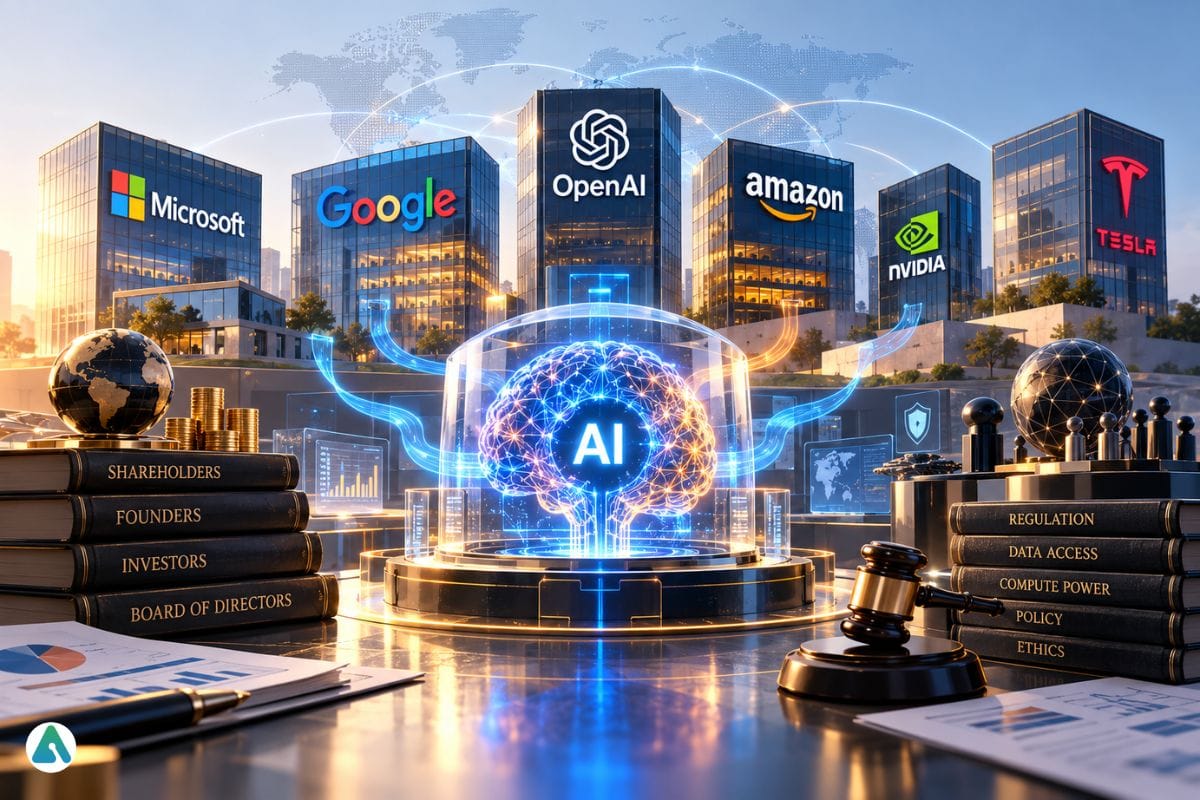

Each major AI lab separates economic ownership from decision-making control in its own way. Founders, nonprofits, and trusts often keep final authority, even when outside investors hold large stakes.
The table covers the largest U.S. frontier labs and platform owners. It isn’t a full list. Mistral, DeepSeek, Alibaba’s Qwen team, Cohere, and others make any “five companies own AI” story too simple.
| AI Product | Company | Latest Public Ownership Disclosure | Who Controls | In-House Chips | Own Cloud |
|---|---|---|---|---|---|
| ChatGPT | OpenAI Group PBC | Oct 2025: Foundation 26%, Microsoft ~27%, others 47% | OpenAI Foundation board | In development | No |
| Gemini | Alphabet / Google DeepMind | Public company filings | Page and Brin via Class B shares | Yes (TPUs) | Yes |
| Meta AI, Llama, Muse | Meta Platforms | Public company filings | Zuckerberg via super-voting shares | Partly (MTIA) | Own data centers |
| Grok | SpaceXAI (inside SpaceX) | Feb 2026 acquisition by SpaceX | Elon Musk | No | Own Colossus clusters |
| Claude | Anthropic PBC | Full percentages never published | Board, Long-Term Benefit Trust, founders | No | No |
OpenAI and ChatGPT
OpenAI Group PBC owns ChatGPT, and the nonprofit OpenAI Foundation controls it. After the October 2025 restructuring, the Foundation held a 26% stake and employees and investors held 47%. OpenAI’s structure page puts Microsoft at roughly 27%.
Those are the latest publicly disclosed percentages. OpenAI has not published a newer complete cap table since its large 2026 funding round, so don’t read them as the September 2026 split.
Control runs the other way. The Foundation appoints and can replace all OpenAI Group board members. The Microsoft relationship has also loosened. One tracker reports that the two companies announced a revamped partnership agreement in April 2026.
The pressure point is cash. Our coverage of OpenAI’s projected 2026 losses shows why every funding round reshapes who has a claim on the company.
Google Gemini
Alphabet owns Gemini through Google DeepMind. It trades publicly, but co-founders Larry Page and Sergey Brin keep outsized voting power through Class B shares.
Google is unusual in holding several layers of the stack in-house: its own TPU chips, Google Cloud, and data from Search, YouTube, and Android. It still depends on TSMC to make those chips.
Meta AI
Meta Platforms owns Meta AI, and Mark Zuckerberg controls the company through super-voting shares.
Meta’s distinctive move is releasing model weights. In August 2026, CNBC reported that Zuckerberg said Meta would open the weights for its Muse Spark 1.2 model. Releasing weights spreads Meta’s models widely, but Meta keeps the license, and the license sets the rules.
SpaceXAI, Grok and Elon Musk
Elon Musk doesn’t own AI, but he controls one major lab. In February 2026, SpaceX acquired xAI, which owns X and develops Grok, in an all-stock transaction.
A July 2026 rebrand to SpaceXAI changed the name, not the legal structure or ownership. Grok’s training runs on the company’s Colossus supercomputers in Memphis and Mississippi. Musk co-founded OpenAI in 2015 but left its board in 2018.
Anthropic and Claude
Anthropic owns Claude and runs as a Delaware public benefit corporation. Its governance is changing fast.
The Long-Term Benefit Trust holds non-economic stock that, according to August 2026 reporting, lets it elect a majority of the company’s seven-member board. Trustees hold no equity.
A second change is underway. The Information reported on August 18, 2026, that Anthropic plans to give CEO Dario Amodei and his co-founders shares with enhanced voting rights ahead of a possible IPO, while keeping the Trust. The same report put Amodei’s personal stake at roughly 2%.
Outside backers sit apart from both layers. Amazon holds no voting shares or board seats, and Google’s stake is capped at 15% with no votes or board seats. Anthropic’s compute leans heavily on outside providers. The company announced a commitment of more than $100 billion over ten years to AWS infrastructure.
Open-Weight AI Models: What Your Business Actually Gets
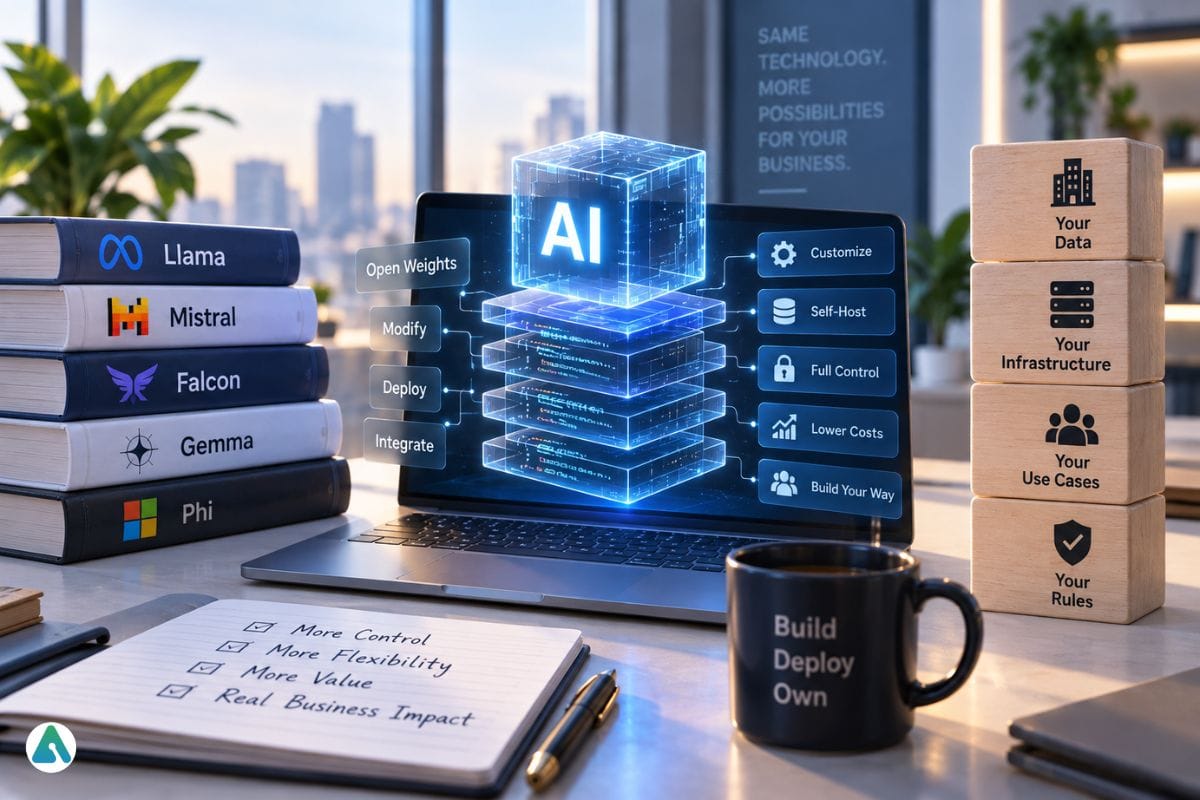

An open-weight model is an AI model whose trained parameters you can download and run yourself. Downloading the weights gives you permission under a license. It doesn’t make you the owner.
Open weights are not the same as open source
These terms get used interchangeably, and they shouldn’t be.
- Open weights: You can download the model’s parameters.
- Open source: The license meets a formal open-source definition, with no bans on particular users or uses.
- Commercially permissive: You can use it in a business, under stated conditions.
Llama shows the gap. Meta markets Llama as open source, but the definition-setting bodies reject that label because Llama’s license discriminates against certain users and uses. The Free Software Foundation reached the same conclusion.
License status by release
The table lists specific releases, because licenses can change between versions of the same family. Summaries below were reviewed on September 23, 2026. Always confirm against the model’s own license file before you ship.
| Model Release | License | Main Commercial Condition |
|---|---|---|
| gpt-oss (OpenAI) | Apache 2.0 | Keep license notices |
| Gemma 4 (Google) | Apache 2.0 | Keep license notices |
| DeepSeek V4 | MIT | Keep license notices |
| GLM-5.2 | MIT | Keep license notices |
| Llama 4 (Meta) | Llama Community License | Separate license above 700M monthly users |
| Qwen (Alibaba) | Varies by release | Some releases add revenue gates |
| Mistral | Varies by release | Some releases add revenue gates |
Sources for the table: gpt-oss, Gemma 4, DeepSeek V4, and GLM-5.2 per a mid-2026 license roundup; Llama 4 per Meta’s license terms, which also add an acceptable-use policy and naming rules. For Qwen, one review found a single release under Apache 2.0 and two under bespoke terms. For Mistral, some releases require companies earning over $20M a month to get a custom license.
One detail catches teams out. Gemma 1 through 3 shipped under Google’s restrictive terms, while Gemma 4 moved to Apache 2.0. Checking the family name once isn’t enough.
Who Owns AI-Generated Content? Contract, Copyright and Indemnity
Owning AI-generated content involves three separate questions. What did the provider promise you in its terms? Does copyright law protect the output at all? And who pays if someone claims the output infringes their work?
The copyright discussion below uses U.S. law, because the leading cases and Copyright Office guidance are American. Other countries, including the UK, EU members, China, India and Pakistan, can apply different authorship rules to AI output.
Contract rights: what the provider gives you
Most major providers pass output rights to the user. OpenAI’s Terms of Use assign OpenAI’s right, title and interest, if any, in Output to the user, and commercial use is generally permitted.
Conditions apply. OpenAI’s terms, for example, bar using output to develop models that compete with OpenAI. Some other providers keep a license back to your output, so check the clause for your exact plan.
Copyright: what U.S. law protects
U.S. copyright requires a human author. The D.C. Circuit held in March 2025 that the Copyright Act requires eligible work to be authored in the first instance by a human being. On March 2, 2026, the Supreme Court declined to hear the appeal, leaving that ruling in place.
That case involved a work its creator said a machine made on its own. For the more common case of AI-assisted work, the Copyright Office’s position is more nuanced. Its Part 2 report on copyrightability says AI output is protected only where a human author determined sufficient expressive elements. That can include perceptible human-authored material or creative arrangement and modification, but not the mere provision of prompts.
The Office also confirms that using AI as an assistant, or including AI material in a larger human work, doesn’t bar copyright. The test is creative human contribution, not the percentage of text you rewrote.
| Situation | Contract Rights | U.S. Copyright Question |
|---|---|---|
| Raw AI output | Set by provider terms | Human authorship may be absent |
| AI output you creatively arranged or modified | Set by provider terms | Your human-authored elements may be protected |
| Human work with some AI material inside | Set by provider terms | The human work can still be protected |
| Material you uploaded | Separate from the output | Your existing rights continue |
Indemnity: who pays if you’re sued
For businesses, this may matter more than ownership. Since 2023, several providers have offered to defend some customers against copyright claims over AI output.
- Microsoft introduced its Copilot Copyright Commitment in 2023.
- Google said it would indemnify Cloud and Workspace customers for claims tied to both its training data and generated output.
- OpenAI’s Copyright Shield covers ChatGPT Enterprise and the API.
- Anthropic updated its commercial terms to indemnify enterprise API customers against copyright claims from authorized use.
These protections usually cover paid business tiers, not free consumer accounts. They also come with caveats and conditions, which in some cases include limits on the provider’s liability. Read the current version of your contract, because these terms change. For high-stakes work, talk to an IP lawyer in your jurisdiction.
Where AI Power Is Concentrated Around the World
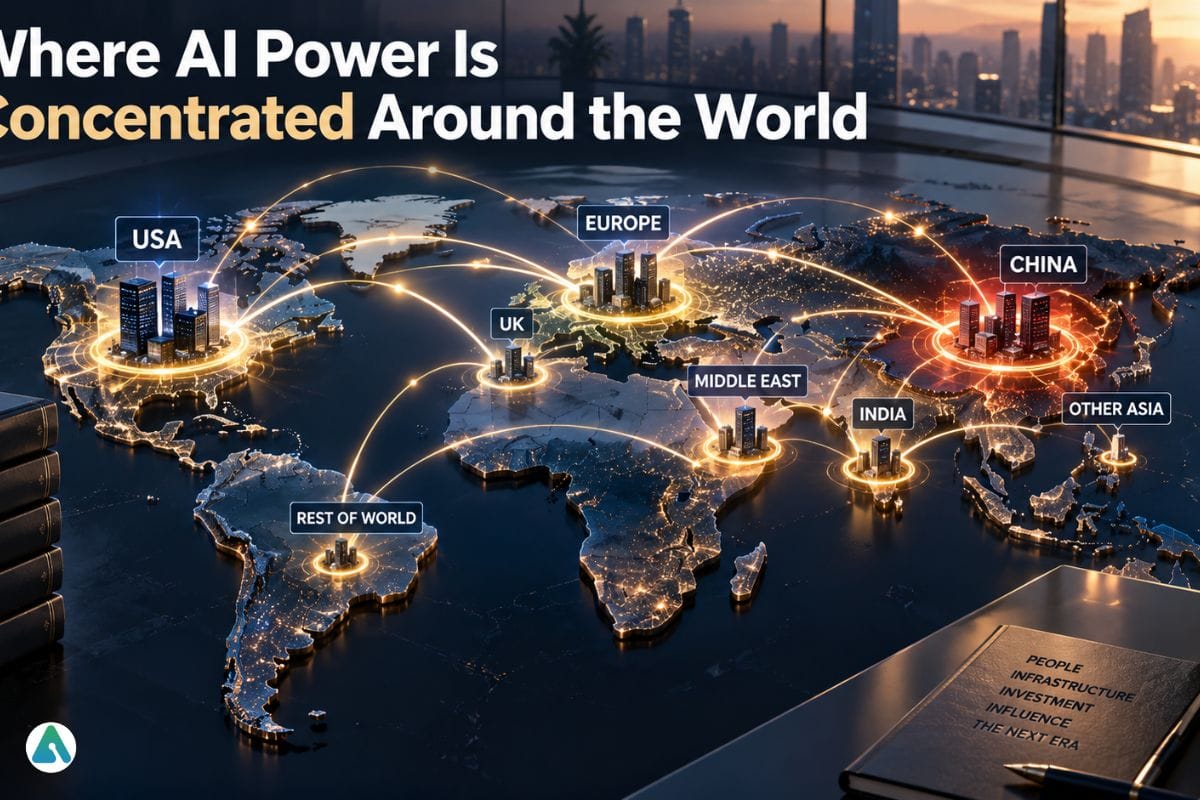

No country owns AI. Different parts of the supply chain concentrate in different countries, so the answer changes depending on which layer you ask about.
Models and investment: the United States and China
The Stanford AI Index’s research chapter reports that the U.S. produced 59 notable models in 2025 to China’s 35, while China leads in publication volume, citations, and patent grants.
The investment gap is far wider. Stanford’s main 2026 report found that U.S. private AI investment reached $285.9 billion in 2025, more than 23 times China’s $12.4 billion. Stanford cautions that private figures likely understate China’s total spending because of government guidance funds.
Hardware: Taiwan, South Korea and the U.S.
Leading chip fabrication concentrates in Taiwan through TSMC. High-bandwidth memory concentrates in South Korea through SK Hynix and Samsung, with Micron as the main U.S. supplier. Chip design leadership sits mostly with U.S. firms.
Sovereign AI: governments want a stake
Governments are building their own capacity. Stanford notes that state-backed investments in AI supercomputing are rising, a sign of growing ambitions for domestic control over AI ecosystems.
How to Check Who Controls an AI Tool
Before you build a workflow or product on any AI tool, work through these five checks:
- Find the underlying model. Many apps wrap GPT, Claude, Gemini, or Llama, so the app maker may control very little.
- Identify the decision-maker. Look for super-voting founders, nonprofit parents, or trusts, not just the largest investor.
- Map the dependencies. Note the provider’s cloud, chip, and region, since outages and export rules travel downstream.
- Read three clauses. Check output rights, banned uses, and indemnity for your exact plan.
- Verify the license version. For open-weight models, confirm user caps, revenue gates, and attribution rules for that specific release.
This matters more now that chatbots act for you. Tools that book, buy, and send messages carry more legal and operational risk, as we cover in how AI chatbots moved beyond conversation.
So, Who Actually Owns AI?
The honest answer comes in layers:
- Nobody owns AI as a field of science.
- Companies own specific models, software, datasets, and infrastructure.
- Investors own economic interests in those companies.
- Boards, foundations, trusts, and super-voting founders hold control, often separately from the biggest shareholders.
- Chip, memory, cloud, and power suppliers create dependency without owning the labs.
- Governments hold leverage through export controls and regulation.
- Licenses decide what you’re permitted to do with open-weight models.
- U.S. copyright law protects the human-authored parts of AI-assisted work, and nothing a provider promises can change that.
Transparency is heading the wrong way at the model layer. Stanford reports that training code, parameter counts, dataset sizes, and training duration are no longer disclosed for several of the most resource-intensive systems. Coming IPO filings should reveal more about who owns these companies, even as their models get harder to inspect.
Frequently Asked Questions
Q. Does Elon Musk own AI?
No. Elon Musk controls one AI lab, SpaceXAI (formerly xAI), which develops Grok and became part of SpaceX in February 2026. He co-founded OpenAI in 2015 but left its board in 2018.
Q. Who owns ChatGPT?
OpenAI Group PBC owns ChatGPT, and the nonprofit OpenAI Foundation controls its board. Microsoft is the largest outside shareholder, holding about 27% at the October 2025 restructuring.
Q. Who owns the most powerful AI?
The most capable models come from a small group of labs: OpenAI, Google DeepMind, Anthropic, SpaceX AI, and Meta in the U.S., plus Chinese labs such as DeepSeek and Alibaba. Rankings change often, so no single company holds the top spot for long.
Q. Who is the mastermind behind AI?
No single person created AI. Alan Turing asked whether machines can think in 1950. John McCarthy coined the term “artificial intelligence” for the 1956 Dartmouth workshop. Geoffrey Hinton, Yann LeCun and Yoshua Bengio won the 2018 Turing Award for the deep learning methods behind today’s systems.
Q. Is open-weight AI the same as open-source AI?
No. Open weights means you can download a model’s parameters. Open source means the license meets a formal open-source definition. Meta’s Llama, for example, is open-weight but restricts some users and uses, so standards bodies don’t classify it as open source.
Q. Can I copyright content I make with AI?
In the U.S., only the human-authored parts qualify. The Copyright Office says prompts alone aren’t enough, but creative arrangement or modification of AI output, or human work that includes AI material, can be protected. Rules differ in other countries.
Q. Will an AI company defend me if its output infringes copyright?
Sometimes. Microsoft, Google, OpenAI, and Anthropic have offered copyright indemnity to certain paid business customers, subject to conditions. Free consumer plans typically aren’t covered, so check your specific contract.
Related: Does Google Own Claude AI? Anthropic’s Ownership
| Disclaimer: AI ownership, company structures, and legal rules can change quickly. This guide reflects publicly available information as of September 2026; ownership figures and control arrangements may change after publication. |
