

Any Conversation sells one idea, printed under its logo on every page: AI characters that remember you.
So I signed up, built two characters, and ran a controlled roleplay to see what the free tier actually delivers. Character consistency and in-context tracking both held up well. However, the memory that anchors the marketing sits entirely behind a $19.99/month paywall.
This review stays deliberately narrow about what it proves. One session per character is enough to judge writing quality and character coherence, but nowhere near enough to judge long-term memory.
Quick Verdict
Any Conversation suits users who want character continuity handled automatically, though I would not call the $19.99 Premium plan proven value yet. My testing found strong character consistency and reliable in-session tracking, while the platform’s defining long-term memory stays unverified because it sits behind the paywall.
| Category | Rating |
|---|---|
| Character creation | 9/10 |
| Character consistency | 8.5/10 |
| Customization | 9/10 |
| Privacy transparency | 8.5/10 |
| Free tier usefulness | 7/10 |
| Pricing and value | 6.5/10 |
| Memory | Not rated — untested |
| Overall | 7.8/10, pending a paid memory test |
Memory deliberately carries no score. Rating a feature I could not access would undermine everything else in this review.
Any Conversation at a Glance
| Platform type | AI character chat and roleplay, web-based |
| Memory system | Smart Memory — AI-generated conversation summaries |
| Free tier | Unlimited messages, 3 custom characters, ad-supported, no long-term memory |
| Paid tiers | Premium $19.99 · Premium+ $29.99 · Ultimate $49.99 per month |
| Annual discount | Advertised at 17% |
| Character import | Tavern, Silly Tavern, Janitor JSON cards |
| Starter characters | 124+ across 15 genres (company figure, September 2026) |
| Persona system | Assign both your character and theirs per conversation |
| Editing tools | Edit any message, reroll any reply |
| Voice | Input on all tiers; output paid only |
| Model access | Native models on Free–Premium+; Ultimate advertises “Gemini Pro AI” |
| Age check | Self-declared 18+ checkbox |
| Data hosting | Google Cloud, United States |
| Payment processor | Epoch |
How I Tested Any Conversation
Transparency about conditions matters more than volume, so here is exactly what happened.
I registered a free account on August 29, 2026 and built two characters from scratch through the platform’s own form: Daniel Anderson, a British senior product manager, and Ramal a English speaking business partner. Neither was imported.
For the primary test, I ran a roleplay with Daniel Anderson using the persona system — Your Character: SEO Professional, Their Character: Daniel Anderson — plus a populated Scenario field establishing that his company’s rankings and organic traffic were declining.
That Scenario field is a confound I need to declare. Because the premise was supplied as standing context, any later reference to it demonstrates the Scenario field working rather than memory. Therefore I have excluded it from the memory findings entirely.
Two conversations came out of it. Daniel Anderson logged 10 messages at 14:12, while Ramal logged 8 at 13:42 — same afternoon, no resumed session, no paid account. That is the whole evidentiary base.
What passed
| Test | What it demonstrates | Result |
|---|---|---|
| Character creation | Two characters built from scratch, no errors | ✅ Passed |
| Persona assignment | Both sides of the roleplay set and retained | ✅ Passed |
| Scenario field | Premise held as standing context throughout | ✅ Passed |
| Voice consistency | No drift across ten messages | ✅ Passed |
| In-context tracking | Model-introduced facts stayed straight | ✅ Passed |
| Message editing | Any message editable in place | ✅ Passed |
| Free-tier gating | Relationship and journals confirmed locked | ✅ Passed |
Observed but not fully tested
Some features were visible and partially exercised without being put under real pressure. JSON import sits in the creator and is documented, though I built both characters manually. Voice input appears in the message bar on the free tier, while voice output does not. The reroll control is present alongside message editing, which I did test. Treat these as confirmed to exist rather than confirmed to work well.
What a free-tier test can’t reach
Persistent memory, relationship tracking, character journals, voice output and Quality Mode all sit behind Premium. Since I ran a free account, none of them were tested — not failed, not tested.
The memory questions that would actually settle this review need conditions I didn’t create: a resumed session, a multi-day gap, a corrected fact, a deliberate contradiction, and a second character queried about the first. All five remain open.
Two features rest on the company’s word alone: the clear-memory control and the deeper-history recall, both announced in their July 29, 2026 update. Two further claims sit lower still, because I found no supporting evidence either way — that character journals influence later behaviour, and that minor-coded content is blocked at the system level.
Drawing that boundary is precisely the part most reviews of this platform skip.
Any Conversation Character Creation and Customization
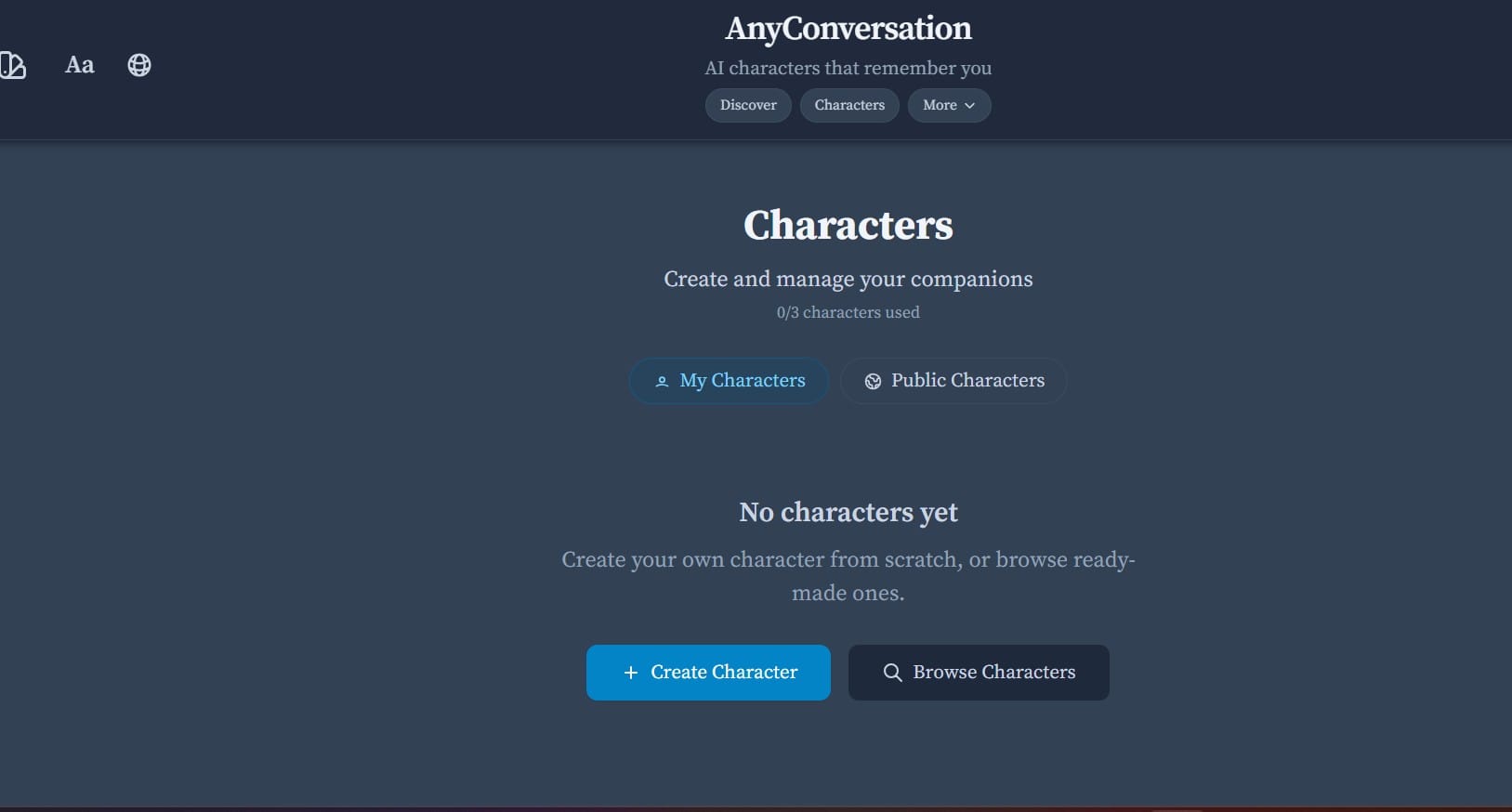

The builder runs more thorough than most free tiers bother with, and it produced usable characters in under five minutes each.

Basic Information covers name, age, and a Form dropdown defaulting to Human. That dropdown carries a design note I liked, namely that non-human characters “stay true to what they are instead of acting like a person in costume.” In practice, a dragon behaves as a dragon.
The description box nudges toward 200–500 words, although my Ramal description landed at 172 — below the recommendation, and worth knowing as context for output quality.
Appearance offers a Subject picker feeding an avatar generator. Previews cost nothing, while only Generate consumes a credit, which is a fairer split than most.
One documentation contradiction worth flagging. Their Janitor alternative page answers “Can I import my Janitor AI characters?” with not directly. Yet the creator screen says the opposite: “Have a Tavern / Silly Tavern / Janitor character card? Click Import JSON to pre-fill the form.” Because the feature clearly exists, the page targeting Janitor switchers is out of date and costing them that exact audience.
Any Conversation Response Quality and Character Consistency
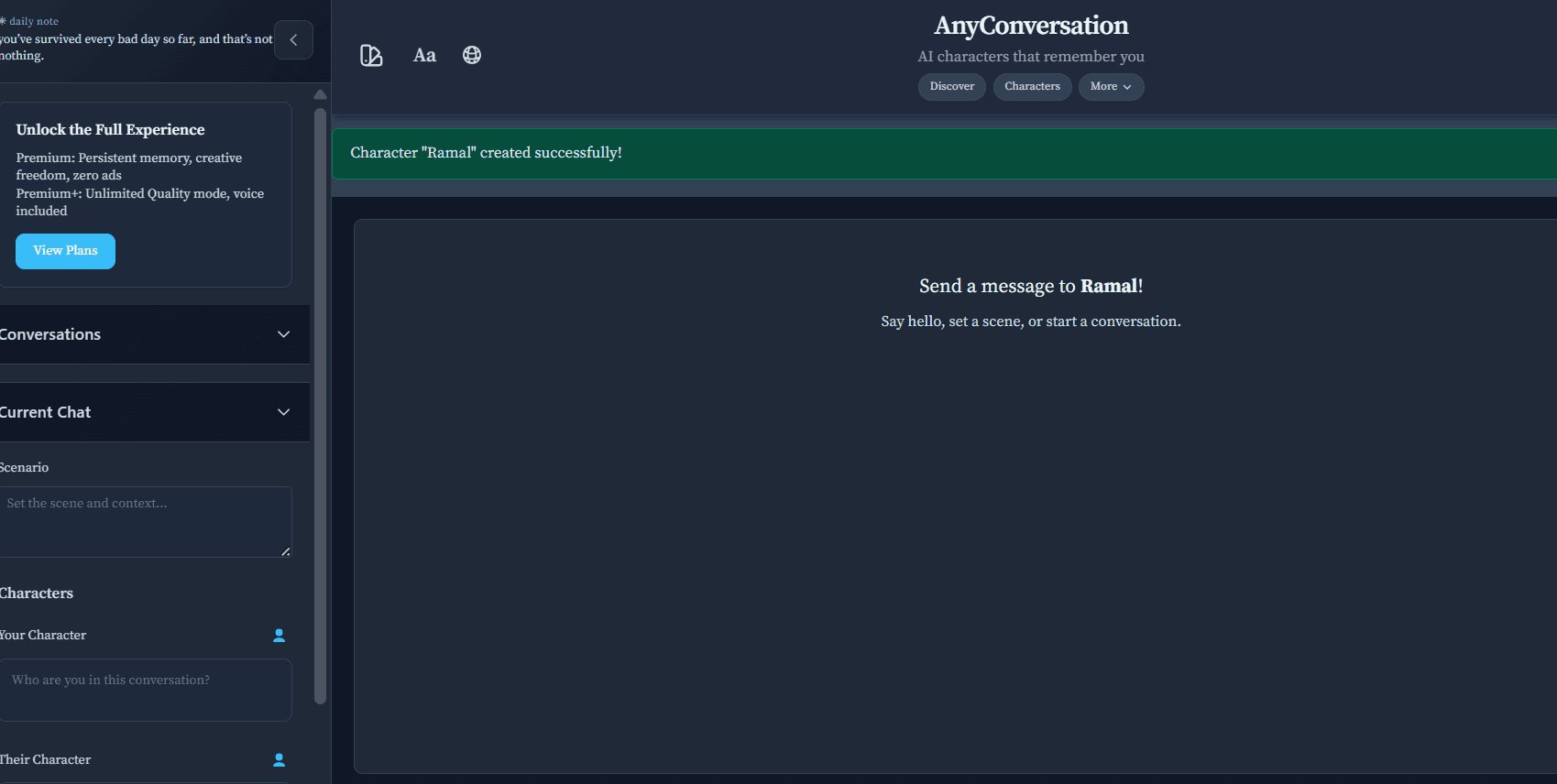
The prose held. Formatting stayed consistent across all ten messages, with no drift into assistant-speak, which is the standard failure mode in this category once a scene runs on.
More telling, though, was that the character generated its own specifics instead of only reacting to mine.

Daniel Anderson introduced and then tracked a February migration, redirect chains never fully cleaned up, pages lost in the shuffle, a dev team insisting the data was fine, and three agencies promising page-one rankings in thirty days on six-month contracts. He also pushed back rather than agreeing, asking how I would structure a fix if the migration turned out to be the root cause.

That is competent narrative structure rather than plausible sentence generation, and it is the strongest thing about the product.
One caveat, however. Ten messages sit comfortably inside any modern context window, so this tells you nothing about what happens after you close the tab.
Any Conversation Memory Explained: What Smart Memory Actually Does
This is the section that matters, so precision beats repeating the marketing.
What Smart Memory is
Any Conversation’s privacy policy names the system Smart Memory and defines it as AI-generated summaries of your conversations, stored to give characters context across sessions.
That detail is architecturally meaningful, yet almost nobody reports it. Summarisation-based memory differs sharply from raw transcript retrieval or vector search over full history, because summaries compress and compression loses things in predictable ways. Therefore a system like this should handle “what’s my deadline” comfortably while struggling more with “you said Monday, then Thursday, which is it.” To be clear, that is a hypothesis about the architecture rather than a finding.
Their July 29, 2026 update claims long relationships now recall moments from far deeper in shared history. Company claim, untested here.
One architectural caveat belongs alongside that. The privacy-policy definition above is the most technically specific description I could find on their site, yet their marketing elsewhere describes memory in considerably richer terms. Because I could not locate a technical explainer reconciling the two, I treat the implementation details as company claims rather than verified architecture, and I would encourage anyone quoting a specific mechanism to do the same.
The Memory toggle is misleading
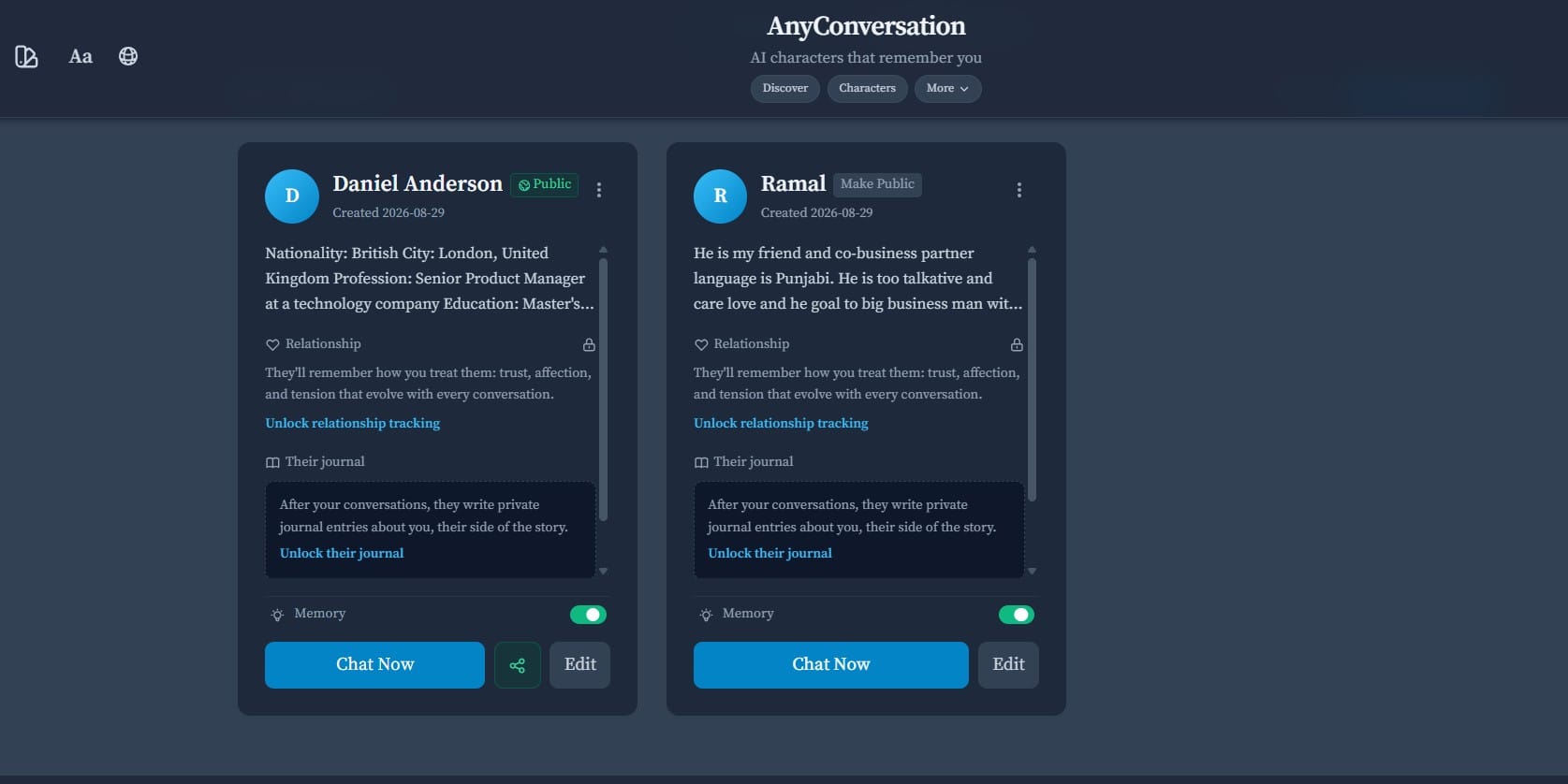

Every character card ships with a Memory toggle switched on by default, on a tier whose pricing page explicitly says “No long-term memory.”
The toggle governs current-conversation context, whereas Smart Memory governs retention across sessions. However, nothing in the interface draws that line, so a new user seeing an active green toggle labelled “Memory” would reasonably assume the headline feature is already running.
The padlocks above it are useful evidence, though, since they confirm that Relationship and Their journal are gated even though the billing table never itemises them.
You can clear memory, but you can’t edit it
A clear-memory control shipped in the July 29 update, and the privacy policy confirms you can delete individual conversations at any time.
Neither gives you granularity, though. If the system reads a throwaway line as a core fact, or stores something from a scene you later retconned, your options are living with it or wiping the character. Because there is no inspection panel, you cannot even confirm the bad memory exists.
Ultimately that is the sharpest structural criticism of the product, and it is precisely where its main competitor has spent 2026 building in the opposite direction.
Day-to-Day Usability
The sidebar is the best-designed part of the interface. Conversations carry timestamps and message counts, while the Scenario field stays editable as you write. Both persona slots also sit in view rather than buried in settings.
Message editing plus reroll gives real authorial control over the transcript, which is genuinely useful for long-form writing and absent from several competitors.
A few smaller notes. A rotating daily-note widget sits top-left, and the message bar carries persona, image, settings, full screen, idea, and microphone controls alongside a gold PREMIUM badge. Saving a new character drops you into an empty chat with no greeting, although their August 25 update added an option for characters to speak first, which I did not enable.
Any Conversation Pricing: Is Premium Worth $19.99?
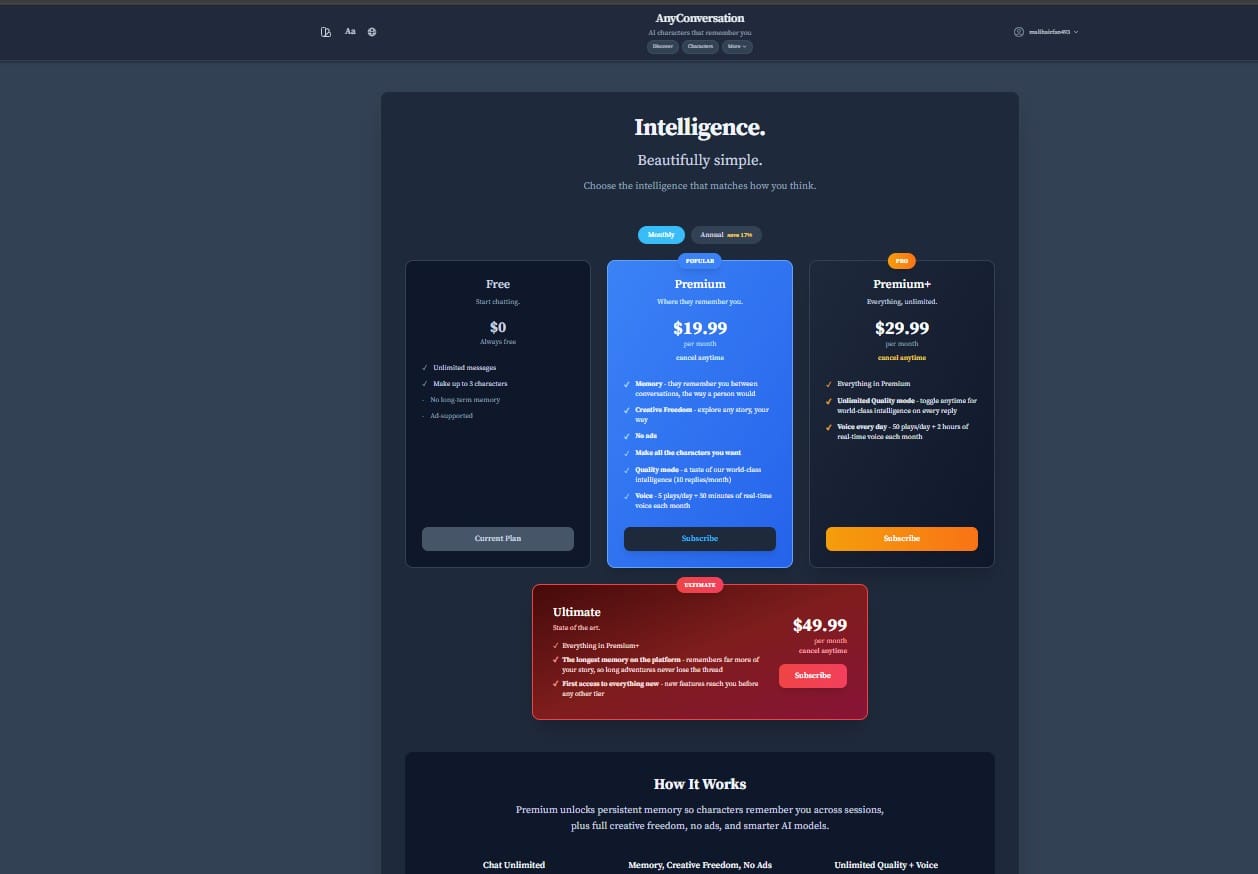

| Tier | Price | Included |
|---|---|---|
| Free | $0 | Unlimited messages, 3 characters, ad-supported |
| Premium | $19.99/mo | Memory between conversations, Creative Freedom, no ads, unlimited characters, Quality Mode (10 replies/mo), voice (5 plays/day + 30 min/mo) |
| Premium+ | $29.99/mo | Unlimited Quality Mode, voice (50 plays/day + 2 hrs/mo), Director Mode, Book Mode |
| Ultimate | $49.99/mo | Longest memory tier, “Gemini Pro AI”, early feature access |
The structural problem is that the trial cannot demonstrate the product. Free shows writing quality, character depth, and the full builder, but none of the memory, relationships, or journals. In other words, you pay before you can evaluate the one thing that differentiates the platform.
What each upgrade actually buys
Free to Premium is the meaningful jump, since it unlocks persistent memory, Creative Freedom, unlimited characters, ad removal, ten Quality Mode replies, and a small voice allowance. Premium to Premium+ buys unlimited Quality Mode plus a much larger voice budget, along with Director Mode and Book Mode. Premium+ to Ultimate buys longer memory, early feature access, and what their marketing calls “Gemini Pro AI.”
| Tier | Verdict |
|---|---|
| Free | Best for judging writing quality before you commit |
| Premium | Worth it only if memory is why you came |
| Premium+ | Worth it if Quality Mode or voice matters to your workflow |
| Ultimate | Hardest to justify, since the headline upgrade has no published measurement |
The problem isn’t that Ultimate offers more memory. It’s that “more” isn’t measurable. You pay $30 above Premium for a quantity with no published number attached. By contrast, Spicy Chat and Crush On AI price memory in context tokens you can actually compare.
Their own pages also disagree on tier contents. For example, the Janitor alternative page says Premium+ “adds Quality Mode,” while the billing page says Premium already includes it at ten replies monthly and Premium+ makes it unlimited. Similarly, the About page describes the free tier as having “limited messages” although the billing page says unlimited. Throughout this review I have followed the billing page as the more specific source.
One workaround worth knowing: the Scenario field is not gated, and Scenarios became a first-class feature with their own Discover tab in the August 25 update. Paste your established facts there. Admittedly it is static and you are doing the system’s job manually, yet it lets you judge character voice properly before paying to discover whether the memory delivers.
Is Any Conversation Safe? Privacy, Data and Age Verification
Their privacy policy, last updated July 31, 2026, runs more specific than most in this category. That counts for something, because the product is built on storing a profile assembled from your conversations.
What it stores and where it goes
The stored set covers chat history, the characters and personas and scenarios you write, Smart Memory summaries, generated images, IP address, device identifiers, and Google Analytics data. Messages then go to external AI providers which, per the policy, do not use them to train their general models. Everything sits on Google Cloud in the United States.
Device identifiers get collected specifically to enforce bans and prevent ban evasion. Notably, the policy says so plainly, which is unusual enough to credit.
How enforcement and deletion work
Several decisions about your account run automatically. Both user messages and AI responses are screened in real time, while repeated violations can trigger suspension without prior notice. Devices tied to banned accounts also get blocked from creating new ones, although you can request human review by email.
Deletion works asymmetrically. Conversations and accounts can be deleted, with that content held in a brief safety quarantine before permanent purge. However, safety strike records survive indefinitely, so deleting your account does not mean no record of you remains.
Otherwise you hold rights of access, correction, deletion, objection and restriction, backed by a 30-day response commitment, with CCPA rights on top for California residents. The policy also states they do not sell personal information.
Content policy and age verification
Every character carries an 18+ designation, and Premium adds a “Creative Freedom” policy for mature themes, marketed as no filter walls mid-scene. Since automated screening runs on all tiers regardless, Creative Freedom widens the permitted range without removing moderation. My professional roleplay scenario hit no friction, which admittedly tested nothing. Verify the boundaries yourself if content policy decides your purchase.
Age verification is a self-declared checkbox with no additional step at any tier. By contrast, Character.AI now runs signal-based age assurance that can escalate to a Persona selfie scan and government ID, while Janitor AI requires documents in Brazil, Australia and the UK. Because I have only tested Any Conversation’s onboarding directly, treat that as a factual difference rather than a ranking.
One last thing to catch before you share anything. Characters can be set Public from the card menu, and Daniel Anderson was Public during my session, so check that toggle if your description contains anything personal.
What this actually means for you. If you use Any Conversation for personal roleplay, assume your conversations become part of the platform’s stored account data. The useful question isn’t whether data gets collected, since the policy plainly says it does. Rather, it’s whether you are comfortable with that data being retained and processed to power memory, safety screening, analytics, and service delivery. For most casual users that trade is unremarkable; for anyone writing genuinely personal material into a character, it deserves a moment’s thought. Our breakdown of whether Janitor AI is safe covers how these platforms compare on data handling generally.
Any Conversation vs Character.AI, Janitor AI and Other Alternatives
Evidence note: I tested Any Conversation hands-on. Competitor entries come from official documentation, product pages, and third-party reviews, not equivalent firsth and testing.
| Platform | Memory approach | Can you inspect it? | Model access | Entry paid price | Tested here? |
|---|---|---|---|---|---|
| Any Conversation | Automatic summaries | No | Native; Ultimate advertises Gemini Pro | $19.99/mo | Free tier only |
| Character.AI | Facts, Story Memory, Lore books | Yes | Native | c.ai+ | No |
| Janitor AI | Manual lore field + context window | Yes, you write it | Bring your own API key | Free core | No |
| Silly Tavern | Fully user-configured | Yes, extensively | Any model | Free, self-hosted | No |
| Spicy Chat | Tiered context (approx. 4K–16K) | Partly, via Memory Manager | Native | ~$5/mo | No |
| Crush On AI | Tiered working memory (8K–24K) | Partly, tier-based | Native | ~$5.99/mo | No |
Character.AI is the strongest counterargument to Any Conversation’s design. Its 2026 rebuild added Story Memory, pinned messages, auto-generated Facts users can view and delete, a Memory Usage visualisation, and July’s Lorebooks for keyword-triggered world knowledge. Consequently, when its memory gets something wrong, you open a panel and fix it.
Janitor AI goes the other way, since you write the persistent context yourself and typically connect an external model for depth. Any Conversation’s own comparison page claims Janitor “resets every conversation,” though that is a vendor claim about a competitor. Our architecture breakdown covers the mechanics properly.
Silly Tavern sits at the maximum-control end: self-hosted, model-agnostic, complete authority over prompt structure, albeit at the cost of setup effort. Because Any Conversation imports Silly Tavern cards, it becomes a plausible landing spot for anyone burnt out on configuration.
Spicy Chat and Crush On AI both sell memory as a published number, which is the sharpest contrast with Any Conversation’s unquantified tiers. Notably, one published Crush On hands-on reported cross-character memory bleed on shared community characters, enabled by default. That is the exact leakage scenario nobody has tested on Any Conversation, including me.
Worth flagging that Any Conversation’s own comparison page still describes Character.AI as having no persistent memory and conversations that reset every session. Given Character.AI shipped Facts, Story Memory and Lore books during 2026, that page is out of date, which is a second reason to treat vendor comparison tables as marketing rather than research.
Which one should you pick?
| If you want… | Pick |
|---|---|
| Continuity without configuring anything | Any Conversation |
| Memories you can view, edit and delete | Character.AI |
| Your own model behind the character | Janitor AI or Silly Tavern |
| Maximum control over prompts and context | Silly Tavern |
| A measurable memory spec | Spicy Chat or Crush On AI |
| The lowest paid entry point | Spicy Chat or Crush On AI |
More options in our Character.AI alternatives roundup.
What Other Any Conversation Reviews Miss
Four gaps recur across the existing coverage.
Most reviews report memory as tested when it isn’t, describing recall in general terms without stating session counts, gaps, or whether a Scenario field was populated. Second, the Memory toggle problem goes unmentioned everywhere I looked. Third, no coverage names Smart Memory or identifies it as summary-based, even though that single detail reframes what the system can reasonably do.
Finally, the internal contradictions go uncaught despite being findable in an afternoon on the company’s own site:
- Starter character counts differ across pages, with 124+ on the blog against higher figures elsewhere
- The Janitor alternative page says card import doesn’t work, while the creator screen offers it
- One page says Premium+ “adds Quality Mode,” while the billing page says Premium already includes it
- The About page says the free tier has limited messages, while billing says unlimited
- Their Character.AI comparison still claims that platform has no persistent memory, which stopped being true in 2026
- Ultimate is described as including “Gemini Pro AI” on the blog but only as “world-class AI” on the roleplay landing page
None of these are fatal individually. Together they mean you should verify any AnyConversation claim against the billing page rather than the marketing pages.
Any Conversation Pros and Cons
What works. Character consistency held cleanly, since the model generated its own specifics and pushed back rather than agreeing. Besides that, the builder is detailed and fast, message editing and reroll give real authorial control, and persona assignment is well designed. JSON import means existing characters transfer, avatar previews cost nothing, and the privacy policy is unusually specific. Finally, the shipping pace is real, with six substantial updates between June and August 2026.
What doesn’t. Memory is entirely paywalled, so the trial cannot demonstrate the product. Moreover, stored memories cannot be inspected or edited, only cleared. Quality Mode’s ten-reply cap is thin at the entry paid tier, while the company’s own pages contradict each other in several places. Age verification remains a bare checkbox, and there is no API key or proxy setup for bringing your own model.
Who Should Use Any Conversation
Consider it if you write long-form roleplay, want continuity handled automatically rather than configured, and find the relationship and journal concepts appealing enough to pay before verifying them. Above all, you need to be comfortable not auditing what the system stores.
Skip it if you want to inspect and correct what an AI remembers, would rather connect your own model, need a measurable memory spec instead of a marketing tier, or refuse to pay for a headline feature you cannot trial.
Start free either way, because the writing quality is what you are really buying at $19.99, and that much you can assess before committing.
FAQs
Q. Does Any Conversation remember previous chats?
According to their billing page, yes on Premium and above. I didn’t test it — my sessions were 30 minutes apart on the same day and neither was resumed. What I confirmed was in-context coherence across ten messages, which any modern model handles regardless of memory features.
Q. Is Any Conversation free?
There’s a free tier with unlimited messages and three custom characters. The pricing page explicitly lists “No long-term memory” for it.
Q. How much does Any Conversation cost?
$19.99/month (Premium), $29.99/month (Premium+), or $49.99/month (Ultimate), with annual billing advertised at 17% off.
Q. What is Smart Memory?
Any Conversation’s memory system. Their privacy policy defines it as AI-generated summaries of your conversations, stored to give characters context across sessions — summarisation-based rather than full-transcript retrieval.
Q. Why is the Memory toggle on if I’m on the free tier?
It controls current-session context, not cross-session retention. Persistent memory is a separate Premium entitlement, and the interface doesn’t explain the difference.
Q. Can you delete what Any Conversation remembers?
You can clear a character’s memory entirely and delete individual conversations. There’s no way to inspect stored memories or remove one while keeping the rest.
Q. Does Any Conversation train AI on my conversations?
Their privacy policy states the external providers processing your messages don’t use the data to train their general models. Data is stored on Google Cloud in the United States.
Q. Is Any Conversation uncensored?
All characters are 18+ and Premium adds a Creative Freedom policy for mature themes, but automated screening runs on all tiers, so it widens the range rather than removing moderation.
Q. Does Any Conversation support character cards?
Yes — JSON import from Tavern, Silly Tavern and Janitor AI, confirmed in the character creator, despite their own Janitor page saying otherwise.
Q. Any Conversation vs Character.AI — which is better for memory?
They’re architecturally opposed rather than better or worse. Any Conversation automates memory and hides the controls; Character.AI exposes Facts, Story Memory and Lore books to inspect and edit. Neither has been benchmarked against the other under identical conditions.
Q. Does Any Conversation allow external AI models?
Not in the way Janitor AI or Silly Tavern do, since there is no API key field or proxy setup. However, a flat “no” would be wrong. Any Conversation’s own comparison blog describes the $49.99 Ultimate tier as including “Gemini Pro AI,” which is Google’s model rather than a house one. Whether that means genuine third-party routing or simply marketing shorthand for a Gemini-powered backend is unclear from their pages. My testing stayed on the free tier, so I have not verified it either way.
Final Verdict
Any Conversation is a well-built character platform with a real writing engine behind it. Across the session I ran, the character generated its own detail, tracked what it had established, and pushed back instead of agreeing — more than most of this category manages.
What I can’t tell you is whether the thing it’s actually selling works. Persistent memory sits behind a paywall the free tier can’t see past, and my testing never crossed a session boundary. Anyone claiming to have verified Any Conversation’s long-term memory in a single afternoon is claiming more than their evidence supports.
The distinction that decides this purchase: “it remembers you” and “you can verify what it remembers” are two different products. Any Conversation sells the first one confidently, doesn’t sell the second at all, and its main competitor increasingly does.
If automatic continuity with zero management is what you want, and you’re comfortable buying it unseen, this is a credible option at $19.99/month. If you want to know what an AI has stored about you and fix it when it’s wrong, look at Character.AI first.
I’ll update this review with delayed recall, fact correction, contradiction handling, and cross-character isolation result
Related: Is Janitor AI Safe? What the Architecture Actually Exposes
| Disclaimer: AI Insights News is not affiliated with or sponsored by AnyConversation. This review reflects our own testing, research, and editorial judgment. Features, pricing, and policies change over time — verify current details through AnyConversation’s official pages before making decisions. |
