
Open any server log in 2026 and count the visitors.
More than half aren’t people.
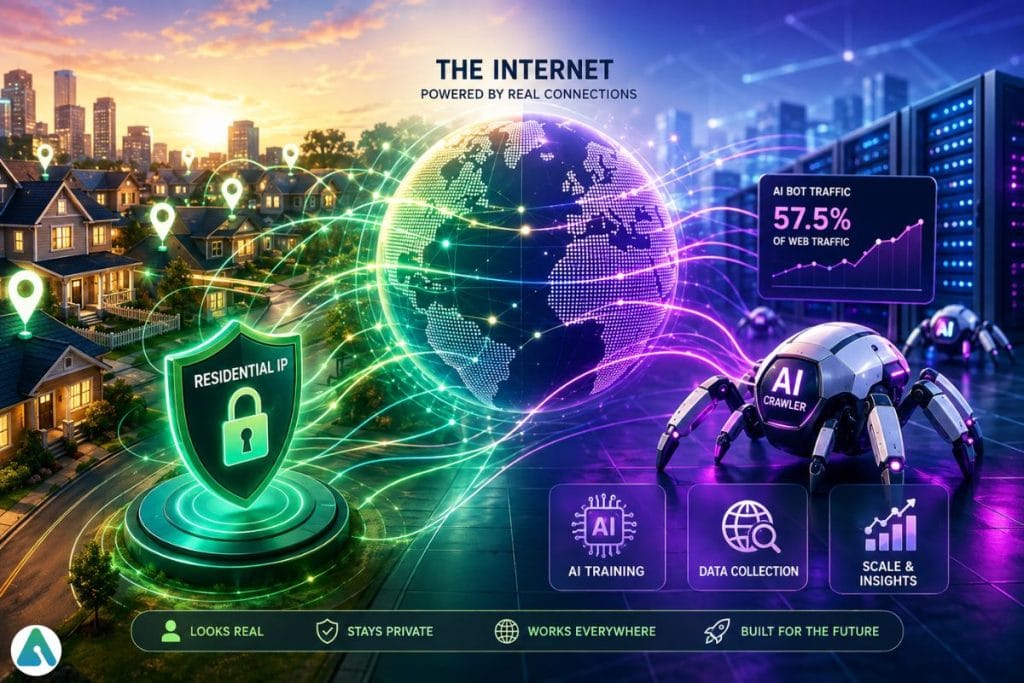
Cloudflare co-founder Matthew Prince confirmed it in June: bots now generate 57.5% of all HTML web traffic, against 42.5% from humans, based on Cloudflare Radar data. Imperva’s separate Bad Bot Report puts total automated traffic at 53% of the web in 2025, up from 51% the year before.
The crossover Prince predicted at SXSW arrived roughly a year ahead of schedule.
The Traffic Problem Nobody Priced In
Website operators built their defenses for a web where most visitors were human, and most bots were Googlebot. That assumption broke.
Within verified bot traffic, Cloudflare now attributes 20.3% to AI crawlers, with AI-search bots adding another 6.5% — pushing AI-related activity to roughly 26.7% of everything identified as a bot. HUMAN Security’s 2026 State of AI Traffic benchmark found AI-driven traffic grew 187% year over year, while traffic from autonomous browsing agents grew 7,851%.
Akamai measured AI bot activity up 300% across its network, with 25 billion AI-bot requests hitting commerce sites in a single two-month stretch last year. DoubleVerify traces 86% of the 2025 rise in general invalid traffic directly to AI crawlers, not classic ad fraud.
For website owners, that’s a security headache. For the infrastructure market underneath VPNs and proxies, it’s a demand shock nobody modeled for.
What AI Actually Changed Here
The old proxy playbook relied on datacenter IPs: cheap, fast, and easy to buy in bulk. AI-era bot detection broke that playbook first.
Modern anti-bot stacks — Cloudflare, DataDome, Kasada, PerimeterX — no longer just check whether an IP belongs to a data center. They fingerprint the TLS handshake, cross-reference browser rendering signals, and score session behavior in real time. Datacenter traffic fails those checks almost immediately; residential-class IPs, which route through real home connections instead of server farms, pass because they look like ordinary users.
That’s a big part of why the web scraping software market is on track to hit $1.17 billion in 2026, according to The Business Research Company, climbing toward $2.28 billion by 2030. The AI-specific extraction layer sitting on top of that market is projected by Market Research Future to grow from roughly $7.5 billion toward $38.4 billion by 2034. Enterprise adoption backs up the trajectory: 65% of companies already feed scraped data straight into AI training and evaluation pipelines.
Protocols matter here too. Fast, lightweight connection standards like WireGuard became the backbone of choice for both privacy-focused VPNs and higher-volume proxy networks precisely because they hold up under constant reconnections without the latency penalty older protocols carried.
The Trust Paradox
Here’s the part most coverage skips: the same residential IP pools that protect an individual’s privacy are now core infrastructure for the AI companies building the systems people are increasingly trying to opt out of tracking by.
| Proxy Type | Detection Resistance | Typical Cost | Common Use |
|---|---|---|---|
| Datacenter | Low — flagged fast by modern WAFs | Lowest | Bulk, low-stakes requests |
| Residential | High — mimics real home traffic | Mid-to-high | Privacy browsing, geo-testing, AI data collection |
| ISP/Static | High, with better session stability | Highest | Long-session logins, account management |
A privacy tool and an AI training pipeline can run on identical infrastructure. That’s not a flaw in either — it’s what happens when “look like a real person online” becomes valuable to defenders and data collectors at the same time.
This is where decentralized models diverge from the centralized proxy giants. Instead of one company owning a proxy fleet, networks built around Residential ip vpn affiliates route traffic through independent participants who opt in, which changes who controls the exit nodes and how the network scales geographically — more than 7,500 residential IP locations across 100-plus countries, in Mysterium VPN’s case, without one company owning the underlying home connections.
What This Means Going Forward
For businesses, the practical implication is straightforward: any workflow that depends on seeing the internet the way a real regional user sees it — price checks, ad verification, AI dataset collection, localization QA — now competes for the same residential-grade infrastructure that privacy-conscious individuals rely on.
For individual users, the bigger shift is less obvious. AI-driven surveillance techniques don’t need a single tracking cookie anymore. Device fingerprinting alone can chain together 250-plus browser, hardware, and network signals into an identifier that survives cookie clears, incognito mode, and even a VPN switch — because the fingerprint sits above the IP address, not inside it.
That’s pushing the privacy conversation past “hide your IP” and into “reduce what’s correlatable at all.” A residential IP helps with the first problem. It doesn’t solve the second on its own.
Anyone tracking how fast this space is moving can follow the ongoing news cycle around AI crawler policy — it’s changing roughly every quarter as platforms renegotiate what bots are allowed to take.
Businesses evaluating a Residential ip vpn affiliates program should weigh it against that backdrop: the value isn’t just IP diversity anymore; it’s whether the network’s structure — centralized or decentralized — matches how comfortable they are with who’s routing their traffic.
The Bottom Line
Residential IPs didn’t get more useful because VPN marketing improved. They got more useful because AI systems, on both sides of the fence, started needing to look like ordinary people at scale — and the infrastructure that lets you do that quietly became one of 2026’s more contested resources.
Related: AI Research Has a Data Access Problem. Static Residential Proxies Can Help
