
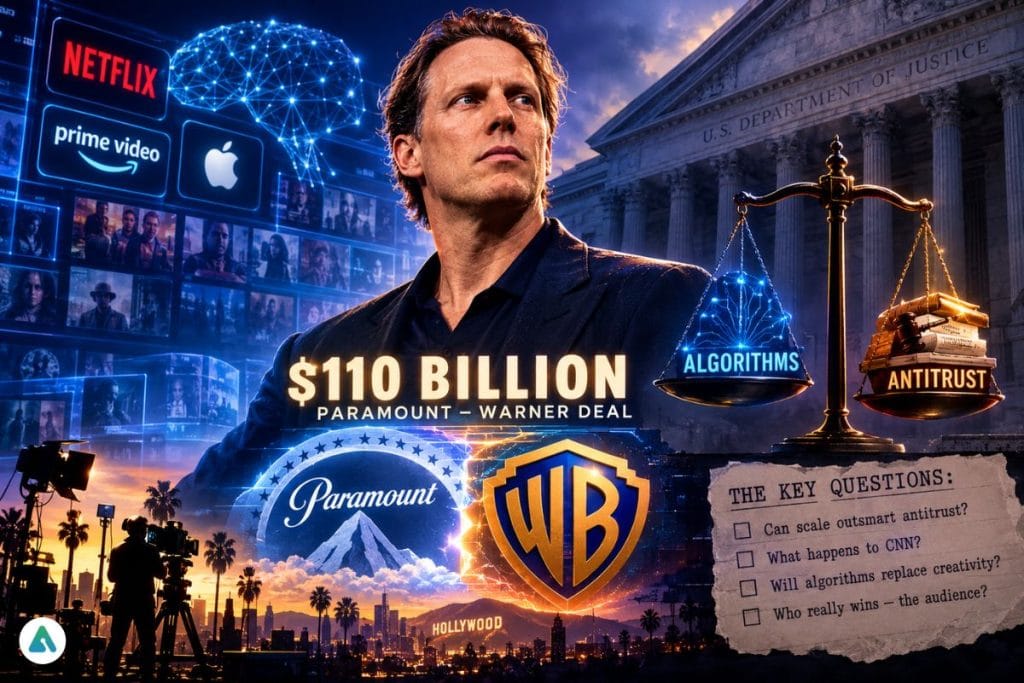
The Silence Breaks
In a New York Times op-ed published this week, the 43-year-old CEO of Paramount Skydance did something he had deliberately avoided since twelve state attorneys general sued to block his $110 billion takeover of Warner Bros. Discovery: he spoke.
His argument? The lawsuits “imagine a Hollywood that no longer exists — an industry ruled by a handful of legacy studios.”
In Ellison’s telling, the combined Paramount-Warner entity would account for less than 20% of total U.S. watch time — “competing every day against Netflix, Amazon, Apple, which are all companies whose resources dwarf ours.”
“I believe this fight is not really about market share,” he wrote. “The issue is whether I can be trusted as a steward of Warner’s CNN.”
The Tech Lord of Burbank
David Ellison isn’t just a producer with family money. He’s the son of Larry Ellison, Oracle’s co-founder and one of the world’s wealthiest humans, with a net worth hovering around $303 billion.
He dropped out of USC film school, made some forgettable aviation movies, and then spent fifteen years building Skydance into a production company that understood something most legacy studios didn’t: IP is software, and software scales.
When Ellison took over Paramount in August 2025 after an $8.4 billion deal, he became the first tech-adjacent executive to control a major Hollywood studio.
His new president, Jeff Shell, reportedly described him as “the perfect executive for the next-generation Hollywood company,” because “he not only can go to a table read, but he can go to the next room and code.”
Ellison has already made moves that signal where this is headed. He hired Dane Glasgow, a former Meta VP who oversaw Facebook’s Feed, Stories, Reels, and Ads products for 3 billion users, as Paramount’s Chief Product Officer.
The mandate? “AI-powered operations,” “immersive storytelling,” and digital platform innovation.
The Numbers That Actually Matter
- Combined watch time share: ~20% (vs. Netflix’s dominance)
- Domestic box office share: 18% over the last 12 months
- Theatrical output commitment: 30 films per year
- Annual content investment: $30 billion+
TV series commitment: 170 annually
Combined debt load if deal closes: approximately $79–$90 billion, making this potentially the largest leveraged buyout in history
Ticking fee starting October 1: roughly $7 million per day until close
Foreign ownership: 38.5% by sovereign wealth funds from Saudi Arabia, Qatar, and UAE (non-voting)
Reverse termination fee if regulators block: $7 billion
The Real Product: CNN as a Political API
In Silicon Valley, you don’t apologize for having political connections — you leverage them. Ellison’s family has been publicly praised by President Trump. Larry Ellison hosted a fundraiser for him. The administration’s DOJ fast-tracked approval of this deal while, according to the Wall Street Journal, career attorneys were weighing a lawsuit to block it.
Ellison’s response in the op-ed was almost algorithmic in its precision: “I have regularly voted for candidates of both parties; I hold some views that would be called conservative and others that would be called liberal, just like most Americans.”
He pledged that CNN and CBS News journalists “will continue to answer to the facts and to all the people they serve — not to any party or cause.”
California Attorney General Rob Bonta, leading the state coalition, has already called this out. “Spinning off one channel from a media conglomerate is not a sufficient remedy to protect consumers and preserve competition,” he posted on X.
The WGA’s lawsuit adds another layer, arguing the merger harms the marketplace for writers.
The Platform War Nobody’s Naming
“Hollywood is losing ground to technology platforms whose algorithms reward the loudest voices. The work is leaving, especially from California — where I grew up and where I’m raising my family — draining the deepest pool of creative talent ever assembled.”
Ellison’s solution? Build a bigger platform. Merge Paramount+ and HBO Max into a single streaming service.
Use Oracle’s cloud infrastructure to compete with Amazon’s AWS-powered MGM.
Deploy AI to make “content production cheaper.”
The Verdict: Courtroom as Beta Test
The legal timeline now looks like this: Paramount wants the antitrust trial to begin November 4, 2026. The states and WGA want April 5, 2027.
A federal judge has already issued a temporary restraining order, and the companies have agreed not to close until after a ruling or June 1, 2027 — whichever comes first.
Every day of delay costs $7 million. By June 2027, if the deal hasn’t closed, Paramount owes Warner $7 billion.
The irony is that Ellison may be right about the market. A combined Paramount-Warner would be a more viable competitor to Netflix and Disney than either company alone. As one Yale SOM analyst noted, “For Netflix, Warner Bros. would have been nice to have. Paramount needed it. Without this deal, I’m not sure how Paramount would scale enough to stay in the game.”
The Bottom Line
So far, the results are mixed. He’s won regulatory approval from 65 countries, including the U.S., EU, and China.
He’s outbid Netflix. He’s secured the Warner board’s approval. He’s even hired a Meta exec to run product.
But he’s also facing a dozen state AGs, the Writers Guild, a class-action shareholder lawsuit alleging an “illegal” deal with Trump,
and a federal judge who has already hit pause.
In his op-ed, Ellison concluded: “Hollywood’s story can have a happy ending only when we connect with our audience.”
