
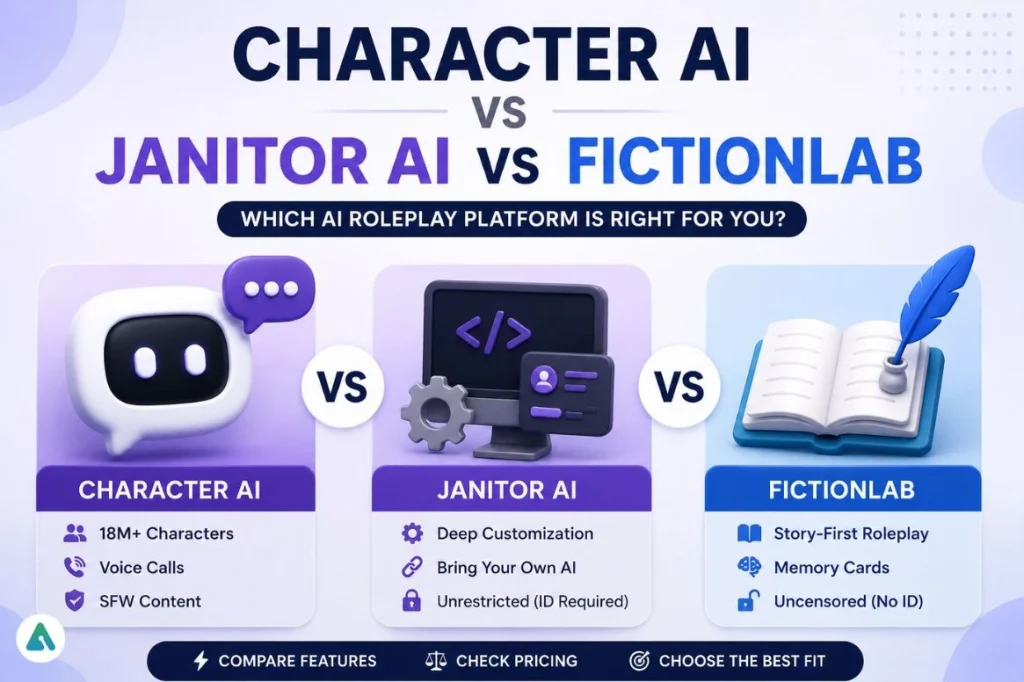
Wrong platform choice = rebuilding characters from scratch later. Each of these three locks you into a different ecosystem, a different set of content rules, and a different kind of story. Here’s which one fits how you actually write.
At a Glance: Best For
| Best For | Winner |
|---|---|
| Beginners | Character AI |
| Long-form storytelling | FictionLab |
| Deep customization | Janitor AI |
| Mobile experience | Character AI |
| Creative freedom | FictionLab / Janitor AI |
| Power users | Janitor AI |
| Character discovery | Character AI |
| Worldbuilding | Janitor AI |
| Fast setup, no config | FictionLab |
| Voice calls with characters | Character AI |
“Overall value” depends entirely on use case — this table reflects our testing criteria, not a universal ranking.
Quick Recommendation
| If you want… | Choose |
|---|---|
| Largest character library | Character AI |
| Full customization + any AI model | Janitor AI |
| Story-first roleplay, zero setup | FictionLab |
| Uncensored content, no ID required | FictionLab |
| Best mobile app | Character AI |
| Bring your own LLM | Janitor AI |
| Strongest free tier | FictionLab |
What Each Platform Is Actually Built For
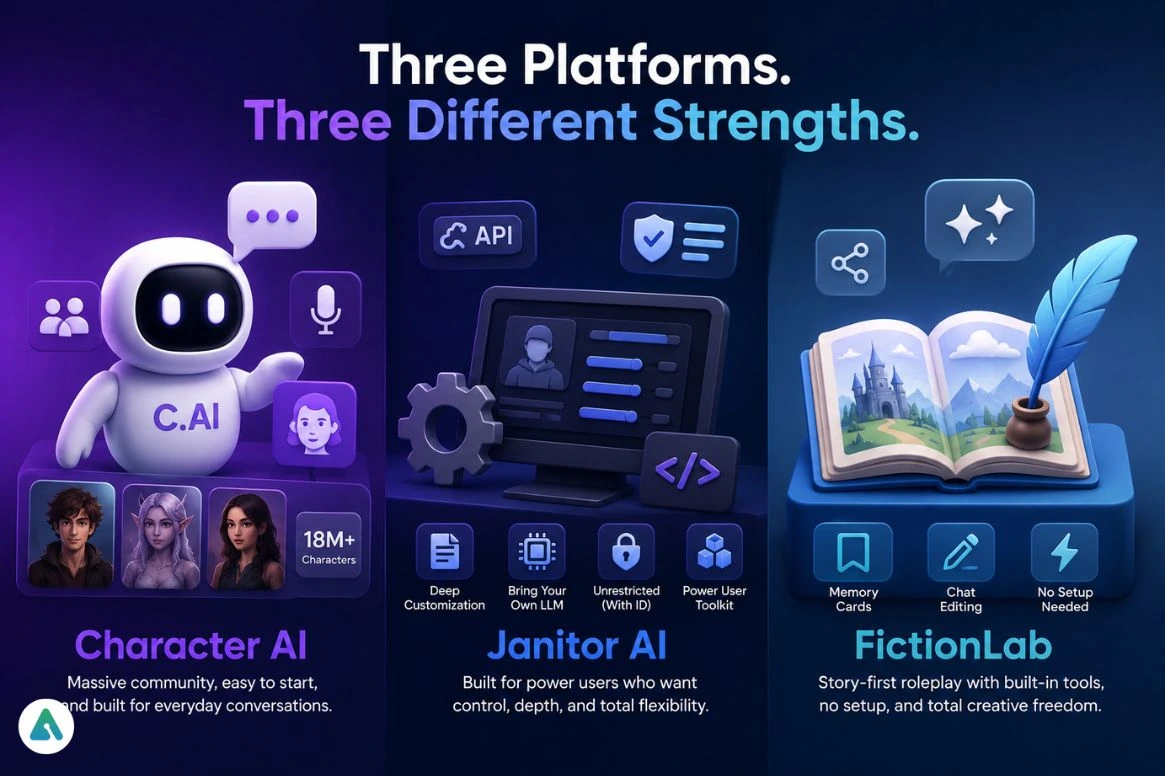
Character AI is built for breadth, not depth. With over 20 million monthly active users and 18 million+ community characters, it’s where most people first discover AI roleplay. Quick interactions, group chats, voice calls — it’s designed to feel like a social platform.
The trade-off: strict content filters and full-screen ads injected mid-conversation since early 2026. Not sidebar ads. Full-screen breaks inside an active chat.
Janitor AI assumes you’re a power user. It expects you to connect an external API key, configure character definitions up to 3,200 tokens deep, and clear a government ID process to unlock adult content. In exchange, it provides the deepest character toolkit in the space and brings your own LLM architecture.
FictionLab skips the setup entirely. It runs its own models in-platform, gives you memory tools and chat editing for free, and puts you inside a working story in minutes. No API key. No ID upload. And no configuration wall.
What Changed in 2026
A lot has shifted in the past year across all three platforms.
Character AI introduced full-screen mid-conversation ads for free users, launched the Imagine Gallery image generator (March 2026), and enforced an under-18 ban (November 25, 2025) that blocks open-ended character conversations for minors entirely.
Janitor AI launched its $9.99/month Pro subscription in April 2026, rolled out the Creator Analytics Dashboard in January 2026 (showing impressions and click-through stats per character), and tightened Limitless Mode to require government ID verification — a rollout that’s been rocky for many users.
FictionLab shipped its Android app in May 2025 (current build v1.6.8 as of June 2026) and has been scaling infrastructure through mid-2026, with server delays appearing as growth outpaces capacity.
Content Freedom: The Real Dividing Line
Character AI: SFW, No Exceptions
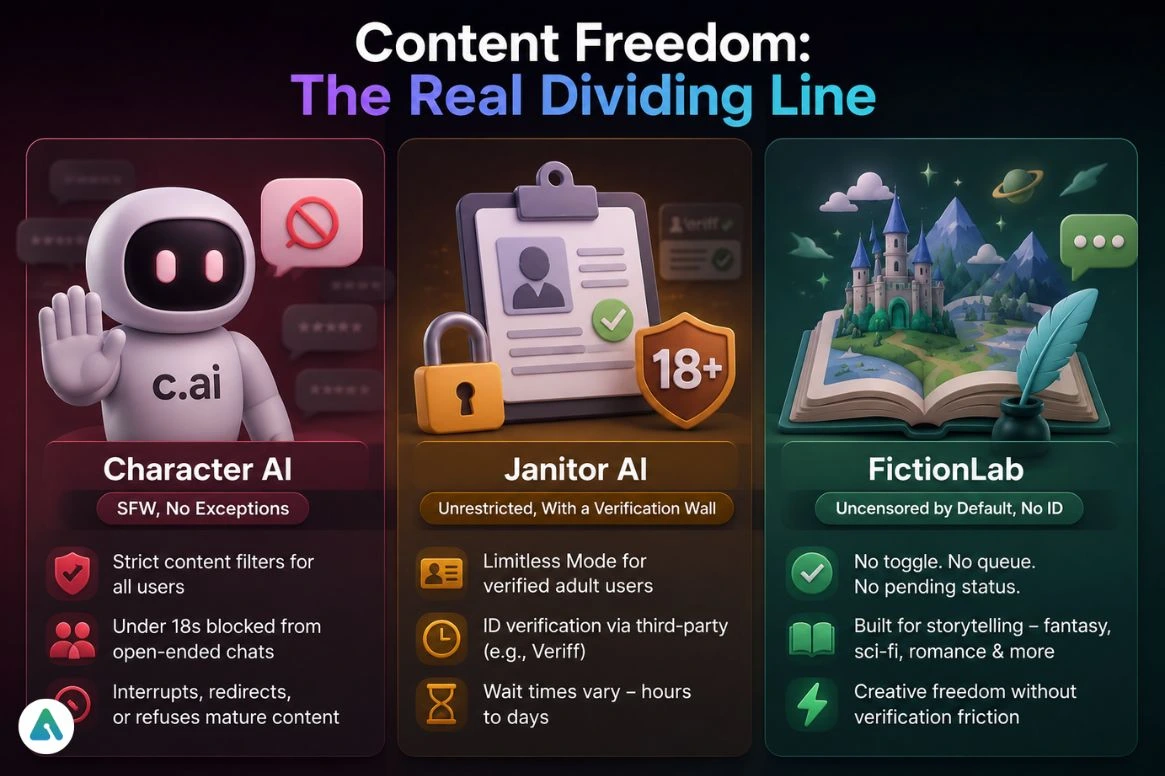
All users get the same SFW ceiling regardless of age or subscription. Push a scene toward anything mature, and the character interrupts, redirects, or refuses. The Character AI subreddit — 2.6 million members — documents this constantly.
Since November 25, 2025, users under 18 can no longer hold open-ended conversations with AI characters at all, following regulatory pressure and high-profile criticism of the platform’s safety practices.
Janitor AI: Unrestricted, With a Verification Wall
Limitless Mode is genuinely unrestricted for verified adult users. Getting there is the friction point.
ID verification goes through a third-party provider (services like Veriff handle this in many markets), and regional compliance rules mean the experience varies widely. Some users clear it in hours. Others wait days, hit pending status, and get slow support response. The process is real, the wait is unpredictable.
FictionLab: Uncensored by Default, No ID
No toggle. No submission queue. And even no pending status.
FictionLab positions itself as a storytelling platform rather than an adult content platform, so community scenarios skew toward fantasy, sci-fi, and romance rather than explicit content specifically. For users who want creative freedom without verification friction, the default state covers most of what they’re after.
Model Quality and What You’re Actually Paying For
Character AI
c.ai+ at $9.99/month ($94.99/year) adds priority access, Imagine Gallery, Chat Memories, and removes ads. It does not upgrade the underlying model — the AI you get on the free tier is the same AI you get on the paid plan.
During testing, casual and short-form interactions worked well. When we set up a slow-burn political intrigue scenario, the character had lost a key plot detail by message 32 — even with Chat Memories active. Chat Memories works through a rolling summary and manual pinning system, not true extended context. It catches broad strokes. Fine details drift.
One genuine differentiator: two-way live voice calls. No typing required. Neither Janitor AI nor FictionLab matches this for companion-style use.
| Free | c.ai+ ($9.99/mo) | |
|---|---|---|
| Messages | Unlimited | Unlimited |
| Ads | Yes | No |
| Model quality | Standard | Same |
| Chat Memories | No | Yes |
| Imagine Gallery | No | Yes |
| Voice calls | Yes | Yes |
Janitor AI
The built-in JanitorLLM holds up in short sessions but drops narrative threads past 15–20 messages — community consensus puts it around 6.5/10. Connect an external API key (OpenAI GPT-4o, DeepSeek, Anthropic Claude, or open-source via OpenRouter) and the quality jump is immediate.
One thing the platform doesn’t emphasize: your data privacy depends on whichever provider you connect to, not on Janitor AI’s own policy. Messages through OpenAI follow OpenAI’s terms. Messages through Anthropic follow Anthropic’s. If privacy matters, the provider you pick matters as much as the platform.
External API usage runs $3–20/month for moderate users, billed separately from the $9.99/month Pro plan.
Real monthly cost for a serious Janitor AI user: $13–40. The $9.99 covers the platform. It doesn’t cover the model.
FictionLab: Ophelia vs Wraith
FictionLab runs two models — and the difference matters depending on how you write.
Ophelia (~70B parameters) is built for narrative depth. In testing, a multi-character fantasy storyline with shifting locations held together across 30+ messages. Details introduced early stayed accurate far longer than lighter models manage. The weakness: action scenes. Ophelia narrates them carefully and slowly. A fight sequence becomes three paragraphs of footwork when the scene needs momentum.
Wraith trades depth for pace — built for faster, snappier exchanges with less memory overhead. Better for quick dialogue. Worse for complex lore that needs to stay consistent across a long session.
Both run on the free tier. Not limited to versions — the actual models.
Prompt behavior comparison — same setup across all three:
“You are Seran, a court advisor who suspects the chancellor is a spy. First person. Late evening, private chamber.”
- Character AI: Responds conversationally, but slips from first to third person mid-scene without prompting.
- Janitor AI (with full character definition): Maintains first-person framing throughout, embeds it in speech patterns from the first response.
- FictionLab / Ophelia: Stays in voice and adds unprompted environmental detail — candlelight, footsteps outside. Can over-describe at the expense of pacing.
Context Windows: The Spec Nobody Mentions
Context window limits — how much conversation history the AI holds before earlier details disappear — matter more than almost any spec in a feature table.
Character AI uses Chat Memories pins to compensate. You manually anchor critical facts and the system keeps them active. Broad strokes survive. Fine plot details drift. Active memory maintenance falls entirely on the user. If this is already frustrating you, this breakdown of AI companion memory issues explains the mechanics.
Janitor AI’s Lorebook (Scripts) injects world-building context dynamically as relevant terms appear in conversation. Lorebooks built well make context drift nearly disappear — even in very long sessions. Premium models via external API extend the effective context window significantly beyond JanitorLLM alone.
FictionLab’s Memory Cards act as persistent plot anchors injected into each new generation. Users running 20+ exchange sessions with active Memory Cards see noticeably more coherent narratives. Adding a card takes seconds. The payoff across a long session is real.
Character Building and Customization
| Character AI | Janitor AI | FictionLab | |
|---|---|---|---|
| Character library | 18M+ community | 32,000+ community | Scenario-based |
| Definition depth | Basic | Up to 3,200 tokens | Story Cards + Personas |
| World injection | No | Lorebook (dynamic) | Memory Cards |
| Group chat | Yes | Yes (2026) | Yes |
| Character export | N/A | Yes | No |
| Slash commands | No | No | /ooc /pov /memory-cards |
Janitor AI
Nothing in this comparison matches its depth. 3,200-token character definitions hold backstory, relationship maps, behavioral rules, speech patterns, and scenario context simultaneously. For writers who need a character to stay consistent across a 60-session arc, this is the toolkit.
FictionLab
Story Cards, Memory Cards, and Personas give real structural control without technical overhead. The slash commands deserve specific attention — /ooc switches to out-of-character mid-scene without breaking immersion, /pov shifts narrative perspective, /memory-cards lets you review and add anchors without leaving the chat. These aren’t cosmetic. They give writers active control over a session that neither competitor offers natively.
The significant gap: no character export as of early 2026. Characters built here stay here. If you’re planning a portable library, know this before investing time. The full FictionLab review covers the Persona and Story Card system in more detail.
Finding niche fandom characters on FictionLab also requires more digging — the creator ecosystem is smaller than Character AI’s by a wide margin. If you’re looking for a specific anime character or popular franchise bot, Character AI will have it. FictionLab may not.
Character AI
18 million characters cover more ground than any other platform. Creation tools are fast. But they don’t go deep, and long-running narrative consistency degrades as context drifts. Strong for discovery and casual interaction. Not designed for 50-session story arcs.
Platform Scores
| Category | Character AI | Janitor AI | FictionLab |
|---|---|---|---|
| Ease of use | ★★★★★ | ★★☆☆☆ | ★★★★☆ |
| Content freedom | ★☆☆☆☆ | ★★★★★ | ★★★★☆ |
| Character depth | ★★☆☆☆ | ★★★★★ | ★★★★☆ |
| Story quality | ★★★☆☆ | ★★★★☆ | ★★★★★ |
| Community size | ★★★★★ | ★★★☆☆ | ★★☆☆☆ |
| Mobile experience | ★★★★★ | ★☆☆☆☆ | ★★★☆☆ |
| Free tier value | ★★★☆☆ | ★★☆☆☆ | ★★★★★ |
| Context retention | ★★☆☆☆ | ★★★★☆ | ★★★★☆ |
Can You Migrate Between Platforms?
This is the question people actually search when they’ve already spent time on one platform.
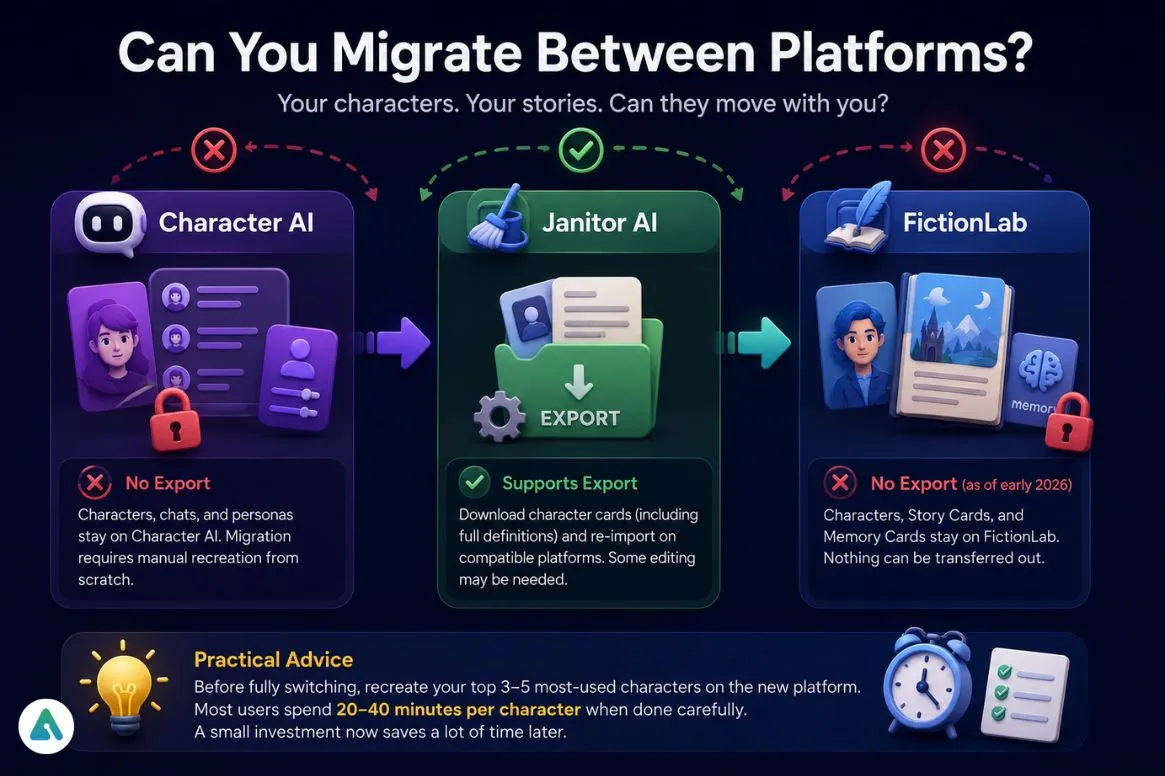
From Character AI to Janitor AI or FictionLab: Character AI has no export function. Your characters, chat histories, and any persona configurations stay on the platform. Migration means manual recreation — copying character descriptions, rewriting personalities from memory, and rebuilding relationship context from scratch. For users with large character libraries, this is a real-time cost, not a minor inconvenience.
From Janitor AI to elsewhere: Janitor AI supports character export. Character card data (including full definitions) can be downloaded and re-imported on compatible platforms. Not every platform accepts the same format, so some editing is usually needed — but the core definition travels with you.
From FictionLab to elsewhere: No export as of early 2026. Same situation as Character AI — your characters stay on the platform. If you’ve built detailed Story Cards and Memory Card setups over months of play, none of that moves.
Practical advice: If you’re considering switching platforms, recreate your top 3–5 most-used characters on the new platform before fully committing. Most users find the recreation takes 20–40 minutes per character when done carefully. That’s a manageable investment before you abandon the old platform entirely.
Discovery: How You Find Characters on Each Platform
Character AI runs a social feed algorithm. Popular characters surface based on interaction volume and community ratings. Discovery is passive — scroll, find something, start chatting. The breadth is unmatched.
Janitor AI feels like a game marketplace. Characters show public engagement stats via the Creator Analytics Dashboard (launched January 2026). Active searching by genre, tag, or character type yields deeper results than browsing.
FictionLab organizes discovery around Scenarios with leaderboards and community events. Trending content here skews toward narrative quality — setups tend to be richer than Character AI equivalents, but the total volume is smaller.
Stability and Mobile
| Character AI | Janitor AI | FictionLab | |
|---|---|---|---|
| Uptime | High | ~78% est. (8–12hr/month downtime) | Growing pains mid-2026 |
| Mobile app | iOS + Android | Browser only | Android + Web |
| Peak performance | Manageable slowdowns | ~40% speed drop | Generation delays reported |
| Infrastructure | Google $2.7B deal backing | Independently funded | Self-funded, scaling |
| Voice calls | Two-way live | No | No |
Janitor AI’s browser-only access matters more than it sounds. Managing long character definitions, API configuration, and session continuity on a mobile browser is genuinely cumbersome. For anyone who roleplays primarily on a phone, this is likely a dealbreaker.
FictionLab’s Android app (v1.6.8) has seen server delays in mid-2026 — multiple user reports of multi-minute generation waits. The issues appear tied to growth pace rather than architecture, but it’s a real friction point right now, not a minor edge case.
Full Pricing Comparison
| Character AI | Janitor AI | FictionLab | |
|---|---|---|---|
| Free tier | Unlimited messages + ads | ~50 msgs/day (JanitorLLM) | Unlimited messages |
| Paid plan | $9.99/mo | $9.99/mo Pro | Premium tier available |
| Annual | $94.99/yr (save ~20%) | ~17% off annual | Available |
| Real power user cost | $9.99/mo | $13–40/mo (Pro + API) | Premium only |
| NSFW | No | Yes (ID verification) | Flexible, no ID |
| Mobile app | iOS + Android | Browser only | Android + Web |
| Own API support | No | Yes — core feature | No |
| Character export | N/A | Yes | No (as of early 2026) |
| Model upgradeable | No | Yes (BYO API) | No (Ophelia/Wraith — both free) |
Who Should Choose — and Who Should Avoid
Character AI
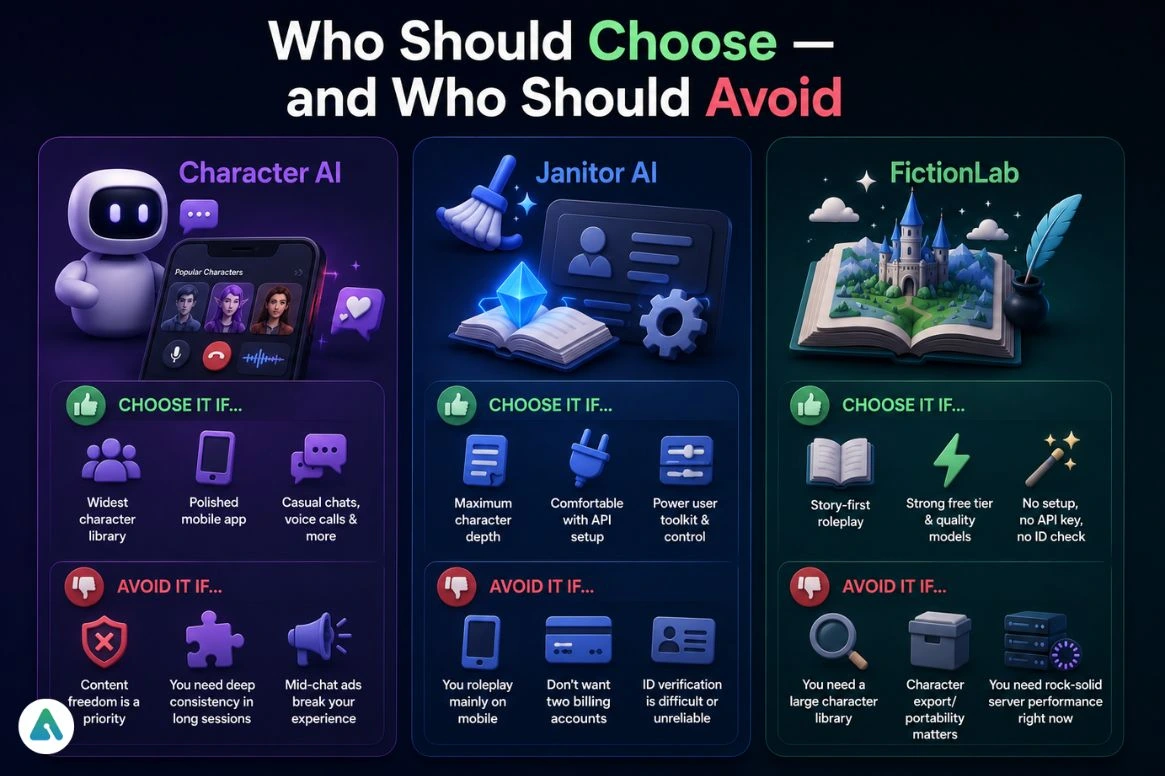
Choose it if you want the widest character library, a polished mobile app, and casual daily interactions without technical setup. Voice calls with characters, language learning bots, fan fiction discovery — all work well here.
Avoid it if content freedom is a priority, you need deep character consistency across long sessions, or mid-chat full-screen ads will break your experience. If those limits hit you eventually, Character AI alternatives are worth knowing before you invest further.
Character.AI remains one of the largest AI character platforms despite growing competition. Recent Character AI statistics show the platform still attracts more than 20 million monthly active users, highlighting both its continued popularity and why so many users are actively searching for alternative AI companion platforms.
Janitor AI
Choose it if character depth is non-negotiable and you’re comfortable with API configuration. 3,200-token definitions, Lorebook world injection, bring-your-own-model architecture — this is the power user platform. Budget $15–40/month realistically.
Avoid it if you want to roleplay primarily on mobile, don’t want to manage two billing accounts, or can’t clear ID verification reliably. The toolkit rewards patience. If the setup friction is too much, Janitor AI alternatives cover the same content freedom with less overhead.
FictionLab
Choose it if you want story-first roleplay without configuration, a strong free tier with real model quality, and slash-command control over narrative structure. The Ophelia model holds complex lore better than most free-tier alternatives. No API key, no ID verification, no setup wall.
Avoid it if you need a large existing character library (especially for fandom/anime), rely on character portability, or need consistent server performance right now. Infrastructure is scaling, but mid-2026 delays are real. Niche character discovery takes more effort than on Character AI.
Decision Tree
Not sure which way to go? Follow this.
Do you want NSFW / adult content?
│
├── No → Do you want the largest character library?
│         ├── Yes → Character AI
│         └── No  → FictionLab
│
└── Yes → Are you comfortable connecting an API key?
          ├── Yes → Janitor AI
          └── No  → FictionLab
                    │
                    └── Need anime/fandom characters specifically?
                              ├── Yes → Character AI (filter issues aside)
                              └── No  → FictionLab
FAQs
Q. Can you move Character AI characters to Janitor AI or FictionLab?
No. Character AI doesn’t support character exports, so you can’t transfer characters directly to Janitor AI or FictionLab. Janitor AI allows character card exports that work on compatible platforms, while FictionLab currently has no export feature. In most cases, switching platforms means manually recreating your characters and their memories.
Q. Which AI roleplay platform has the best memory in 2026?
Janitor AI offers the best long-term memory when paired with an external AI model and Lorebook. FictionLab’s Memory Cards are a strong second, helping preserve story context without extra setup. Character AI’s Chat Memories maintain broad continuity but often lose finer details during longer roleplay sessions.
Q. Which AI roleplay platform is best for privacy?
None of these platforms offers end-to-end encrypted chats. Character AI and FictionLab process conversations on their own systems, while Janitor AI’s privacy depends on the AI provider you connect to, such as OpenAI or Claude. If privacy matters, review both the platform’s and the model provider’s policies.
The Wider Pattern
Character AI’s content tightening and Janitor AI’s verification rollout both accelerated in the same window. FictionLab’s growth through that period wasn’t accidental — it offered an exit ramp at the right moment.
The deeper dynamic: platforms serving everyone face pressure from both directions. Regulators want stricter controls. Users want creative freedom. Specialized platforms with a clear philosophy hold users better once someone finds their fit.
Whether the AI roleplay space looks the same in 2027 is genuinely uncertain. What won’t change is the core decision: story depth, content freedom, ease of use — you’re picking which of those matters most.
That choice connects to something worth understanding separately: why humans bond with AI in the first place, and how AI companion dependency builds before most users notice it happening.
Related: How to Use DeepSeek on Janitor AI (2026 No-Error Guide)
| Disclaimer: This comparison is based on official platform information, editorial research, community insights, and our evaluation of each platform’s features and user experience at the time of publication. AI platforms change quickly, so pricing, features, and policies may differ over time. Always check the official website before making a decision. AIInsightsNews is independently owned and isn’t affiliated with Character AI, Janitor AI, or FictionLab. |
