
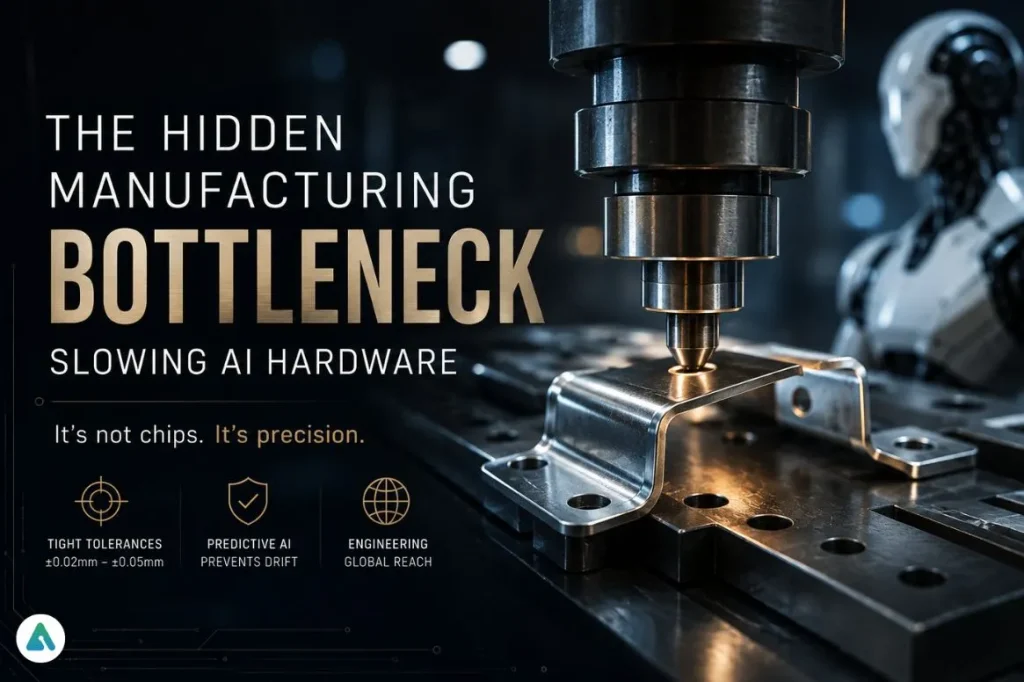
Goldman Sachs projects humanoid robot sales will reach 50,000 units in 2026 and exceed one million units per year by 2031.
Boston Dynamics, Figure AI, and Apptronik are all running pre-production stress tests on actuator housings and planetary gearbox frames right now. Every one of those parts needs to be stamped to tolerances of ±0.05mm on a joint bracket and ±0.02mm on an electrical connector.
That precision doesn’t happen because the CAD file says so. It happens because the stamping process, the tooling, and the materials are all engineered together from the start.
Most robotics programs find that out too late.
The algorithms are ready. The chips are shipping. The dies are not.
The Problem Nobody Saw Coming: Pilot Purgatory at the Physical Layer
McKinsey’s Industry 4.0 Lighthouse research has a name for what’s happening to 74% of hardware manufacturers right now: “pilot purgatory.”
Promising prototypes. Stalled production. A scaling wall that no software update fixes.
For AI hardware programs, the most common reason isn’t firmware, compute, or supply chain logistics in the traditional sense. It’s die tryout failures and yield ramp-up problems in precision stamped parts — the brackets, housings, and connectors that hold everything together.
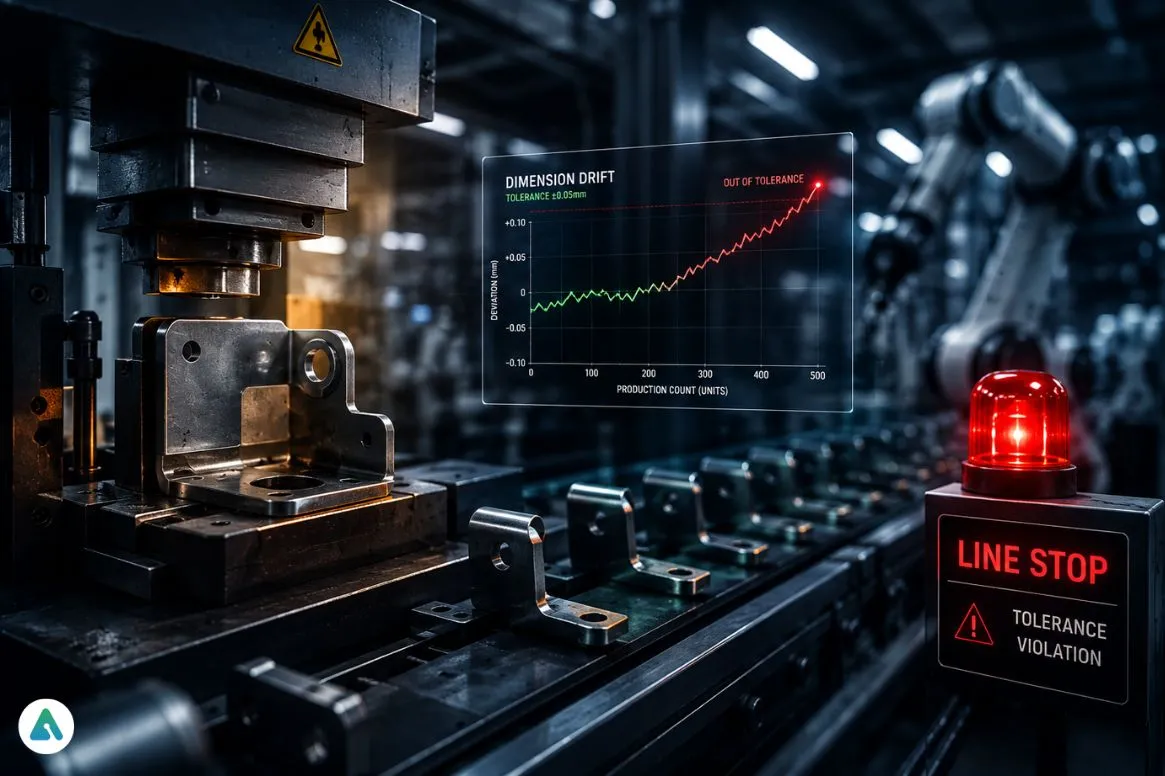
Here’s what that looks like on the floor: a sensor array bracket that holds ±0.05mm through the first 200 units starts drifting to ±0.08mm by unit 500. Not because the design is wrong. Because tool wear during grueling 24/7 production shifts introduces micro-dimensional changes that nobody modeled in the CAD phase.
The assembly line stops. The tooling engineer gets called. The production window closes.
The Designed-But-Unbuildable Paradox
Hardware engineers push materials to their limits — lightweight titanium alloys, complex bend geometries, wall sections thin enough to shave grams off a bipedal actuator frame.
What the CAD model doesn’t show: what those choices do to metal under 400 tons of stamping pressure.
A sensor housing with a sharp internal corner cracks at the sheared edge. A gearbox bracket with uneven wall thickness springs back 6 degrees instead of the 3 the die was compensated for. A connector stamped in phosphor bronze develops micro-burrs at the tool edge by cycle 80,000 that the incoming inspection missed because they were measuring the wrong dimension.
These aren’t exotic failure modes. They happen in every serious robotics program that moves from prototype tooling to production runs. The difference between programs that catch them early and programs that don’t is almost always when manufacturing engineering got involved in the design process.
Case Study in Micro-Drift: How 50 Microns Halts an Assembly Line
A mid-size humanoid robotics startup — tooling sourced from a Shenzhen progressive die shop, assembly in Austin — hit this wall in Q3 2024.
Their actuator joint bracket called for ±0.05mm on a critical mounting face. The first article inspection passed. Production launched.
By unit 340, the CMM was reading ±0.09mm. The die had drifted. The supplier was 14 time zones away. Emergency rework on 340 brackets. Six weeks of assembly line downtime. A product launch window missed entirely.
The fix cost less than $8,000 in tooling adjustments. The delay cost the program an estimated $2.1 million in lost production and customer penalties.
50 microns. Six weeks. $2.1 million.
This is not a rare story. It’s the standard story for hardware startups that treat stamping as a commodity procurement decision rather than an engineering partnership.
Machine Learning in the Stamping Cell: Real-Time Closed-Loop Controls

The same ML infrastructure driving autonomous robots now runs inside the stamping cells making their components.
Computer Vision at Production Speed
AI vision systems inspect every part as it leaves the die — catching surface defects, dimensional anomalies, and burr formation that manual sampling misses entirely. Key benchmarks from tier-one automotive deployments:
- Defect detection accuracy above 99.997% across variable raw material batches
- Scrap rates down 22.4% annually with vision-integrated lines
- Overall product quality up 35% in AI-assisted stamping environments
Predictive Die Maintenance — Before the Drift Becomes a Defect
Machine learning models read press tonnage, vibration signatures, and acoustic emissions in real time — on presses from 60-ton sensor bracket lines to 400-ton structural actuator frame presses.
The system flags emerging dimensional drift after unit 50. Not unit 500. The die gets scheduled for maintenance during a planned downtime window, not an emergency shutdown.
Why that matters financially: a single class-A progressive die for complex AI hardware components costs $80,000–$150,000 and carries a 12–26 week replacement lead time if it fails catastrophically. Predictive maintenance eliminates most of that risk entirely — saving up to 40% of repair costs compared to reactive models.
Closed-Loop Process Control
In-line measurement feeds directly back to press control systems. When a dimension trends toward its specification limit, the system adjusts tonnage, speed, or lubrication automatically — no engineer intervention required.
Result: CPK values held above 1.33 across the full production run, not just during initial validation.
In 2026, 45% of G2000 manufacturers connect field and engineering data via AI to drive quality improvements and cost reduction. In precision stamping, that connectivity is the difference between a self-correcting manufacturing system and a die that slowly destroys your launch timeline.
Material Selection: Where Most Robotics Programs Fail First
Material selection is the highest-leverage decision in precision stamping — and the one made with the least manufacturing input in most hardware programs.
The Precision Metalforming Association identifies three failure modes that dominate robotics component stamping:
- Springback at tight radii — especially severe in high-strength steels and titanium alloys, requiring compensation angles of 3–8 degrees built into die geometry
- Micro-crack propagation at sheared edges — invisible at first article, catastrophic under cyclic loading
- Ductility limits causing tearing in thin-wall sections — common in aluminum housings pushed to minimum wall thickness for weight targets
All three are predictable. All three are preventable. And All three happen when material selection gets made by designers who haven’t run forming simulations.
Understanding how different alloys behave under stamping stress — the systematic analysis covered in dedicated custom metal stamping services material guides — gives engineering teams the data to make these decisions correctly before a single die gets ordered.
The component-to-material trade-off matrix:
| Component Type | Preferred Material | Stamping Challenge | Critical Tolerance |
|---|---|---|---|
| Actuator & Joint Brackets | 301 Stainless Steel | High Springback | ± 0.05 mm |
| Sensor & Camera Housings | 6061-T6 Aluminum | Low Ductility / Tearing | ± 0.08 mm |
| Electrical Connectors | Phosphor Bronze | Tool Wear / Micro-burrs | ± 0.02 mm |
Optimizing these alloy trade-offs during the CAD phase — not after tooling is ordered — prevents the kind of catastrophic tooling adjustments that cost programs months of iteration.
The Cross-Border Stamping Problem Nobody Talks About
Most AI hardware startups design in San Francisco or Munich. Most of them source their stamping dies from Shenzhen, Dongguan, or Taiwan.
That supply chain geography creates a specific risk profile that domestic-only analysis misses entirely.
Class-A progressive tooling sourced from Chinese die shops runs 40–60% cheaper than equivalent North American or German tooling. The trade-off: 12–20 week lead times, limited DFM collaboration across time zones, and significant quality variance between shops that carry the same ISO certification on paper.
When a die drifts in production — and statistically, it will — the nearest tooling engineer is not down the hall. The engineering conversation happens on WeChat at 2am. The corrected insert ships in three weeks. The assembly line waits.
Hardware programs that source stamping dies purely on unit cost without accounting for iteration cycle time and emergency response capability are making the same mistake that the Austin startup made in Q3 2024.
The question isn’t whether to source from Asia. It’s whether the engineering partnership structure — DFM reviews, tolerance sign-off protocols, on-site validation runs — matches the technical requirements of the program.
Compressing Timelines: Parallel Engineering and DFM Reviews
The average industrial robot payback period dropped from 5.3 years in 2019 to 1.3 years in 2024. That math only works if the robot ships on schedule.
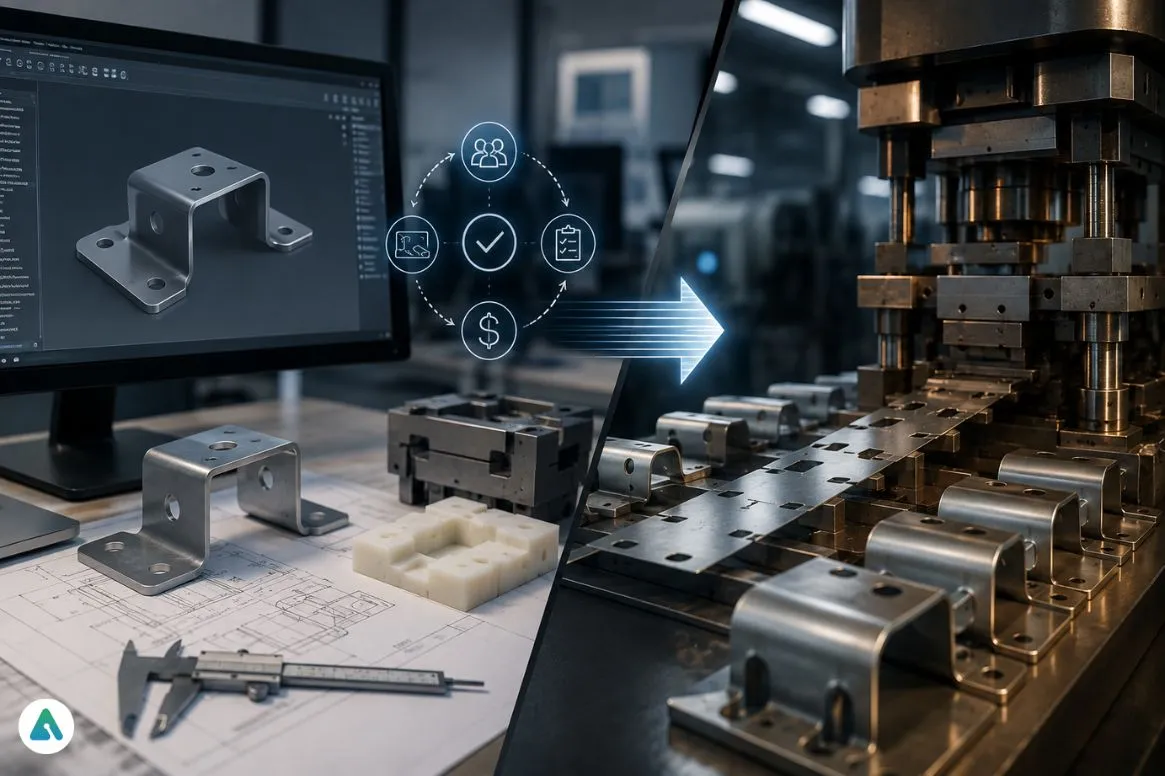
The traditional stamping development sequence — Design → Tooling → Process Validation → Inspection Planning — runs sequentially. A 16-week cycle with two design iterations becomes 28 weeks. In AI hardware, 28 weeks is a market window.
Choosing the right method from day one:
- Progressive die stamping — high-volume connector brackets and structural clips; strip feed automation drives unit cost down at scale
- Transfer die stamping — complex gearbox housings and structural frames; inter-station transfer allows geometry that progressive tooling can’t achieve
- Deep drawing — battery enclosures and spherical joint housings; deep-nested forms that require dedicated blank sizing and draw ratio analysis
Wrong method specified at design stage: add 4–8 weeks of retooling minimum.
The parallel approach that actually compresses timelines:
- DFM reviews run before tooling is ordered — corner radii, wall thickness transitions, and burr direction all resolved in the CAD environment
- Rapid tooling (3D-printed polymer dies, wire EDM inserts) produces functional prototype parts in days for fit checks and limited testing
- Production tooling gets commissioned only after the design is proven — no expensive die revisions
Getting a competitive metal stamping quote at the design stage — not after tooling lock — surfaces real cost and feasibility data that changes what engineers specify. It’s the fastest way to find out whether the design is buildable before the program depends on it being buildable.
The Supply Chain Certification Gap
95% of manufacturers plan to invest in AI or machine learning within five years, per Rockwell Automation’s State of Smart Manufacturing 2025 report.
That investment assumes parts arrive on time. Single-supplier dependency is the risk that breaks that assumption without warning.
A stamped gearbox housing with one qualified supplier means a die failure equals a complete assembly line shutdown. The downtime cost routinely exceeds the die replacement cost by an order of magnitude — and in a robotics program racing toward a launch window, by far more.
Certifications provide independent verification of process discipline — not just paper quality systems, but actual production control:
- ISO 9001 — foundational quality management
- IATF 16949 — automotive-grade process control; the standard that harmonizes assessment systems across global production sites
- AS9100D — aerospace-level zero-defect rigor; configuration management and traceability that survive the most demanding audits
For robotics programs in 2026, supplier certification isn’t procurement due diligence. It’s the engineering risk control that keeps a program alive when everything else is running at maximum velocity.
Related: GEN-1 Hits 99% Reliability: The Breakthrough That Turns Robots Into a Scalable Workforce
