

There’s no single number for how much water AI uses per day. A text prompt might cost a quarter-milliliter. A large data center might use over a million gallons a day. Both numbers are real. They measure different things.
|
AI Water Use Explained: Withdrawal vs. Consumption vs. Discharge

Three terms decide what any water number actually means.
- Withdrawal is water pulled from a source — a river, an aquifer, a city supply.
- Consumption is the part that doesn’t go back, usually because it evaporates during cooling.
- Discharge is water returned to its source or recycled through treatment.
A data center can withdraw a lot of water and consume very little of it. It depends on the cooling design. Most “contradictory” AI water statistics aren’t contradictions. They mix these three terms without saying so.
How Much Water Does One AI Prompt Use?

A short prompt on an efficient model can cost under 2 mL. A long response from a heavy reasoning model can cost over 150 mL. Model choice moves the number by more than two orders of magnitude.
Google’s Number
Google publishes the most detailed first-party figure available. Its median Gemini text prompt uses 0.24 watt-hours of energy and 0.26 milliliters of water — five drops. Google measures this across the full serving stack, including idle capacity and cooling overhead.
Engineers track this efficiency with Water Usage Effectiveness, or WUE: liters of water per kilowatt-hour of IT equipment energy. The industry average sits around 1.8 to 1.9 L/kWh, based on U.S. Department of Energy data.
Independent researchers, including UC Riverside’s Shaolei Ren, have pushed back on treating Google’s number as pure efficiency gain. Some of the gap versus earlier independent estimates likely comes from what each methodology counts, not from real-world improvement alone.
ChatGPT’s Number
Sam Altman has claimed a similar figure for ChatGPT — about 0.32 mL per query. OpenAI hasn’t published the underlying methodology. Treat that number as a company statement, not an audited result.
The 519 mL Figure
Here’s the number most people actually remember. The Washington Post and UC Riverside estimated in 2024 that a 100-word GPT-4 email costs around 519 mL of water. That figure adds the water used upstream to generate the electricity. It’s a wider accounting boundary, not a bigger lie. Google counts the tap. The Washington Post counted the whole pipe back to the power plant.
That number is also aging out. Ren, the researcher behind the original estimate, has since revised his own figure down to roughly 15 mL for a GPT-4-class prompt on current systems — about 5 mL of that on-site cooling — and calls the original 519 mL figure outdated for today’s hardware. The lesson isn’t that the old number was fabricated. It’s that AI water figures decay fast as models and cooling infrastructure improve, so a 2024 estimate needs a current-year check before you cite it as today’s reality.
Reasoning Models Change Everything
A May 2025 benchmarking paper on arXiv, “How Hungry is AI?”, tested 30 commercial models under a standardized energy framework. The most energy-intensive models — o3 and DeepSeek-R1 — exceed 33 watt-hours per long prompt, more than 70 times GPT-4.1 nano’s consumption. On water specifically, the paper’s own figures show efficient models like GPT-4.1 nano staying under 2 mL per query across all prompt lengths, while DeepSeek-R1 consistently tops 150 mL. A modeled 700-million-query scenario matched the freshwater evaporation of roughly 1.2 million people’s annual drinking water.
The paper models water through WUE and infrastructure assumptions. It doesn’t directly meter each commercial model’s live water draw, so treat these as a rigorous modeled range rather than an audited utility bill.
Images Cost More Than Text
Image generation has real data behind it now. The June 2026 UNU-INWEH report puts a standard-resolution AI image at roughly 28.6 mL of water — over 100 times a short Gemini text prompt. No comparably rigorous per-video figure exists yet from any major lab. Treat any specific liters-per-video number you see online as unverified.
Why AI Water Estimates Are So Different
Three layers stack on top of each other, and most articles only measure one.

On-site cooling water evaporates at the data center itself. This is Google’s number. Full lifecycle water adds the water used upstream to generate the electricity — where the Washington Post’s original 519 mL figure comes from. Embodied water goes deeper still, into the water used to fabricate the chips. A typical semiconductor fab uses millions of gallons of ultrapure water a day, according to World Economic Forum reporting on TSMC and its peers. Almost no per-prompt AI estimate accounts for this layer at all.
Cooling method changes the math again. Evaporative systems work like an oversized swamp cooler. They consume water directly. Closed-loop and air-cooled systems use far less on-site water, but they draw more electricity — shifting the burden to the power plant instead.
Training vs. Inference: Which Costs More Water?
Training gets most of the attention because it’s a single, dramatic number. One widely cited 2023 estimate found that training a GPT-3-scale model could directly evaporate roughly 700,000 liters of freshwater, under a modeled scenario using Microsoft’s U.S. data centers.
But training happens once. Inference — running the model for actual users — happens billions of times. The UNU-INWEH report estimates inference now drives 80 to 90 percent of total AI energy use, not training. A model’s training cost gets amortized across however many queries it eventually serves, which is exactly why a clean “per query” number is so hard to isolate after launch.
Why Location Changes the Answer
The same prompt can carry a radically different water cost depending on where the server sits. A data center in a humid, temperate climate can rely more on air cooling. One in a hot, dry region often leans on evaporative systems that consume far more local water. Electricity source matters too: a grid running on hydropower or nuclear carries a different water footprint than one running on coal. Local water availability, reclaimed-water access, and seasonal demand all shift the real-world number away from any single global average.
How Data Centers Are Trying to Use Less Water
Newer cooling designs cut water use directly instead of just optimizing around it. Direct-to-chip liquid cooling and immersion cooling can sharply reduce both water and energy draw compared to open evaporative towers, according to the Environmental and Energy Study Institute. Reclaimed wastewater, instead of fresh aquifer or river withdrawal, is becoming standard for new large facilities. Dry air cooling uses the least water of any method, at the cost of higher electricity demand and lower efficiency in extreme heat.
Also Read: Does Character.AI Use Water? What Google’s Latest Environmental Report Reveals
How Much Water Do Data Centers Use Per Day?
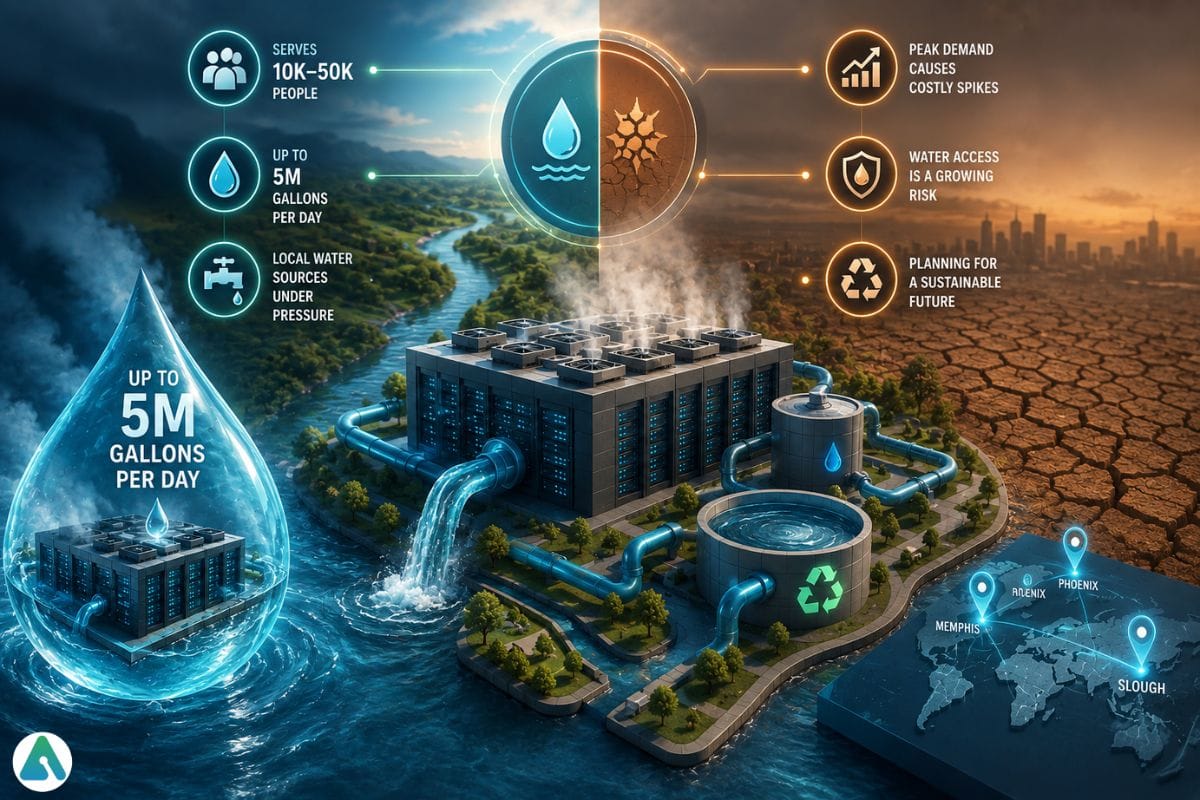
Individual facilities range from several hundred thousand to several million gallons a day. Where the water comes from matters as much as the volume.
The Environmental and Energy Study Institute puts the upper end for large facilities at up to 5 million gallons daily — comparable to a town of 10,000 to 50,000 people. A Meta data center in Newton County, Georgia uses about 500,000 gallons a day. That’s roughly a tenth of the entire county’s water consumption, according to the Lincoln Institute of Land Policy.
Colossus, the Memphis supercomputer campus, draws the most attention. SpaceXAI runs it now, following SpaceX’s acquisition of xAI in February 2026. Colossus draws close to 1 million gallons a day from the Memphis Sand aquifer — the same source that supplies the city’s drinking water. The city contract caps withdrawal at 1.2 million gallons daily. Treat the 1-million-gallon figure as a widely reported estimate, not a number pulled from a released contract document.
SpaceXAI broke ground on an $80 million wastewater recycling plant in October 2025. It’s designed to recycle about 13 million gallons a day of treated greywater in place of aquifer draw — a recycling capacity, not Colossus’s actual daily draw. Construction paused in April 2026 to prioritize the Colossus 2 buildout. After pressure from Memphis Mayor Paul Young and utility officials, SpaceXAI President Michael Nicolls committed in June 2026 to resume work no later than Q1 2027. Elon Musk has floated a Q4 2026 restart if the timeline holds.
Why Peak Demand Matters More Than the Annual Average
A UC Riverside and Caltech study found data center cooling could need 697 million to 1.45 billion additional gallons of peak U.S. capacity by 2030. Evaporative systems can draw six to thirty times their annual average on the hottest days. Meeting that spike could cost water utilities $10 billion to $58 billion in new infrastructure — a bill that tends to land on local ratepayers, not the operator that triggered it. The bigger infrastructure problem isn’t the total water a data center consumes over a year. It’s whether the local utility can deliver enough water on the hottest day of summer.
This isn’t just a Memphis story. Northern Virginia’s “Data Center Alley,” the Phoenix-Mesa desert corridor, and Slough in the UK are fighting the same battle between AI buildout and local water supply. Some newer projects are trying a different path: distributed setups that tap existing home power infrastructure instead of building single mega-facilities that concentrate water and power demand in one place.
Water access has become a formal financial risk, too. SpaceX added water scarcity, drought conditions, and competition for local water resources to its IPO risk factors in June 2026. It warned this could constrain data center expansion and raise costs. One of the largest AI infrastructure operators just told investors, in writing, that water is now as material a constraint as power and chips.
What Could AI’s Water Footprint Cost By 2030?

The “trillions of gallons by 2030” headline isn’t one number. It’s several numbers, measuring different things, and most outlets blur them together.
The most current comes from the UNU-INWEH report, published June 3, 2026, and led by researcher Miriam Aczel under institute director Kaveh Madani. It projects a 9.3-trillion-liter annual water footprint for AI-linked data center electricity by 2030 — equal to the basic domestic water needs of sub-Saharan Africa’s 1.3 billion people. The report pairs that with 945 terawatt-hours of electricity demand and a land footprint above 14,500 square kilometers. Its central warning: efficiency gains alone won’t contain this, because cheaper AI tends to get used more — a rebound effect the authors compare to the Jevons Paradox.
A separate, older UC Riverside estimate, often cited through the World Resources Institute, puts global AI infrastructure’s freshwater draw at 1.1 to 1.7 trillion gallons a year — roughly what every California household uses combined. Sources disagree on whether that lands by 2027 or 2030. That disagreement shows how unsettled this category still is.
For a present-day anchor: the IEA estimated all global data centers — AI and non-AI combined — consumed about 560 billion liters of water in 2023. Secondary reporting splits that roughly two-thirds indirect power-plant water to one-third direct cooling, though that split needs a stronger primary citation. None of these three figures share the same accounting boundary, so don’t stack them together.
Is AI’s Water Use Actually A Problem?

Globally, agriculture still dwarfs AI’s water footprint by a wide margin. Locally, the picture changes fast.
A single large facility can rival a small city’s daily draw. That’s exactly where the real fights are breaking out — not in national statistics. The UNU-INWEH report cited fast-tracked buildout in Querétaro, Mexico during prolonged drought. A 2023 case in Uruguay saw protests over a proposed facility during a freshwater crisis severe enough to make Montevideo’s tap water briefly unsafe to drink.
Right now this reads as a real, worsening local infrastructure and utility-cost problem in specific water-stressed regions, not a planetary crisis. With SpaceX’s IPO filing now naming water as a risk factor, it’s becoming an investor-disclosure story too.
How We Compared These Numbers
This article separates measured values, company-reported figures, modeled estimates, and facility-level withdrawals, rather than treating them as interchangeable. Every number here carries its accounting boundary. Where a figure couldn’t be traced to a primary source with a stated methodology, that’s flagged directly instead of presented with false confidence.
AI Water Use At A Glance
| Metric | Water Estimate | Accounting Boundary | Evidence Type | Source |
|---|---|---|---|---|
| Gemini text prompt (median) | 0.26 mL (~5 drops) | On-site cooling, full serving stack | Measured, company-published | Google Cloud methodology report, 2025 |
| ChatGPT query (average) | ~0.32 mL | Unclear | Company statement | Sam Altman / OpenAI, 2025 |
| GPT-4, 100-word email | ~519 mL (original); ~15 mL (revised) | Full lifecycle — cooling + power-plant water | Research estimate, later revised | Washington Post / UC Riverside, 2024; Ren revision, 2026 |
| Efficient model query | Under 2 mL | Modeled, infrastructure-aware | Academic benchmark | “How Hungry is AI?”, arXiv, 2025 |
| Reasoning model query (DeepSeek-R1) | Over 150 mL | Modeled, infrastructure-aware | Academic benchmark | “How Hungry is AI?”, arXiv, 2025 |
| Standard-resolution AI image | ~28.6 mL | Literature/model-based | Modeled estimate | UNU-INWEH, June 2026 |
| Large hyperscale data center | Up to 5,000,000 gal/day | Facility-level water consumption | Estimate, upper end | EESI |
| SpaceXAI Colossus (Memphis) | ~1,000,000 gal/day, 1.2M contractual cap | Municipal aquifer withdrawal | Widely reported estimate | Memphis Light, Gas and Water; local reporting, 2026 |
| Global data centers (AI + non-AI), 2023 | ~560 billion liters/year | Combined direct + indirect | Primary agency estimate | IEA |
| AI-linked footprint by 2030 | 9.3 trillion liters/year | Electricity-demand-tied projection | Modeled projection | UNU-INWEH, June 2026 |
FAQs
Q. How much water does one AI query use?
One AI query can use anywhere from under 2 mL to more than 150 mL of water, depending on the model, response length, cooling system, and accounting method. Google estimates a median Gemini text prompt at about 0.26 mL, while academic modeling puts some long reasoning-model queries above 150 mL.
Q. Does ChatGPT use a bottle of water for every query?
No. The often-cited 519 mL “bottle of water” figure refers to a modeled 100-word GPT-4 email and includes water used to generate electricity, not just water consumed by the data center. Sam Altman has separately cited about 0.32 mL per average ChatGPT query, but OpenAI has not published enough methodology to independently audit that figure.
Q. How much water does an AI-generated image use?
A standard-resolution AI-generated image is estimated to use about 28.6 mL of water under a June 2026 UNU-INWEH assessment. That is more than 100 times Google’s reported median water use for a short Gemini text prompt, although the two figures use different methodologies.
Q. What uses more water: AI training or AI inference?
AI inference now accounts for an estimated 80% to 90% of AI energy use, because models answer billions of user requests after training. Training can still have a large one-time footprint: a GPT-3-scale training run was estimated to directly evaporate about 700,000 liters of freshwater under a modeled scenario.
Q. Can AI data centers reduce their water consumption?
Yes. Direct-to-chip liquid cooling, immersion cooling, dry-air cooling, and reclaimed wastewater can substantially reduce freshwater consumption compared with conventional evaporative cooling. However, some low-water cooling systems can require more electricity, shifting part of the environmental footprint from water to energy.
Q. Why does AI water consumption vary by location?
AI water use depends heavily on climate, cooling technology, electricity source, and local water availability. A data center in a cool climate may need less evaporative cooling than one in a hot, dry region. The same AI workload can therefore have very different water footprints depending on where it runs.
Q. Does AI data center cooling use drinking water?
Sometimes. Some data centers use municipal water supplies or freshwater sources for cooling. In Memphis, for example, the Colossus facility has been widely reported as drawing water from the Memphis Sand aquifer, which also supplies the city’s drinking-water system.
Q. Does AI water consumption permanently waste the water?
Not necessarily. Water consumption usually means water that leaves the local water system, primarily through evaporation, rather than water that is permanently destroyed. Closed-loop cooling and reclaimed-water systems can reduce freshwater withdrawals and return or reuse much of the water.
Q. How much water does ChatGPT use per day?
There is no publicly verified total daily water-use figure for ChatGPT. A daily estimate would require reliable data on the number of queries, the models serving those queries, their energy consumption, cooling systems, locations, and the accounting boundary used to calculate water consumption.
Q. Is AI’s water use bigger than agriculture’s water use?
No. Agriculture uses vastly more water globally than AI data centers. The concern with AI is primarily local: a large data center can place substantial pressure on a particular water supply, especially during droughts or periods of peak summer demand.
Q. Will AI use more or less water by 2030?
Total AI water demand is expected to increase by 2030 even as individual AI queries become more efficient. Efficiency improvements can reduce water and energy use per task, but rapidly growing AI adoption, inference workloads, and data center construction can increase total demand.
Q. How much water could AI use by 2030?
A June 2026 UNU-INWEH report projects an annual 9.3 trillion-liter water footprint associated with AI-linked data center electricity demand by 2030. This is a modeled projection rather than a directly measured global total, so it should not be compared directly with narrower estimates of on-site cooling water.
Q. Why are estimates of AI water use so different?
AI water estimates differ because researchers and companies measure different parts of the water footprint. Some count only on-site cooling, while others include water used to generate electricity or manufacture hardware. Model size, response length, data-center location, cooling technology, and electricity mix also change the result.
Related: Is Character AI Bad for the Environment? The Hidden Carbon Cost of Chatbots
| Disclaimer: AI water-use figures vary widely because companies and researchers use different methods and accounting boundaries. Some numbers are measured, while others are modeled estimates or company-reported figures. Actual water use can change based on the model, data-center location, cooling system, and electricity source. This article is for informational purposes and reflects available data as of August 2026; figures may change as better data becomes available. |
