
Most conversations about AI disruption center on hospitals, banks, and self-driving cars. Nobody talks much about the HVAC technician who built a decent business on word-of-mouth referrals and suddenly can’t figure out why the phone stopped ringing the way it used to.
That’s not a coincidence. That’s AI restructuring local search from the ground up.
Search Engines Stopped Matching Keywords. They Started Reading Intent.
For years, local SEO operated on a fairly simple principle: target the right keywords, build some backlinks, and rank. That model held up reasonably well until Google’s AI-powered systems — specifically the Search Generative Experience and AI Overviews — changed what actually appears at the top of the results page.
A homeowner typing “why is my AC blowing warm air” no longer sees a list of HVAC companies first. They get an AI-generated answer synthesized from multiple sources. The local business listings appear below that. For companies that depended entirely on ranking for short, transactional keywords, this shift quietly drained their traffic without any obvious explanation.
Two numbers put this in perspective. BrightLocal’s Local Consumer Review Survey found that 82% of consumers now read AI-generated review summaries — but only 40% of all consumers actually trust AI platforms to give them accurate local business recommendations. That gap between reading and trusting tells you something important: customers are using AI summaries as a starting point, then fact-checking. In fact, 88% of AI summary readers verify the information against original reviews before making a final decision.
That behavior pattern matters for HVAC businesses more than most realize. The AI answer box shapes the first impression. What customers find when they verify that impression determines whether they call.
The businesses that understood this early stopped optimizing only for rankings. They started optimizing for the verification layer — the reviews, citations, and third-party signals that customers and AI systems both rely on to confirm credibility. That shift changes how HVAC companies approach SEO at a structural level. The work moves from keyword targeting to proving credibility across every source an AI system reads.
AI Doesn’t Just Find Businesses Anymore. It Investigates Them.
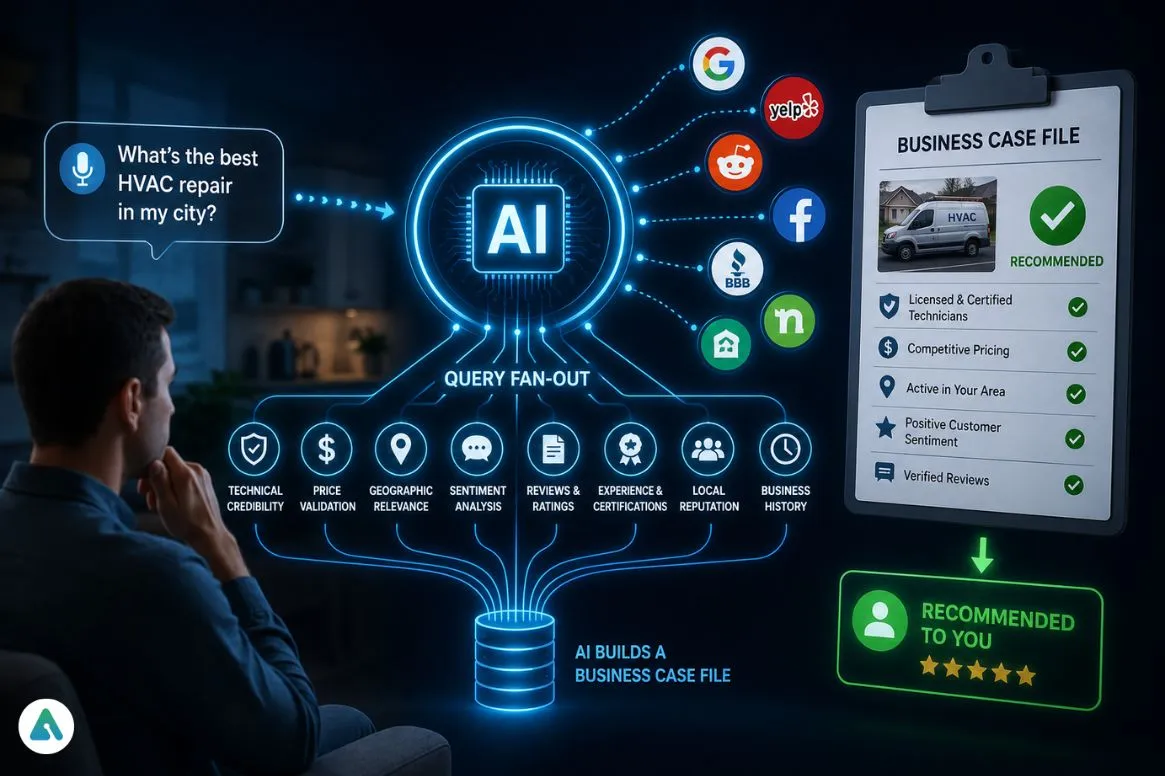
When someone asks an AI assistant for “the best HVAC repair in my city,” the system doesn’t run a simple keyword match. It runs what researchers call Query Fan-Out — a process where a single prompt gets broken into eight or nine sub-queries running simultaneously in the background.
The AI checks technical credibility (are your technicians certified?), price validation (do your rates match the local average?), geographic relevance (do you have verified activity in the customer’s specific neighborhood?), and sentiment analysis across platforms like Reddit, Yelp, and local forums.
In other words, the AI builds a case file on your business before it ever recommends you to the user. A company with a clean website but thin third-party presence loses that evaluation every time, even if they rank well in traditional search.
This changes what “visibility” actually means for local service businesses. It’s no longer just about being on page one. It’s about being verifiable across the entire web ecosystem that AI systems crawl and synthesize.
The Tools Reshaping How HVAC Companies Build Their Strategy
AI hasn’t only changed how customers find businesses — it changed how smart operators build their marketing strategies in the first place.
Platforms like Surfer SEO, MarketMuse, and SEMrush’s AI Assist now process thousands of local search queries and surface patterns a human analyst would take weeks to identify manually. They map out seasonal demand curves before they peak, identify content gaps competitors haven’t filled, and flag which service pages carry ranking potential versus which ones drain crawl budget without returning value.
The practical output of this is significant. HVAC companies working with specialized HVAC SEO services that integrate these AI tools can build a 12-month content calendar in a fraction of the time it once required — and target long-tail queries that short-tail competitors completely ignore.
That matters because long-tail searches — phrases like “best ductless AC installation for older homes” — now account for a growing share of high-intent HVAC traffic. A 2025 keyword analysis of 319 HVAC-related search terms found that long-tail queries represent 21.6% of the dataset and convert at significantly higher rates than broad terms. These searches attract customers who already know what they want. They don’t need convincing. They need a company that shows up for exactly their problem.
Most local operators still target the broad terms and wonder why their traffic doesn’t convert.
The Cost Gap Between AI-Assisted and Traditional SEO Is Widening Fast
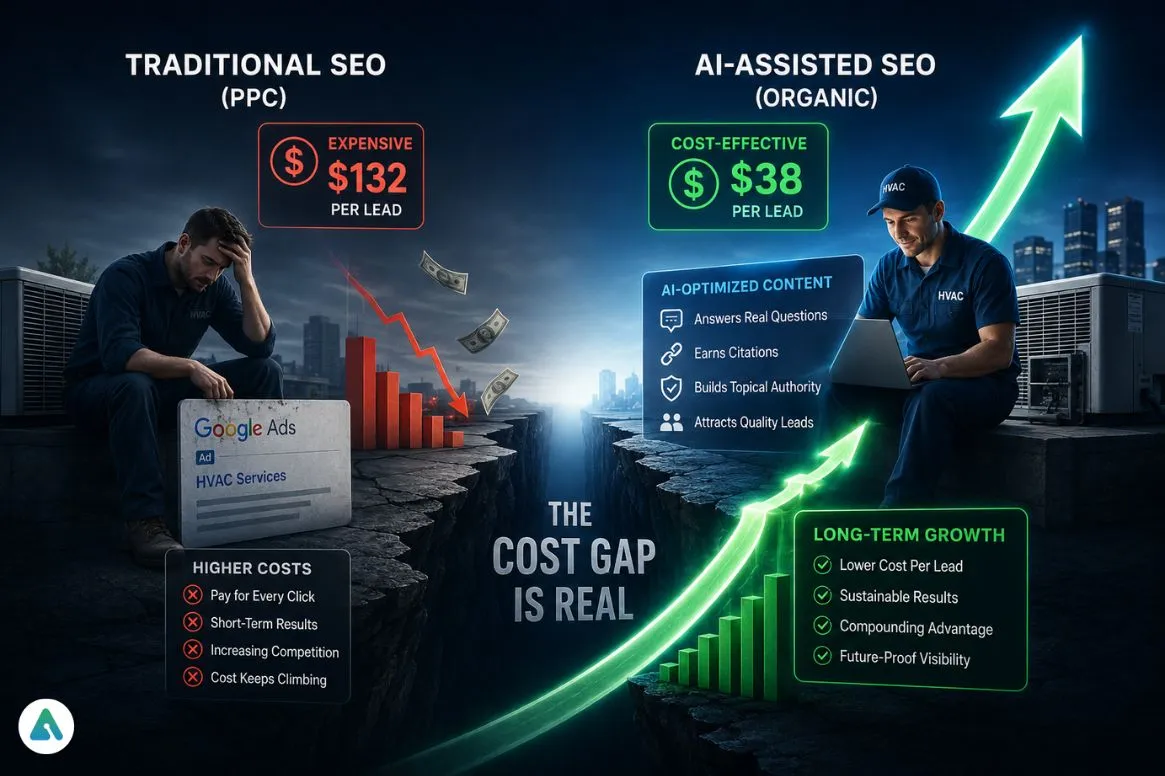
Here’s a data point worth sitting with: according to a 2025 study, commercial HVAC companies using AI-informed SEO saw a 54% higher lead-to-contract rate compared to those relying on pay-per-click advertising alone. More striking is the cost disparity — Google Ads now averages $132 per commercial HVAC lead, while AI-optimized organic pages generate leads at an average cost of $38.
That’s not a marginal efficiency gain. That’s a structural cost advantage that compounds over time.
A digital marketing agency in Orlando that works across local service verticals put it plainly: the businesses gaining ground in local search right now aren’t the ones spending more on ads. They’re the ones building AI-readable content architectures that answer real questions, earn third-party citations, and establish topical authority in their service areas — month after month.
The gap between those two groups widens every quarter. And once a competitor earns consistent placement in AI Overviews or voice search responses, closing that gap becomes exponentially harder.
What Structural AI Readiness Actually Looks Like
It’s worth being specific about what “AI-optimized” content means in practice, because the term gets used loosely.
AI crawlers prioritize structured, answer-first content. That means FAQ schema with concise 40–60 word responses that voice assistants can extract directly. It means service pages with Georadius schema that define exact service boundaries, so location-based queries return accurate results. It means geotagged photos and job-specific descriptions that verify a company actually operates in the neighborhoods it claims to serve.
An emerging standard called llm.txt — essentially an instruction file for AI bots — helps crawlers navigate a site’s data hierarchy without getting stuck on irrelevant pages. Most HVAC websites have none of this. The ones that do have a measurable head start in AI-driven referrals, which convert at higher rates precisely because the AI has already verified the business’s credibility before the customer even makes contact.
The Window Is Still Open — But Not for Long
Traditional search volume for generic HVAC queries is declining. BrightLocal data shows that 69% of all searches now end without a single click — users find what they need directly inside AI-generated summaries at the top of the results page. That zero-click shift used to be a minor inconvenience. Now it’s the default behavior. The share of consumers using AI for local business recommendations also jumped from just 6% in early 2025 to 45% within months — a pace of adoption that caught most local businesses completely off guard.
Lead quality from AI-driven referrals is rising sharply, though — because the system filters out low-intent browsing before making a recommendation.
That dynamic rewards businesses that invest in depth over breadth. One genuinely authoritative service page beats twenty thin keyword-stuffed pages in every AI evaluation. A business with verified reviews across multiple platforms, clear schema markup, and consistent local citations earns AI trust faster than a business with a polished homepage and nothing behind it.
The HVAC companies that recognized this shift early didn’t wait for their traffic to drop before responding. They built their AI readiness while competitors were still optimizing title tags.
That gap is real, it’s measurable, and it keeps growing.
Related: AI Just Took Over Holiday Shopping — And Retail Will Never Be the Same
