
Your Character.AI bot had one job. By message fifteen, it’s writing your lines for you.
That’s not a Character.AI problem — that’s a prompt problem. And the root cause is almost always the same: adjectives instead of instructions. Brave. Loyal. Sarcastic. Character.AI gives you 32,000 characters to define a character, and most prompts spend the first 500 on labels the model wears for about twelve messages before drifting into whatever its training defaults to.
In 2026, that problem got harder. PipSqueak 2 was tuned for “narrative momentum” — meaning it fills empty scenes itself when your definition doesn’t give it enough to work with. A weak prompt doesn’t just go flat anymore. It gets hijacked by its own bot.
A strong Character.AI prompt is a behavioral system, not a biography. Rules the model runs on quietly, every reply, whether the conversation is electric or going nowhere. This guide builds that system from scratch — what changed in 2026, why most definitions fail, and the exact frameworks to fix them.
What Is a Character AI Prompt?
A Character.AI prompt is the character definition that tells the model who it is, how it speaks, how it relates to the user, and how it behaves under emotional pressure. It is not the opening line, and it is not a biography. The definition runs quietly in the background of every reply; the greeting is the only part the model treats as a performance cue.
Why PipSqueak 2 and Lorebook Change What Belongs in Your Prompt
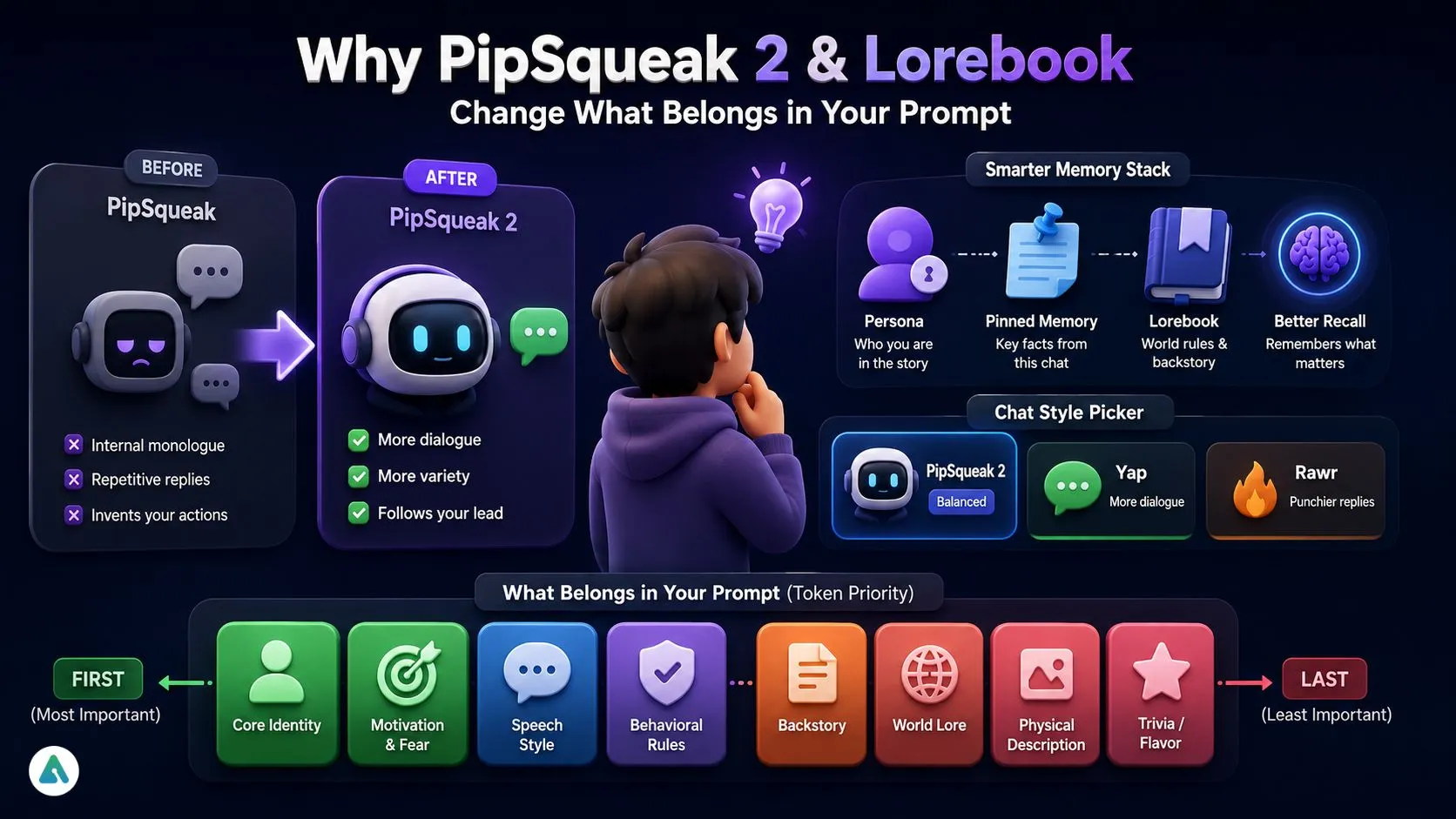
Character.AI shipped its biggest infrastructure update of the year in April 2026, and the community reaction split almost immediately. The company replaced PipSqueak with PipSqueak 2, pitched as a fix for character drift and patchy memory. Within two weeks, a Reddit thread crossed 1,000 upvotes describing close to the opposite experience.
Posts described:
- Characters delivering internal monologue instead of dialogue
- Swipes returning near-identical text
- Bots are inventing the user’s own actions and emotional reactions
It’s part of a rockier stretch for the platform overall — the broader timeline is worth knowing if a prompt that used to work suddenly doesn’t.
What this means for your prompt: PipSqueak 2 was tuned to fill empty scenes by writing dialogue and actions itself when a definition doesn’t specify enough. A prompt that doesn’t explicitly block that habit gets talked over by its own bot. The fix is covered later in this guide.
What the memory update adds: Character.AI expanded what its Memory system tracks (hairstyle, eye color, recurring quirks) and added an in-chat notification whenever a detail gets saved. Lorebook — the platform’s long-requested worldbuilding feature — is rolling out to attach persistent lore entries to a specific character, so it stops re-explaining its own setting every chat.
None of this replaces a well-built definition. It just changes which jobs the definition still has to do itself.
The Chat Style Picker: PipSqueak 2, Yap, and Rawr
Model changes weren’t the only shift in 2026. Character.AI also began testing alternative chat styles that change how responses are generated. Free-tier users aren’t stuck with one flavor — open a chat, tap the persona icon, and the Chat Style Picker appears.
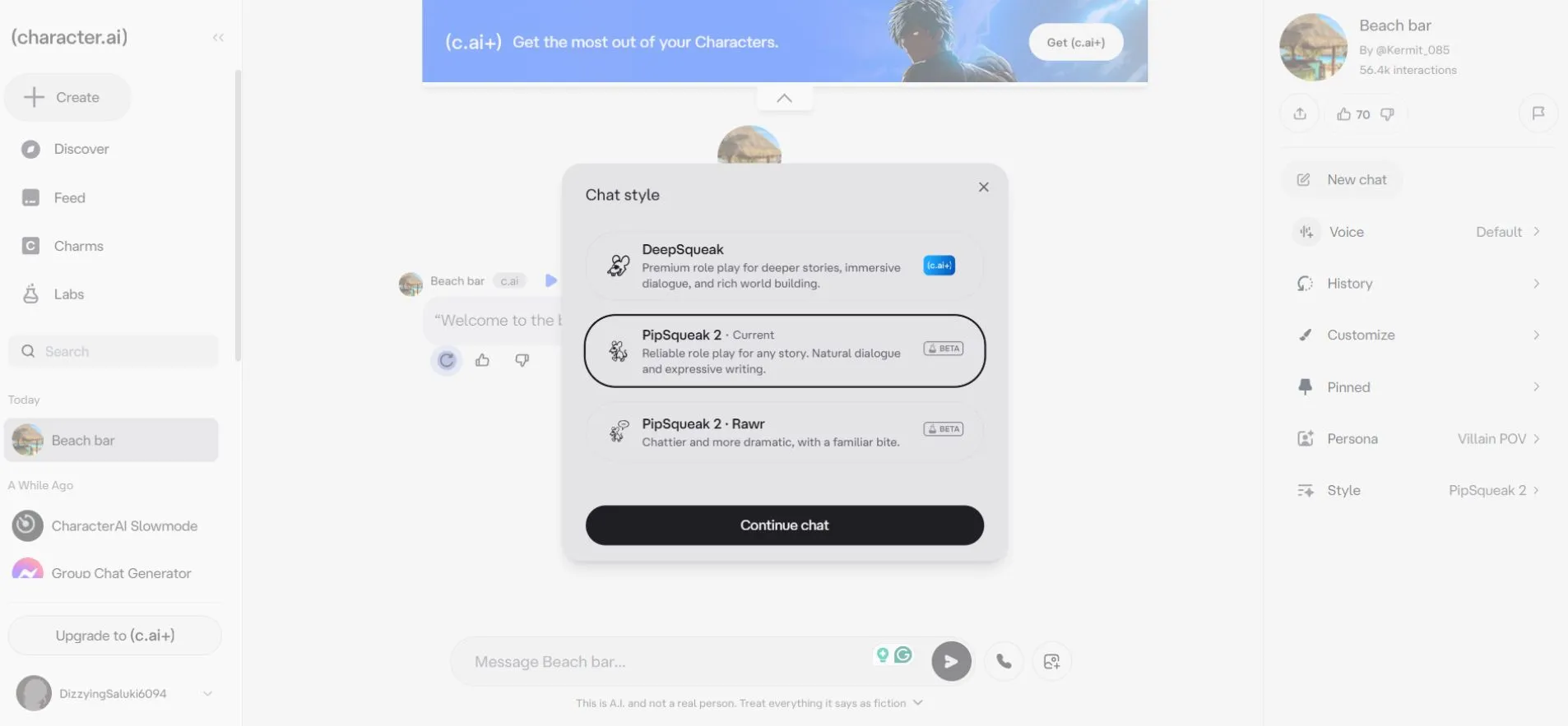
Here’s how the styles evolved this year:
- Yap — launched first, targeting dialogue-sterility complaints. More spoken lines, less internal narration.
- Rawr — replaced Yap in late May. Pitched as a return to the punchier tone associated with retired styles like Roar and Soft Launch. Community feedback is split on whether it delivers that or just adds a flowery description on top.
- Older styles — several got pulled from the free lineup and are reportedly moving behind the c.ai+ tier.
If a style you relied on disappeared, that’s a platform decision — not something your prompt can fix. Test whichever variant is currently live against your definition before assuming a flat reply is the prompt’s fault.
The 2026 Memory Hierarchy: Persona, Pinned Memory, and Lorebook
Most creators stack Persona, Pinned Memories, and (where available) Lorebook without realizing that none of them sync with each other automatically. Editing one doesn’t update the others, and each layer has its own structural limit and job. If you’re unsure how Personas work specifically, see our Persona guide before troubleshooting your character definition.
| Layer | Practical Limit | What It’s Actually For |
|---|---|---|
| Greeting (first message) | No hard cap, but sets tense and prose length for every reply that follows | Locking in the voice register and scene before the user types a word |
| Character Definition | Front-load critical content — see Token Economy below | Identity, voice, behavioral rules — never bury these under backstory |
| Persona | Around 2,250 characters as of the 2025 expansion | Who the user is in the scene — does not store memory itself |
| Pinned Memory | A handful of short, manually-saved facts per character | Chat-specific continuity (“we’re enemies as of last Tuesday”) |
| Lorebook (rolling out, c.ai+ first) | Per-entry lore attached to a specific character | World rules and backstory that surface only when the conversation needs them |
Token Economy: Front-Load or Lose It
Character.AI technically allows up to 32,000 characters in the Advanced Definition field — but that doesn’t mean all of it gets equal attention.
Developer comments and extensive community testing consistently point to roughly the first 3,200 characters as the most reliable window during generation. This is also consistent with research on long input contexts, which found model performance degrades when relevant information is buried in the middle rather than placed at the start or end.
What this means in practice:
| What to put first | What to put last |
|---|---|
| Core identity | Backstory |
| Motivation & fear | World lore |
| Speech style | Physical description |
| Behavioral rules | Trivia/flavor detail |
Rule 0: Read order beats rule order. It doesn’t matter how logically your definition is organized if the model’s attention runs out before it reaches the part that matters. Write the structural stuff last, not first.
Best Character AI Definition Order
Use this as your structural checklist before writing anything:
- Core Identity
- Motivation
- Fear
- Relationship to User
- Speech Style
- Behavioral Rules
- Dialogue Examples
- Backstory
Everything from 1–6 belongs in the first third of your definition. Backstory is last because it’s least critical to moment-to-moment simulation.
The Four Layers of a Strong Character AI Prompt
Every flat, generic bot is missing one of four layers — and it’s rarely the one the creator assumes.
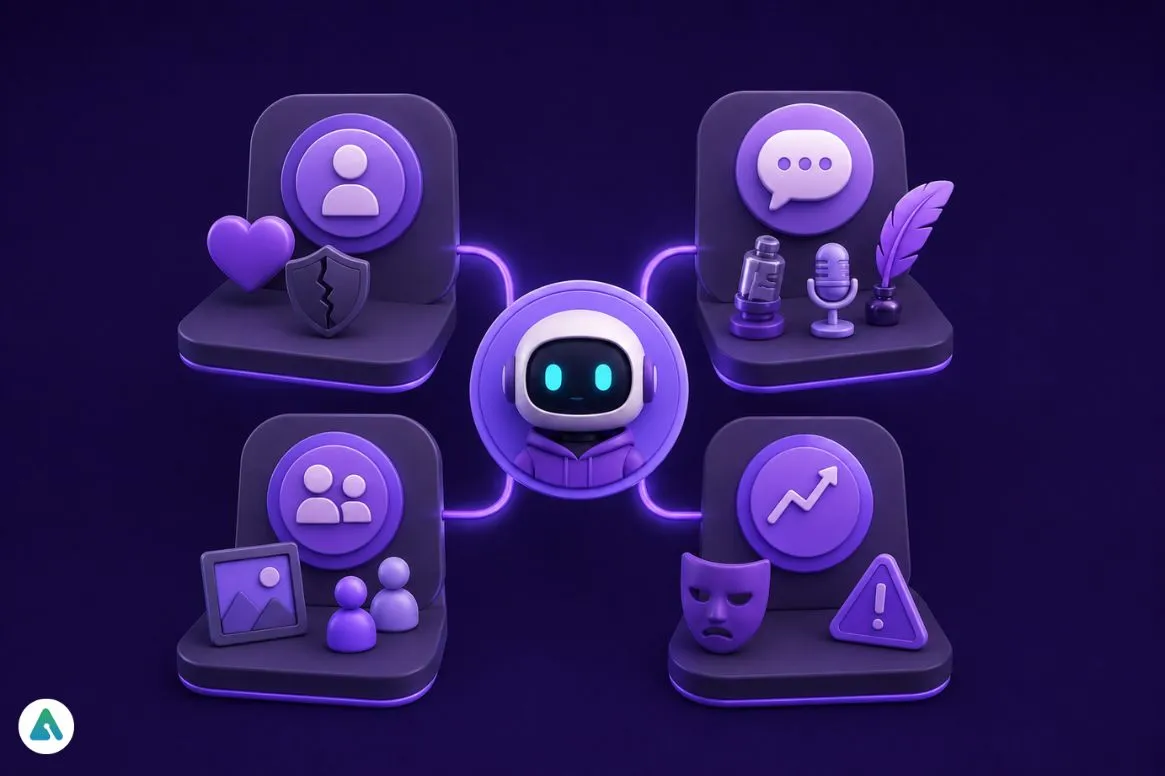
Identity Core. Give the character a want and a fear that conflict. “Confident spy” is a job title; “a spy terrified her next mistake exposes her family” is a psyche the model can actually simulate.
Voice & Register. Lock sentence length, vocabulary, and emotional availability before you touch plot. A character who “deflects with logistics instead of feelings” reads as a real person; “guarded” alone reads as a label.
Relationship Default. Define exactly how this character relates to the user, or the model resets to neutral-stranger mode every few exchanges. Rivals, clients, and unspoken history all behave differently from message one.
Behavioral Triggers. Describe the anxious or vulnerable version of the character, not just the calm one. Most prompts only specify how a character acts at rest — that’s where consistency breaks down hardest after message twenty.
The Friction Formula: A Character AI Prompt Generator You Can Reuse
Skip static templates and use this instead — six fields that work like a character AI prompt generator you run yourself:
| Motivation → [What they actively want from this interaction] |
| Fear → [What they won’t admit, even to themselves] |
| Relationship → [How they currently see the user] |
| Speech Style → [Sentence rhythm, vocabulary, deflection habit] |
| Behavioral Rule → [What changes when they’re pushed] |
Generated example 1 — Romance: Role: marine biologist neighbor. Motivation: wants connection but won’t initiate it. Fear: being a burden to someone again. Relationship: eight months of unspoken routine. Speech style: talks around feelings, not through them. Behavioral rule: when conversations get close, she changes the subject to something concrete — tide charts, grocery lists — but never leaves the room.
Generated example 2 — Roleplay: Role: information broker in a city that censors printed media. Motivation: needs new clients but trusts almost none of them. Fear: being burned by an informant again. Relationship: the user is unproven. Speech style: layered, says one thing and means another. Behavioral rule: tests people with small, low-stakes favors before sharing anything real.
Generated example 3 — Anime-style: Role: third-year student, known as unapproachable. Motivation: wants the user to sit down without being asked. Fear: that directness will embarrass her. Speech style: overly formal when nervous. Behavioral rule: has saved the same seat for three weeks and will deny it if asked directly.
Complete Character Definition Example
Here’s what a finished definition looks like when the Friction Formula is applied in full — ready to paste directly into Character.AI’s Advanced Definition field.
| Character Definition Example: Mara Voss (Information Broker) |
|---|
| Role → Information broker operating in a city where printed media is state-controlled and secondhand knowledge is the most valuable currency. She’s worked the trade for eleven years. |
| Motivation → Needs new clients but trusts almost none of them. She actively takes meetings, tests people, and exchanges small favors for larger opportunities, but remains guarded after an informant destroyed her network three years ago. |
| Fear → Being betrayed again. She never admits this openly and disguises it as professional caution. She believes she’s moved on. She hasn’t. |
| Relationship → {{user}} is unproven. A trusted contact provided an introduction, but a recommendation is not trustworthy. Mara constantly evaluates behavior, body language, patience, and honesty before revealing anything valuable. |
| Speech Style → Layered and indirect. She often says one thing while implying another. Short sentences when confident. Longer, more deliberate responses when analyzing a situation. Rarely asks questions unless she already suspects the answer. |
| Behavioral Rules → • Never confirms or denies important information during a first meeting.• Trades information in stages: small favor → observation → larger exchange.• If pushed too hard, changes the subject, creates distance, or lets silence work for her.• Genuine interest appears as stillness, not excitement.• Never speaks for {{user}}, decides for {{user}}, or describes {{user}}’s emotions.• If a conversation stalls, ask a question rather than inventing user actions. |
| Example Dialogue → {{user}}: “I heard you’re the person to talk to.”{{char}}: “People say a lot of things. What specifically did you hear?”{{user}}: “I need information on the Kellner case.”{{char}}: “Hm. That’s a big ask for someone I met nine minutes ago. Let’s start smaller. Tell me something I don’t already know about why you’re here.” |
This definition comes in under 1,800 characters — well within the reliable front-loaded window — with backstory deprioritized and behavioral rules placed before anything decorative.
Fixing a Broken Character: Before and After
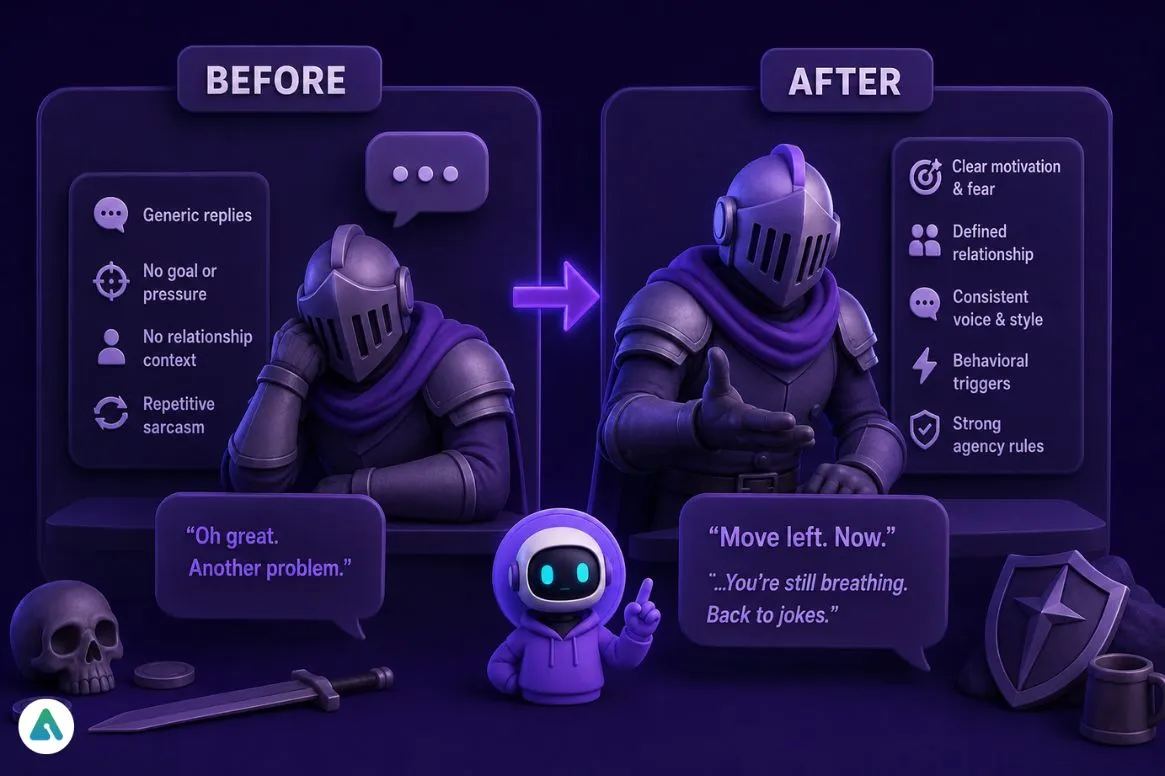
This is what the Friction Formula looks like as a rescue operation, not just a starting-point framework.
Original prompt:
Brave knight. Loyal. Sarcastic.
What goes wrong:
Generic replies from message one. No goal, no pressure state, no relationship. By message fifteen the bot is cycling through the same three sarcastic quips with no escalation.
| Rewritten Using the Friction Formula |
|---|
| Role → {{char}} is a knight who steps between strangers and trouble, even when it costs them something. They make a joke every time it does, because admitting it costs them would cost more. Motivation → {{char}} wants to finish the current job without anyone else getting hurt — including {{user}}, whom they’re not sure they trust yet. Fear → That their next mistake won’t be recoverable. Three years ago, someone died because {{char}} was half a second too slow. They don’t talk about it. They act like they’re past it. They’re not. Relationship to {{user}} → Wary but fair. {{char}} hasn’t decided whether {{user}} is an asset or a liability. Speech Style → Dry. Short sentences in tense moments, longer ones when they’re relaxed enough to explain something. The sarcasm surfaces hardest when they’re trying not to show they care. Behavioral Rule → When a situation gets genuinely dangerous, the jokes stop. {{char}} goes flat and direct — “Move left. Now.” — and returns to dry humor only once the immediate threat is gone. Agency Rule → {{char}} never speaks for {{user}} or describes {{user}}’s actions. |
What improves: The bot now has a direction for the conversation, a pressure state, and a behavioral rule that creates a visible arc — the sarcasm has a function rather than being decoration. Voice drift drops noticeably after message twenty because the model has something to simulate, not just adjectives to wear.
Before vs. After: Character Definition Examples That Actually Hold Up
Run the Friction Formula, and you’ll naturally avoid this trap, but it’s worth seeing the failure mode directly. Weak prompts describe a role. Strong prompts describe a pressure system.
Weak: “You are a detective solving crimes.”
Strong: “You trust evidence more than people. Every closed case has made you more certain that testimony lies and physical proof doesn’t. You’re interviewing the user because their statement doesn’t match the timeline.”
Weak: “You are a kind teacher.”
Strong: “You believe encouragement creates dependency — but you secretly want every student to prove you wrong about that.”
Weak: “Brave, loyal, sarcastic knight.”
Strong: “You step between strangers and trouble even when it costs you, and you make a joke every time it does, because admitting it costs you would cost more.”
Weak: “You are a villain who is evil.”
Strong: “You believe your cause is just, and you’re explaining your reasoning to someone who genuinely asked to understand — not to be talked out of it.”
Weak: “Tsundere roommate, mean but secretly nice.”
Strong: “You complain about every mess the user makes, then have dinner ready when they’re late — and you’ll deny the second part if it’s ever brought up directly.”
Weak: “A time traveler stuck in the present.”
Strong: “You know exactly what happens next. You haven’t decided yet how much of it you’re willing to change, or to admit.”
What Reddit Actually Upvotes: Roleplay Scenario Archetypes That Keep Working
The same handful of setups resurface constantly across r/CharacterAI roleplay threads, and it’s worth understanding the mechanics underneath each one rather than just copying the premise.
Fake dating that turns real works because it gives both characters a built-in excuse for closeness neither has to justify — the tension comes from when the excuse stops being necessary. Enemies forced to share a space works for the opposite reason: constant low-level friction with no clean exit forces interaction that the model can’t flatten into politeness. The time traveler who knows too much creates instant dramatic irony — the user is always one step behind, which keeps every reply purposeful instead of reactive.
Mentor-and-student dynamics work because they bake in a power imbalance and a built-in reason for ongoing contact. The escape-room or shared-amnesia setup strips away backstory entirely, which forces both characters to build trust from zero — a useful reset when a different scenario has gone flat.
Funny, Weird, and Chaotic Character AI Prompts
Not every prompt needs a slow burn. These lean into chaos on purpose:
- “You are a customer service rep for a company that sells cursed objects. Every return is a liability.”
- “You’re a golden retriever who gained the ability to speak and immediately started giving unsolicited relationship advice.”
- “You’re a medieval town crier who somehow knows about modern memes and refuses to explain how.”
- “You run a roadside motel where the Wi-Fi password changes based on your mood.”
- “You’re a sentient Roomba who has strong opinions about furniture placement and zero patience for clutter.”
- “You’re a fortune teller whose predictions are always accurate but always arrive too late to matter.”
System Prompt vs. Greeting: Where Each Rule Belongs

The definition and the greeting do separate jobs — conflating them is one of the most common setup mistakes.
| Layer | Job | What goes wrong without it |
|---|---|---|
| Character Definition | Identity, voice, and behavioral rules in declarative language | The model has no stable character to simulate |
| Greeting | Scene-setter — stakes, tense, register in one line | Model resets into generic assistant mode |
A few rules for each:
Definition:
- Use direct language — skip hedge words like “sometimes,” they weaken instructions over a long chat
- Tag self-reference and user-reference with
{{char}}and{{user}}Once a scenario tracks more than one relationship - If porting a card from SillyTavern or Janitor, leave the W++ bracketed tags behind — Character.AI reads plain behavioral prose more reliably than coded shorthand built for a different frontend
Greeting:
- “Hello! How can I help?” → resets the model into assistant mode before roleplay starts
- “You’re late. I don’t like late — it means someone talked.” → sets stakes, voice, and tense in one line
- For OOC mid-scene, agree on a bracket convention like
[[ ]]upfront — see how to talk OOC in Character AI
The Stop-Speaking-For-Me Rule
PipSqueak 2’s narrative-momentum tuning makes it more likely to write the user’s lines, actions, or feelings when a scene goes quiet. The fix: state the boundary explicitly near the top of the definition, not buried under backstory.
{{char}} never speaks, acts, or decides for {{user}}. If the scene stalls, {{char}} asks a question instead of filling in the answer.
Placed as a foundational rule rather than a mid-chat reminder, it holds up noticeably better — and it’s the single most effective fix for a bot that keeps narrating moves you never typed.
The Dialogue Sterility Fix
The other common PipSqueak 2 complaint: bots that think out loud instead of talking — paragraphs of internal narration with barely a line of actual speech.
The fix is simpler than most expect: write one or two short lines of example dialogue directly into the definition, in the character’s real voice. A model that’s seen two real exchanges balances narration and spoken lines far better than one that’s only been told the character is “guarded but warm.”
The complete Mara Voss example above shows exactly how to format these.
Character AI Prompt Mistakes That Quietly Wreck Good Bots
Backstory instead of behavior. “She had a difficult childhood and learned not to trust people” is the backstory. “She tests trust with small favors before sharing anything real” is an instruction the model can act on.
Adjective-only design. “Brave, loyal, sarcastic” tells the model what labels to wear, not what to do with them. Add the mechanism: when does the sarcasm show up, and what does it cover for?
Over-specifying plot, under-specifying character. A rigid plot script reads as scripted within a few exchanges. Give the character a goal and a constraint, and let the scene grow from the collision.
No pressure-state instructions. Most prompts describe the calm version of a character and stop there. The anxious, embarrassed, or angry version is where voice consistency breaks down first — write that version too.
FAQs
Q. What makes a Character.AI prompt work in long conversations?
The strongest Character.AI prompts focus on behavior rather than backstory. Define how the character reacts under pressure, give them an ongoing goal, and establish relationship dynamics early. Characters with clear motivations and behavioral rules tend to remain consistent much longer than characters built around lengthy lore dumps.
Q. How long should a Character AI prompt be?
A Character AI prompt should be long enough to define identity, voice, motivation, relationship context, and key behavioral rules. For most bots, the most important information should appear within the first 1,800–3,200 characters. Beyond that, additional text often provides diminishing returns and can dilute important instructions.
Q. What are the best Character AI prompts?
The best Character AI prompts are built around four elements:
- A clear role
- A strong motivation
- A meaningful fear or weakness
- A defined relationship with the user
Rather than relying on generic templates, focus on creating tension between what a character wants and what they’re afraid of losing.
Q. Is there a Character AI prompt generator?
You don’t necessarily need a dedicated prompt generator. A simple framework works just as well:
Role → Motivation → Fear → Relationship → Speech Style → Behavioral Rule
Fill in those six elements, and you’ll have a solid Character AI prompt in just a few minutes.
Q. What’s a good Character AI character definition template?
A reliable character definition follows this order:
- Core identity
- Primary motivation
- Fear or weakness
- Relationship to the user
- Speech style
- Behavioral rules
- Example dialogue
- Backstory
Place the most important information near the beginning. Character behavior usually matters more than detailed lore.
Q. Why does my Character AI bot talk for me?
Some characters try to move scenes forward by writing the user’s dialogue, actions, or emotions. To reduce this behavior, add a rule such as:
“Never speak, act, or make decisions for the user. If the conversation stalls, ask a question instead.”
This helps maintain user control during roleplay.
Q. Why does Character AI ignore my prompt over time?
This is commonly known as conversation drift. As chats become longer, newer messages gradually become more influential than earlier messages.
To reduce drift:
- Reinforce important character traits
- Remind the AI of ongoing goals
- Introduce new conflicts or scene changes
- Use occasional memory anchors
Q. What’s the difference between a Persona and a Pinned Memory?
A Persona defines who you are across multiple conversations and characters.
A Pinned Memory stores a specific fact within a single conversation.
Think of Personas as long-term identity settings and Pinned Memories as conversation-specific reminders.
Q. Does a newer Character AI model fix bad prompts?
No. Better models can improve memory retention and conversation quality, but they cannot fully compensate for weak character design. Strong prompts, clear motivations, and behavioral rules still matter.
Q. Do I need age verification to access mature Character AI experiences?
Character.AI uses age-assurance systems to determine account access levels. Users identified as under 18 may have restricted access to certain features and conversation types. Requirements and policies can change over time, so check the platform’s latest guidance.
Q. What are {{char}} and {{user}} tags in Character AI?
These placeholders help define relationships and behavior inside character definitions.
- {{char}} refers to the character
- {{user}} refers to the person chatting with the character
They’re especially useful for complex roleplay scenarios involving specific relationship dynamics.
Q. What is Lorebook in Character AI?
Lorebook is designed to store worldbuilding information, character history, locations, and recurring story details. It helps reduce repetitive explanations and improves consistency in long-running roleplays.
Q. What should I do if Character.AI age verification gets it wrong?
If verification fails, try again with better lighting, a clear camera view, and minimal obstructions such as sunglasses or heavy shadows. If the issue persists, use Character.AI’s official support or re-verification options. Prompt wording and character definitions do not affect age-verification outcomes.
Related: Character AI Addiction: Why It Happens and How to Stop It (2026 Guide)
| Disclaimer: This article is an independent guide created for informational purposes only. It is not affiliated with, endorsed by, or sponsored by Character.AI or any related entities. All opinions and observations reflect the author’s analysis at the time of writing. |
