
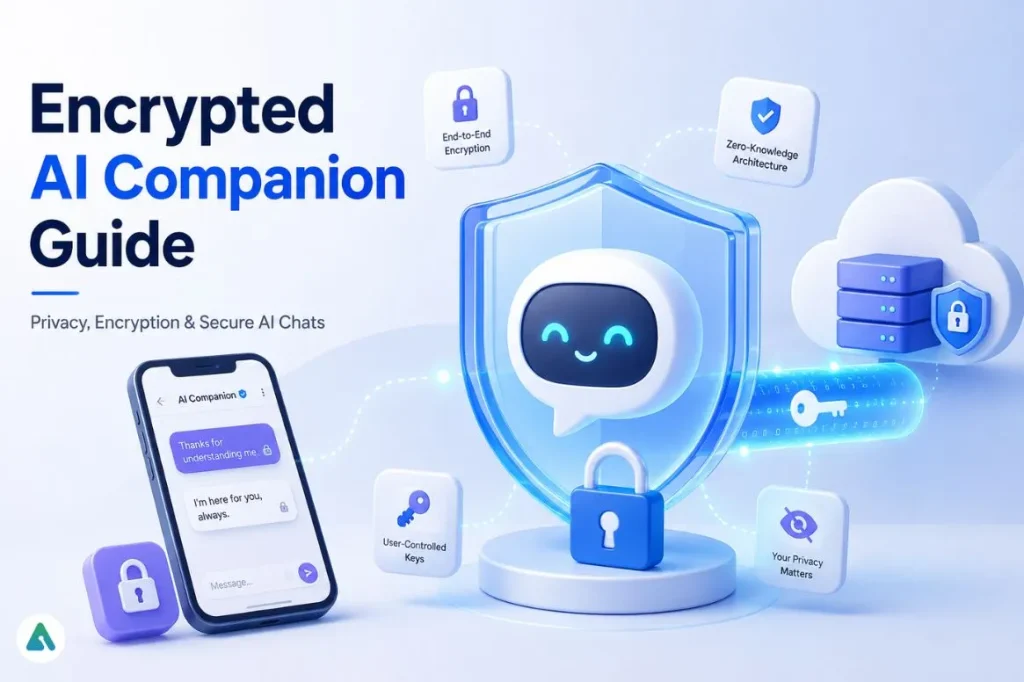
Most AI companions claim your conversations are encrypted. What they don’t always tell you is that encryption doesn’t automatically mean privacy. The question that matters is simple: who holds the keys? In 2026, a handful of new AI architectures are finally offering a different answer.
TL;DR — Key Takeaways
|
Most people searching for an encrypted AI companion aren’t looking for a lesson in cryptography.
They’re asking something simpler — and more personal: Can I trust this AI with what I’m about to tell it?
In 2026, that answer is more complex than it was a few years ago — but also more meaningful.
AI companions are no longer basic chatbots. Millions of users now rely on them as emotional sounding boards, creative partners, and daily conversation tools. People share things they wouldn’t normally say out loud: relationship problems, financial stress, or mental health struggles. To support this, platforms build long-term memory and relationship continuity — which means storing large amounts of deeply personal data.
That creates a tension most marketing pages don’t clearly explain.
The more emotionally intelligent an AI companion becomes, the more personal data it must store. And terms like “encrypted,” “secure,” and “zero-knowledge” are often used interchangeably — even though they mean very different things in practice.
This guide breaks down what those terms actually mean, who can access your data, and how to tell whether an AI companion is truly private or just marketed that way.
The Encryption Misconception That Costs Users Their Privacy
Strip away the marketing language, and encryption is a mathematical lock. It scrambles readable text into cryptographic noise that requires a key to reverse.
The question that matters isn’t whether the lock exists. It’s who holds the key.
A platform can truthfully claim “military-grade AES-256 encryption” while simultaneously storing your conversation history in a form their own engineers can decrypt, search, and feed into training pipelines. The encryption protects your data from outside hackers. It does nothing to constrain the company that holds the keys.
This is not a technicality. It’s the central privacy question, and most AI companion marketing deliberately avoids addressing it.
How Standard Cloud AI Companions Are Actually Structured
When you send a message to a mainstream cloud-based AI companion, your data passes through three layers — and privacy erodes at each one.
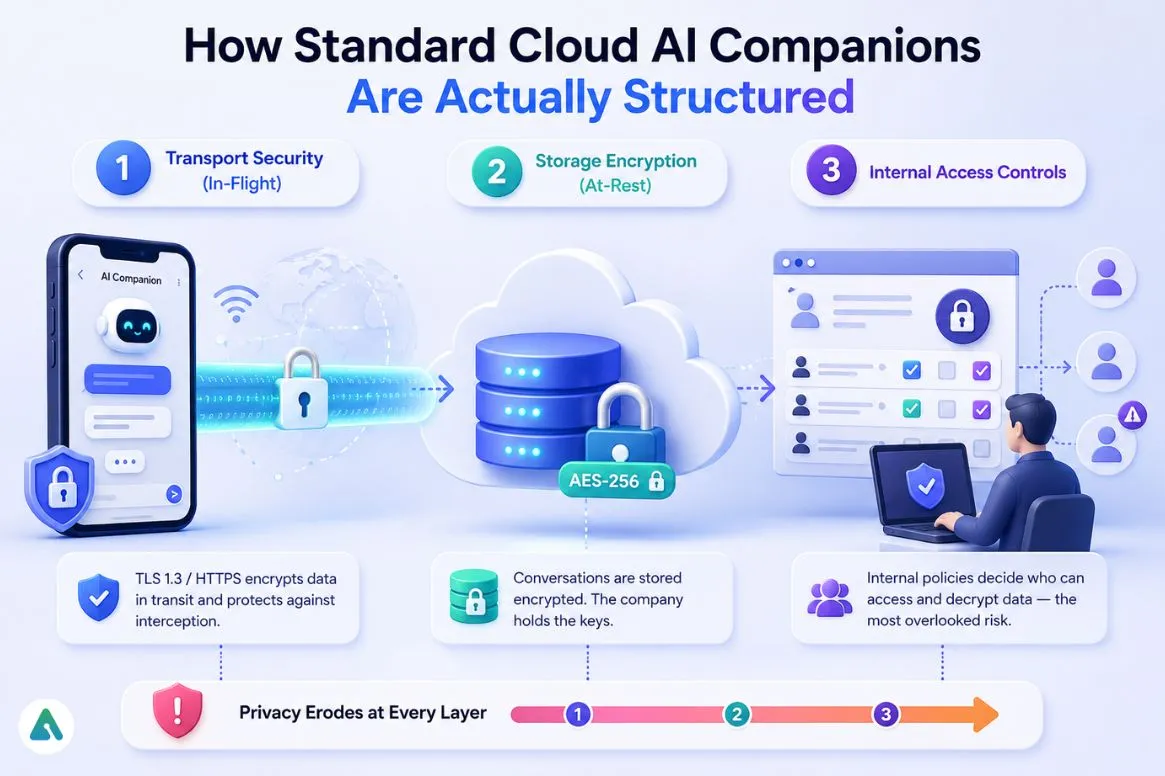
Layer 1: Transport Security (In-Flight) TLS 1.3 and HTTPS encrypt your message as it moves from your device to the company’s servers. This stops public Wi-Fi interception and man-in-the-middle attacks. It does nothing once your data arrives.
Layer 2: Storage Encryption (At-Rest) Most platforms store conversation histories in encrypted cloud databases using AES-256 or equivalent standards. This protects against raw server breaches. The company still holds the decryption keys, so they can read your data any time they choose — or are legally compelled to.
Layer 3: Internal Access Controls. The most overlooked layer. Role-based permissions, access auditing, and employee restrictions determine who inside the organization can actually open the vault. A perfectly encrypted database with loose internal access controls is still a privacy liability. This layer is often more consequential than the encryption itself — and almost no AI companion publishes clear information about it.
Why Traditional End-to-End Encryption Doesn’t Fit Cloud AI — and How TEEs Changed the Equation
End-to-end encryption works brilliantly for messaging apps because the server only needs to relay an encrypted packet — it never needs to understand its contents.
AI inference breaks that model. A language model cannot generate a response to a prompt it cannot read. For every cloud-based AI system, the server historically needed to process your message in plaintext.
That constraint defined AI privacy for years. Then two architectural shifts dismantled it.
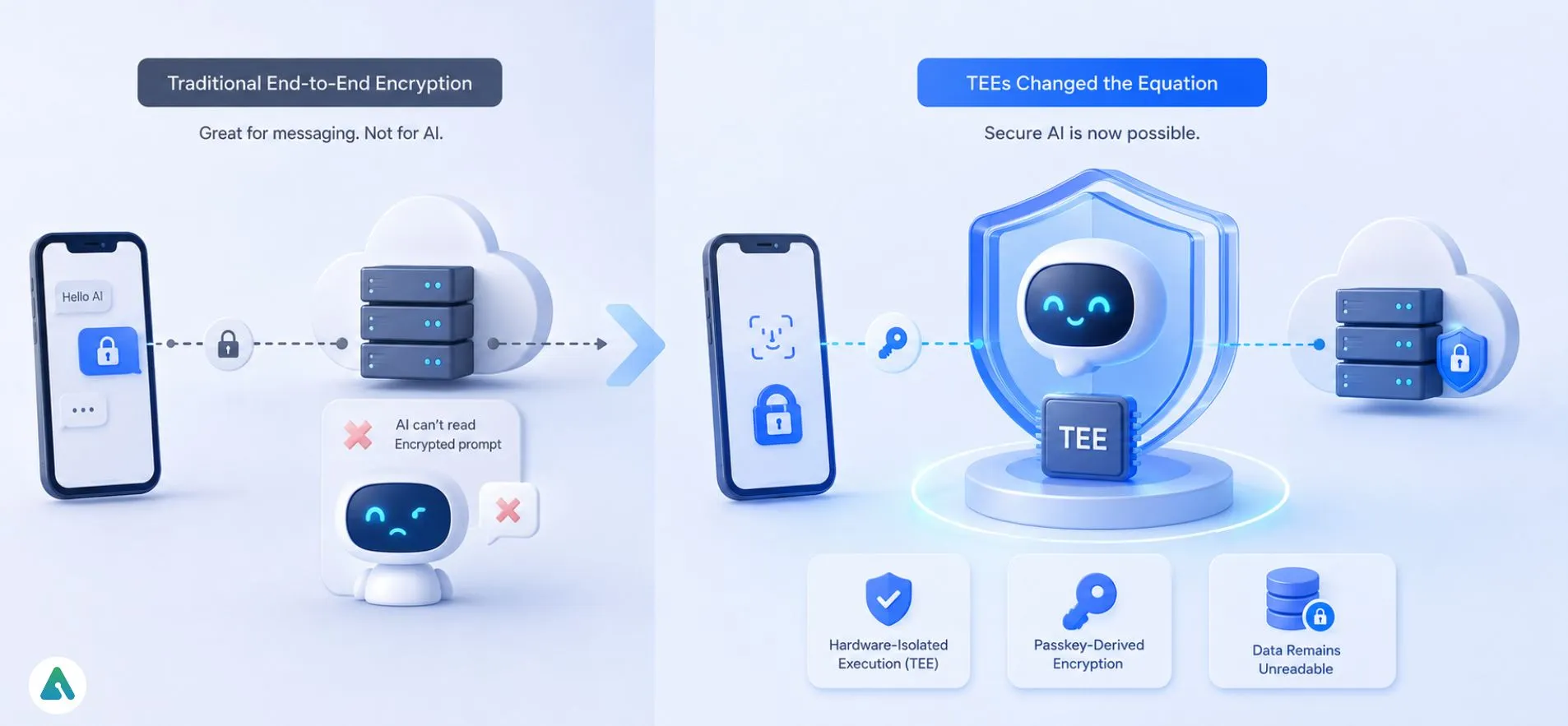
Trusted Execution Environments (TEEs)
Modern server CPUs now support hardware-isolated execution environments — sealed silicon vaults that the host machine itself cannot inspect. When Confer AI processes your prompt inside a TEE, Confer’s own server administrators cannot access the plaintext, because the TEE’s memory state is cryptographically isolated from the host. The host supplies CPU, memory, and power, but cannot see what runs inside the enclave. Remote attestation lets users cryptographically verify the exact code running in that environment.
WebAuthn PRF Extensions via Passkeys
Confer pairs TEE inference with passkey-derived encryption using the WebAuthn Pseudo-Random Function (PRF) extension. Your device’s biometric lock (Face ID, fingerprint, Windows Hello) generates the encryption key locally. The server handles computation; it never possesses the key required to read your stored memory. The result is that even if Confer’s databases were breached or subpoenaed, the conversation data is unreadable without your device.
The Significance of Confer AI
Launched in January 2026 by Signal founder Moxie Marlinspike, Confer pioneered the first widely verified production architecture for private cloud AI inference. Every prompt travels encrypted from your device into the TEE via Noise Pipes — a protocol providing forward secrecy through ephemeral session keys. The LLM runs stateless inference inside the enclave, generates a response, and the enclave wipes its memory state. The host machine has no access to the plaintext at any point in this pipeline.
In March 2026, Marlinspike announced Confer’s core technology would be integrated directly into Meta AI — mirroring the move he made a decade earlier when the Signal Protocol was baked into WhatsApp.
Confer is the most prominent public example of this architecture, but the broader shift matters more than any single company. Hardware-isolated AI processing is being actively explored across major cloud providers, enterprise security vendors, and AI startups — suggesting that privacy-preserving inference via TEEs may become a wider industry baseline over the next several years rather than remaining a single-platform differentiator.
Platform-by-Platform Privacy Breakdown
Replika: Maximum Continuity, Minimum Data Minimization
Replika is the most established emotional companion platform, with relationship persistence and long-term memory as its core product differentiators. To maintain its relationship matrix across devices and sessions, Replika aggregates behavioral profiles and retains extensive conversation archives on traditional cloud infrastructure.
The stakes of that model aren’t hypothetical. In 2023, Italy’s data protection authority (the Garante) temporarily blocked Replika from processing Italian users’ data, citing inadequate protections for minors and vulnerable adults. Replika responded with age-verification measures and policy updates before service was restored — but the episode illustrated what happens when an intimate-data platform meets a regulator with enforcement teeth.
The platform is built for emotional immersion, not anonymity. Users who value memory and continuity should understand this is an intentional product tradeoff, not a technical oversight.
Nomi AI and Kindroid: Realism Requires Access
Both Nomi and Kindroid have built strong reputations for conversational depth, personality consistency, and rich worldbuilding. They achieve this by maintaining large, continuously updated context windows, which requires ongoing unencrypted access to your conversation history during inference.
Their internal security practices may be solid by enterprise standards. But both operate on a fundamental trust model: the provider retains technical access to stored conversation data as part of their cloud-based architecture, subject to their policies and access controls. That’s not a condemnation — it’s the structural reality of how their memory systems work.
| Editorial note: When testing Nomi’s long-term memory for this guide, a fictional, detailed personal conflict was shared to see how the system handled sensitive context. Within three days, that scenario was woven into an unprompted check-in message. It felt seamless — genuinely impressive, actually. And then, that seamlessness is only possible because a server parsed, stored, and indexed that “vulnerability” in a queryable format. The magic and the privacy risk are the same feature. |
Confer AI: The TEE-First Architecture
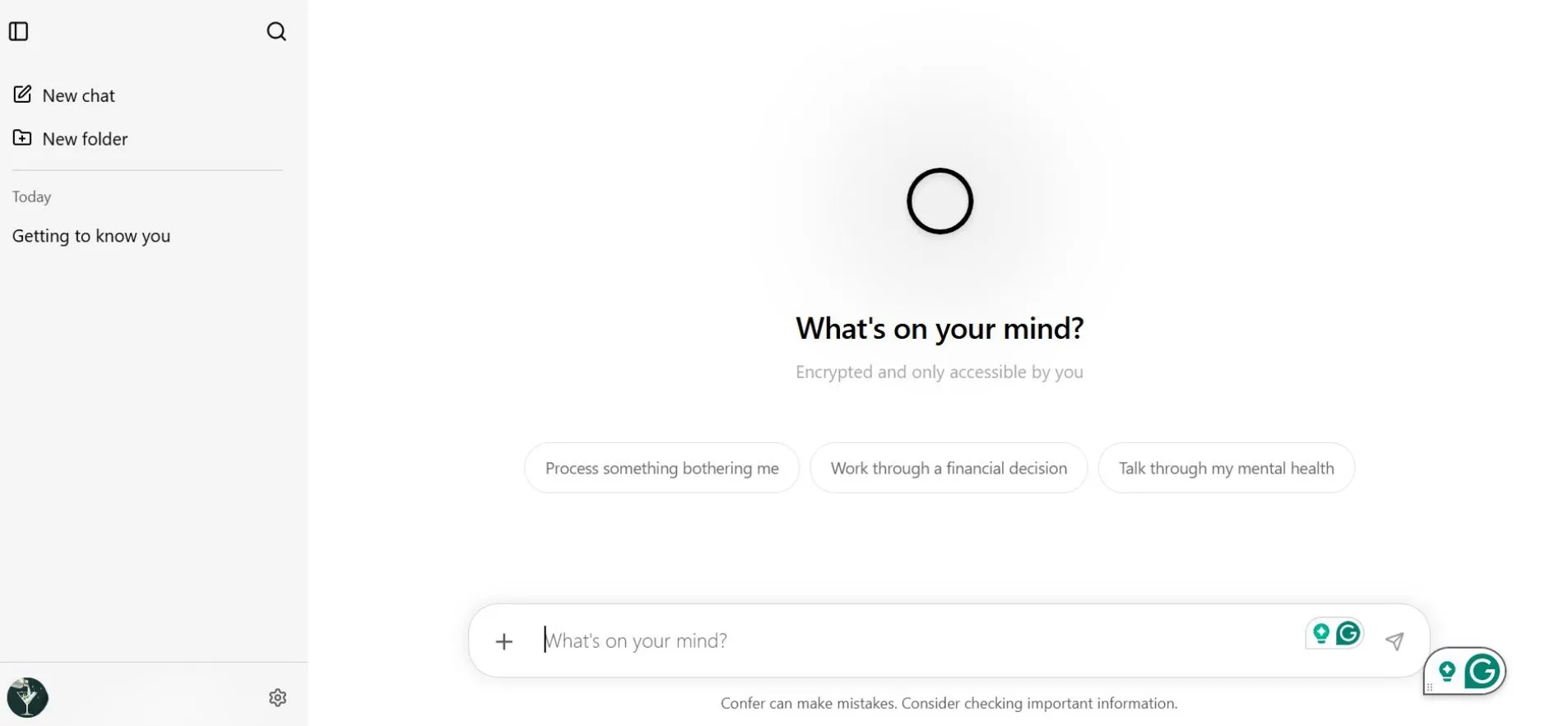
Confer is not an emotional companion in the Replika sense — it positions itself as an AI assistant with privacy as its primary technical feature. But it represents the most consequential architecture shift in AI privacy since local inference became viable. For users who need a cloud AI that has been independently audited to prevent provider access to their conversations, Confer’s TEE + passkey architecture offers cryptographic proof rather than a privacy policy promise. As of June 2026, it remains the most prominent publicly documented implementation of this approach.
Fully Local AI: The Zero-Trust Alternative
For users who want the strongest possible guarantee, local AI eliminates the trust question. Applications like Faraday.dev and LM Studio let users run compact, fine-tuned open-source models — Llama 3.1 8B, Mistral 7B, Phi-4, and similar variants — entirely on-device. Modern NPU-equipped hardware (Apple Silicon, Snapdragon X Elite, Intel Meteor Lake) handles these models without the performance penalties that made local AI impractical in 2023.
The tradeoff is real: no cross-device sync, no persistent cloud memory, and hardware requirements that not everyone can meet. But your conversations never touch a server. Data leaks become physically impossible, not merely contractually prohibited.
The Elephant in the Room: ChatGPT, Claude, and Character.AI
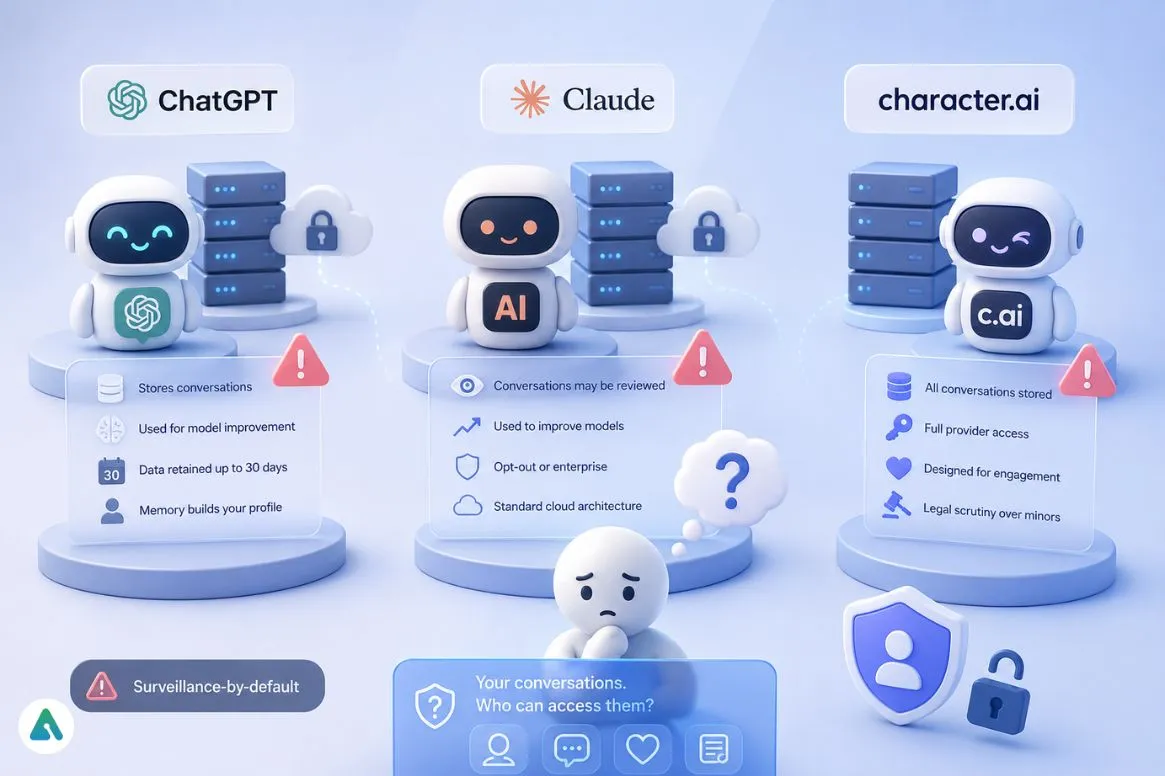
Millions of people use ChatGPT, Claude, and Character.AI as daily conversation partners — effectively as companions — without ever thinking of them as “companion apps.” Their omission from most privacy comparisons is a gap worth closing.
ChatGPT (OpenAI): By default, ChatGPT stores conversations and uses them for model improvement. Users can disable chat history in settings, but even with history off, OpenAI’s current policies retain data for up to 30 days to monitor for abuse. ChatGPT Memory — the feature that builds a persistent profile of you across conversations — is opt-in, but once enabled, it actively aggregates personal context in a form OpenAI can access. The architecture is standard centralized cloud; the company holds keys.
Claude (Anthropic): Anthropic’s approach is broadly similar. Conversations can be reviewed by employees for safety and quality purposes, and Anthropic’s privacy policy allows use of data to improve models unless users opt out or operate under an enterprise agreement with stronger terms. Claude’s character and tone make it feel like a confidant. The data architecture is a standard cloud model.
Character.AI: Designed for maximum engagement and persona depth, Character.AI stores all conversation data on centralized servers with full provider access. The platform has faced serious scrutiny over interactions with minors, leading to several legal actions and policy changes in 2024–2025. Its privacy architecture prioritizes engagement continuity over data minimization in a way that makes it particularly unsuited to sharing sensitive personal information.
None of these platforms is on the privacy tier list because they operate on a surveillance-by-default model for consumer accounts. That’s not a disqualifying flaw for general use — but it matters if you’re treating them as a private confidant.
The AI Companion Privacy Spectrum
| Configuration | Privacy Tier | Core Architecture | Who Can Access Plaintext | Training Risk |
|---|---|---|---|---|
| Fully Local AI (Faraday.dev / LM Studio + Llama 3) | Highest | On-device NPU inference | Nobody — data never leaves the device | None |
| Zero-Knowledge Cloud (Confer AI) | Very High | TEE + Passkey PRF + Noise Pipes | Cryptographically excluded | None (stateless inference) |
| Privacy-Focused Cloud | Moderate | Opt-out training + audited internal access | A company with restrictions | Low to Medium |
| Standard Commercial AI (Replika, Nomi, Kindroid) | Lower | Centralized cloud storage, company-held keys | Company + legal process | Medium to High |
| Default Cloud AI with Memory Retention | Lowest | Persistent plaintext-accessible storage + active training | Company, contractors, subpoenas | High |
The Regulatory Pressure Accelerating Change
Privacy is no longer just an architectural feature — regulators are turning it into a compliance mandate. The landscape shifted meaningfully in May 2026.
On May 7, 2026, EU institutions reached a provisional political agreement on the Digital Omnibus on AI — the first set of amendments to the EU AI Act since its adoption in June 2024. The headline outcome: a staggered deferral of high-risk AI compliance deadlines that had been putting significant pressure on the industry.
The revised timeline under the Digital Omnibus:
- Already active: Prohibited AI practices (since February 2025) and General Purpose AI rules (since August 2025)
- December 2, 2026: New ban on non-consensual AI-generated intimate imagery takes effect
- December 2, 2027: Standalone high-risk AI systems (Annex III) must meet full compliance requirements
- August 2, 2028: AI systems embedded as safety components in physical products
For AI companion platforms, the most relevant provisions concern emotional recognition technology and systems designed to influence behavior — both flagged as areas requiring transparent disclosure under the Act’s transparency obligations, which continue rolling out through 2026.
ISO/IEC 42001:2023 — the world’s first international AI Management System standard — has become the de facto governance certification for platforms selling into regulated enterprise and consumer markets. AWS, Microsoft, and a growing list of AI providers now hold 42001 certification. For users, its presence signals that a platform has submitted AI governance practices to an independent third-party audit. Its absence means you’re taking the company’s word for it.
Red Flag Checklist Before You Create an Account
Run through this before sharing anything personal with an AI companion platform.
- Vague training language — phrases like “we may use interactions to improve our services” mean your emotional disclosures are training data. This isn’t disclosed as a feature. It’s buried in the terms.
- No single-click account deletion with data purge — if removing your history requires emailing a support team, your data ownership is theoretical.
- Excessive device permissions — a text-based companion doesn’t need background location, contact access, or broad storage permissions. If it requests them, ask why before granting.
- No ISO/IEC 42001:2023 or equivalent AI governance certification — for cloud platforms handling sensitive personal data, the absence of an independent third-party AI management audit is a gap worth flagging.
- No documentation of inference architecture — if a platform can’t explain whether processing happens in a TEE or standard cloud environment, assume it’s the latter.
- Ambiguous key management — “your data is encrypted” without specifying key ownership means the company holds the keys. Always.
Five Questions to Ask Before Trusting Any Privacy Claim
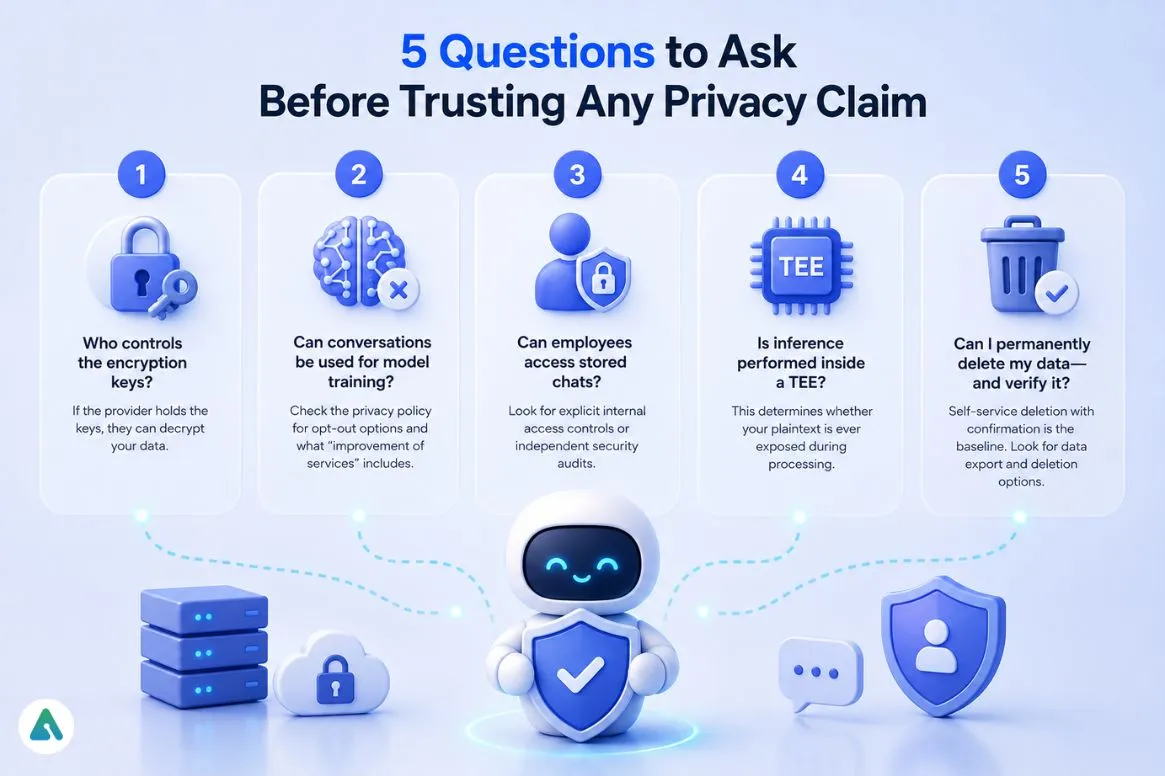
Marketing language moves faster than architecture. Before taking any platform’s privacy claims at face value — including the platforms covered in this guide — run through these five questions. If a company can’t answer them clearly in their documentation, treat the claim with skepticism.
1. Who controls the encryption keys? If the provider holds the keys, they can decrypt your data. Zero-knowledge architecture and passkey-derived encryption are the two main approaches that transfer key control to the user.
2. Can conversations be used for model training? The privacy policy will say. Look specifically for opt-out mechanisms and what “improvement of services” actually covers. Default opt-in to training is common.
3. Can employees access stored chats? Most companies don’t publish the answer, which is itself an answer. Look for explicit internal access control documentation or independent security audits.
4. Is inference performed inside a TEE or standard cloud environment? This determines whether your plaintext is ever exposed during processing — the gap that zero-knowledge cloud architecture addresses. Standard cloud means the provider processes your message in a readable state.
5. Can I permanently delete my data — and verify it? Self-service deletion with a clear confirmation mechanism is the baseline. Platforms that route deletion through a support ticket or omit a dedicated data export and deletion page are not built around user data ownership.
How to Choose Based on What You Actually Need
If privacy is non-negotiable: Run a local model via Faraday.dev or LM Studio. Accept the tradeoff on cross-device continuity. This is the only option where data leaks are physically impossible rather than contractually promised away.
If you need cloud AI with verifiable private inference, Confer AI pioneered the TEE + passkey architecture and remains the most documented production implementation of this approach. It’s positioned as an assistant rather than a companion, but the privacy architecture is genuinely without mainstream parallel.
If you want emotional depth and accept the trust model, Replika, Nomi, and Kindroid deliver compelling experiences. Review their current privacy policies and data deletion options before sharing anything you’d be uncomfortable seeing in a legal document.
Whatever you choose: Test the deletion flow before you rely on it. A companion app that stores a year of your private conversations but makes data removal difficult is not offering you privacy — it’s offering you the appearance of it.
Frequently Asked Questions
Q. What is an encrypted AI companion?
An encrypted AI companion is an AI chatbot or virtual companion that uses encryption to protect conversations while they are transmitted, stored, or processed. Depending on the platform, this may include TLS encryption, encrypted cloud storage, Trusted Execution Environments (TEEs), or fully local AI processing. However, encryption alone does not guarantee privacy because the provider may still have access to decryption keys.
Q. Can AI companion companies read my conversations?
Usually, yes. Most cloud-based AI companion platforms can technically access stored conversations because they control the servers and encryption keys. Privacy-focused alternatives use hardware-isolated processing or local AI models to limit provider access. Whether a company can read your chats depends on its architecture, key management system, and privacy policies.
Q. Are AI companions private?
AI companions vary widely in privacy. Most commercial AI companions encrypt data in transit and at rest, but retain technical access to conversations. The most private options are local AI companions that run entirely on your device and zero-knowledge cloud systems that use Trusted Execution Environments (TEEs) and user-controlled encryption keys.
Q. Why can’t AI companions use end-to-end encryption like Signal?
Traditional end-to-end encryption prevents servers from reading messages. AI models need access to prompts in order to generate responses, which historically made end-to-end encryption incompatible with cloud AI. New technologies such as Trusted Execution Environments (TEEs) allow AI systems to process data inside hardware-protected environments without exposing plaintext to the server operator.
Q. What is a Trusted Execution Environment (TEE) in AI?
A Trusted Execution Environment (TEE) is a hardware-protected enclave built into modern processors. It allows AI models to process user data inside a secure environment that the host server cannot inspect. TEEs are increasingly used to enable privacy-preserving AI inference and provide stronger security guarantees than traditional cloud infrastructure.
Q. Are local AI companions safer than cloud AI companions?
Yes, local AI companions are generally safer from a privacy perspective. Because the AI runs entirely on your device, conversations never leave your hardware and cannot be accessed by a cloud provider. The tradeoff is that local AI often requires more powerful devices and may not offer cloud-based features such as syncing and persistent online memory.
Q. What is zero-knowledge AI?
Zero-knowledge AI refers to AI systems designed so that the provider cannot access user conversations or stored memories. These systems typically use technologies such as passkey-derived encryption, Trusted Execution Environments (TEEs), and user-controlled keys. The goal is to allow AI processing without giving the service provider visibility into private data.
Q. What is ISO/IEC 42001:2023?
ISO/IEC 42001:2023 is the first international standard for AI management systems. It helps organizations implement governance, risk management, transparency, and accountability practices for artificial intelligence. For AI companion platforms, ISO 42001 certification indicates that AI policies and operational controls have undergone an independent third-party review.
Q. Which AI companions offer the best privacy?
Local AI platforms generally provide the strongest privacy because conversation data never leaves the device. Privacy-focused cloud AI platforms that use Trusted Execution Environments (TEEs) and user-controlled encryption provide the next highest level of protection. Traditional cloud-based AI companions prioritize convenience and memory features but require greater trust in the provider.
Q. Why aren’t ChatGPT, Claude, and Character.AI considered privacy-first AI companions?
ChatGPT, Claude, and Character.AI operate on centralized cloud infrastructure where providers retain technical access to stored conversation data. Although some services offer privacy controls, training opt-outs, or enterprise protections, they do not currently meet the stricter privacy standards used by privacy-first evaluations that emphasize local processing, zero-knowledge architecture, or hardware-isolated inference.
Q. What should I check before sharing personal information with an AI companion?
Before sharing sensitive information, review the platform’s privacy policy, data retention practices, training policies, deletion process, and security architecture. Check whether conversations are used to train AI models, whether you can permanently delete your data, and whether the provider explains how conversations are processed and protected.
Final Verdict
Encryption is necessary. It is not sufficient.
The real privacy question in 2026 isn’t whether your conversations are encrypted — virtually every serious platform encrypts in transit and at rest. The question is whether the provider can read them: during inference, in storage, under subpoena, during a breach, or while training next year’s model.
The TEE + passkey architecture pioneered by Confer represents a genuine architectural shift, not a marketing upgrade. And fully local inference remains the only option where the answer to “can anyone read this?” is demonstrably no.
Mainstream companions like Replika, Nomi, and Kindroid offer real value. They also require trusting a corporation with some of the most personal data you’ll ever generate. That’s not inherently wrong — but it should be a conscious choice, not an assumption buried in a terms-of-service checkbox.
Related: Character.AI vs Kindroid vs Nomi: A 60-Day AI Companion Comparison (2026)
| Disclaimer: This article is intended for informational and educational purposes only. While we strive for accuracy and clarity, privacy practices and technical implementations may evolve over time. Readers should review the official documentation and policies of any platform before making decisions involving sensitive data. This content does not constitute legal, security, or professional advice. |
