
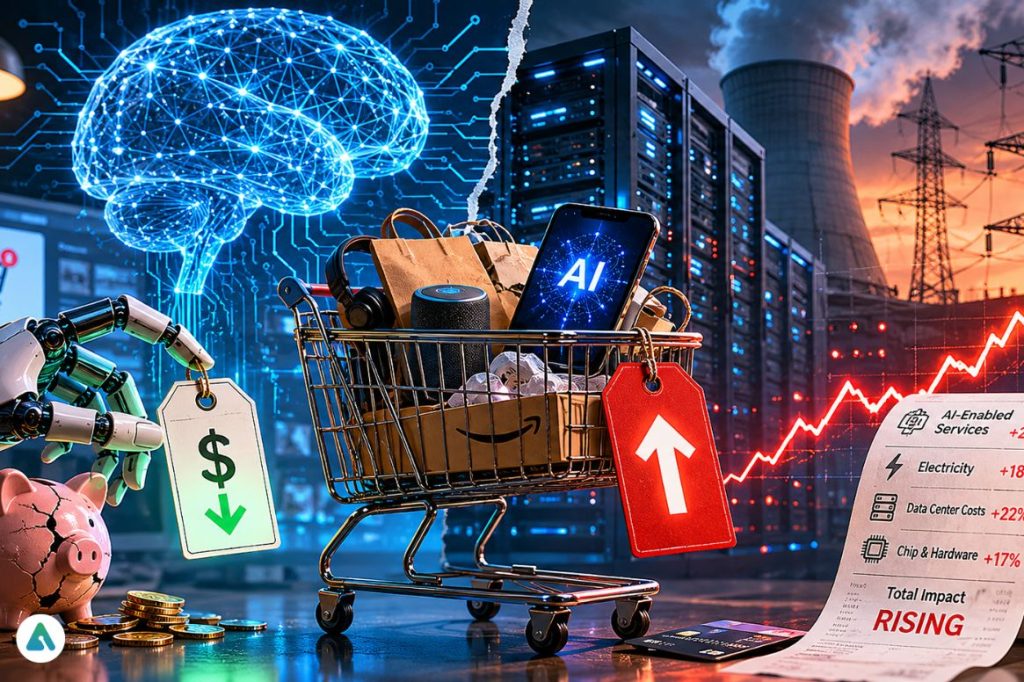
The original AI pitch wasn’t just optimistic — it was mechanical.
Automate labor. Compress costs. Prices fall.
That logic still works on paper. It just isn’t showing up in the numbers.
What’s happening instead looks less like deflation and more like a classic capital shock: a technology arriving all at once, demanding enormous upfront investment in energy, chips, and physical infrastructure — and pushing prices higher before any efficiency gains have time to land.
The Infrastructure Reality: Power, Not Code
Behind every AI query is a physical system that looks nothing like the “lightweight software” narrative.
A single large-model query can consume multiple times the energy of a traditional search. At scale, that difference compounds fast. In Northern Virginia — home to the world’s largest concentration of data centers — utilities are already warning about substation bottlenecks and multi-year delays to connect new capacity.
The companies driving this expansion — Microsoft, Meta, and Alphabet — are collectively spending tens of billions per quarter on AI infrastructure. Not software. Physical systems: land, transformers, cooling, backup generation.
And when the grid can’t keep up, the fallback isn’t elegant. It’s expensive.
In several U.S. markets, utilities have restarted or extended the life of natural gas “peaker plants” just to stabilize supply for data center demand — directly colliding with the same companies’ net-zero commitments.
Electricity prices are responding accordingly. In key regions, industrial and residential rates are rising faster than headline inflation — not solely because of AI, but increasingly because of it.
This is the part the deflation narrative skipped: before AI reduces costs, it has to build capacity. And capacity is expensive.
The CAPEX Gap: Costs Now, Efficiency Later
There’s a growing mismatch between when AI costs are incurred and when its benefits appear.
Right now:
- Chip prices remain elevated due to supply constraints
- Energy demand is spiking in localized grids
- Construction and cooling costs are rising with scale
Eventually:
- Automation reduces labor inputs
- Marginal costs fall
- Competitive pressure forces price compression
The problem is timing. The cost curve is front-loaded. The savings curve isn’t.
Morgan Stanley strategist Andrew Sheets summarized it bluntly: input costs — especially power and semiconductors — are still moving up, not down. That’s not a temporary distortion. It’s the base case for the next phase of the cycle.
Precision Pricing: AI as a Margin Tool
Even if costs were stable, prices might not fall — because AI is getting very good at preventing that.
Dynamic pricing used to operate at the category level. Airlines, hotels, ride-sharing. Now it operates at the individual level.
Retailers and platforms are deploying models that adjust prices based on:
- Browsing behavior and hesitation patterns
- Local demand signals and weather
- Device type and session timing
- Inferred income brackets and purchase urgency
The shift is subtle but decisive. Prices are no longer “higher” in a visible way. They’re optimized — quietly, continuously — to match what each customer is most likely to pay.
That shows up in the data. E-commerce basket sizes are rising even when unit volumes aren’t. Same goods. Higher spend.
Call it what it is: not inflation driven by scarcity, but extraction driven by information.
The AI Premium Is Becoming the Baseline
There’s also a more visible layer of pricing pressure: the AI surcharge.
Major software platforms have already normalized it:
- Microsoft added Copilot features to enterprise plans at roughly $30 per user/month
- Salesforce introduced Einstein AI tiers with similar add-ons
- Adobe embedded generative tools into Creative Cloud pricing structures
Right now, these are positioned as premium upgrades.
But pricing history is predictable. Premium features become standard features. Standard features become expected. And expected features stop being optional — which means the higher price becomes the floor.
Geography Is Back in the Cost Equation
For a decade, cloud computing flattened geography. AI is starting to reverse that.
The cost of running large models varies dramatically depending on local electricity pricing, grid stability, and regulatory constraints. That’s already influencing deployment decisions.
In Europe, high energy costs and stricter carbon rules are slowing expansion. Even OpenAI has had to adjust infrastructure plans in energy-constrained markets.
The next step is predictable: price differentiation.
If it costs more to run AI in one region than another, services won’t remain globally uniform. Pricing will fragment — tied not to software, but to kilowatt-hours.
The Consumer Layer: Where It Actually Hits
For consumers, this doesn’t show up as a single headline number. It shows up as friction:
- Flight prices that shift within minutes of repeated searches
- Insurance quotes that vary based on behavioral signals
- Subscription bundles that quietly reprice after adding AI features
- E-commerce checkouts where discounts feel rarer, not larger
There’s no single “AI inflation index.” But the pattern is consistent: more precise pricing, fewer inefficiencies, tighter margins — for companies.
The Macro Risk: Growth Funding Its Own Friction
This is where the story loops back into macroeconomics.
If AI investment continues at its current pace, it will sustain demand for energy, materials, and capital. That keeps inflationary pressure alive — even as productivity gains are still ramping.
Strategists like Trevor Greetham at Royal London Asset Management have flagged the second-order effect: central banks may have to keep rates higher for longer.
And higher rates do something uncomfortable — they increase the cost of financing the very AI infrastructure driving growth.
It’s a feedback loop:
AI investment → inflation pressure → higher rates → more expensive AI investment.
So Where Is the Deflation?
It’s still plausible. Just not immediate.
AI will likely reduce costs at scale — once infrastructure stabilizes, competition intensifies, and productivity gains become measurable in actual price data, not just earnings calls.
But that phase hasn’t arrived yet.
What we’re seeing instead is the transition phase:
an economy absorbing the cost of building the system before it benefits from using it.
And during that transition, the promise flips.
The deflation machine isn’t broken.
It’s just early — and for now, it’s running on expensive electricity, optimized pricing, and a cost curve that hasn’t turned yet.
Related: AI Transformation Is a Governance Problem (Not Tech) — 2026 Truth
