Is Lizlis AI Worth It? Features, Pricing & Honest Review (2026)
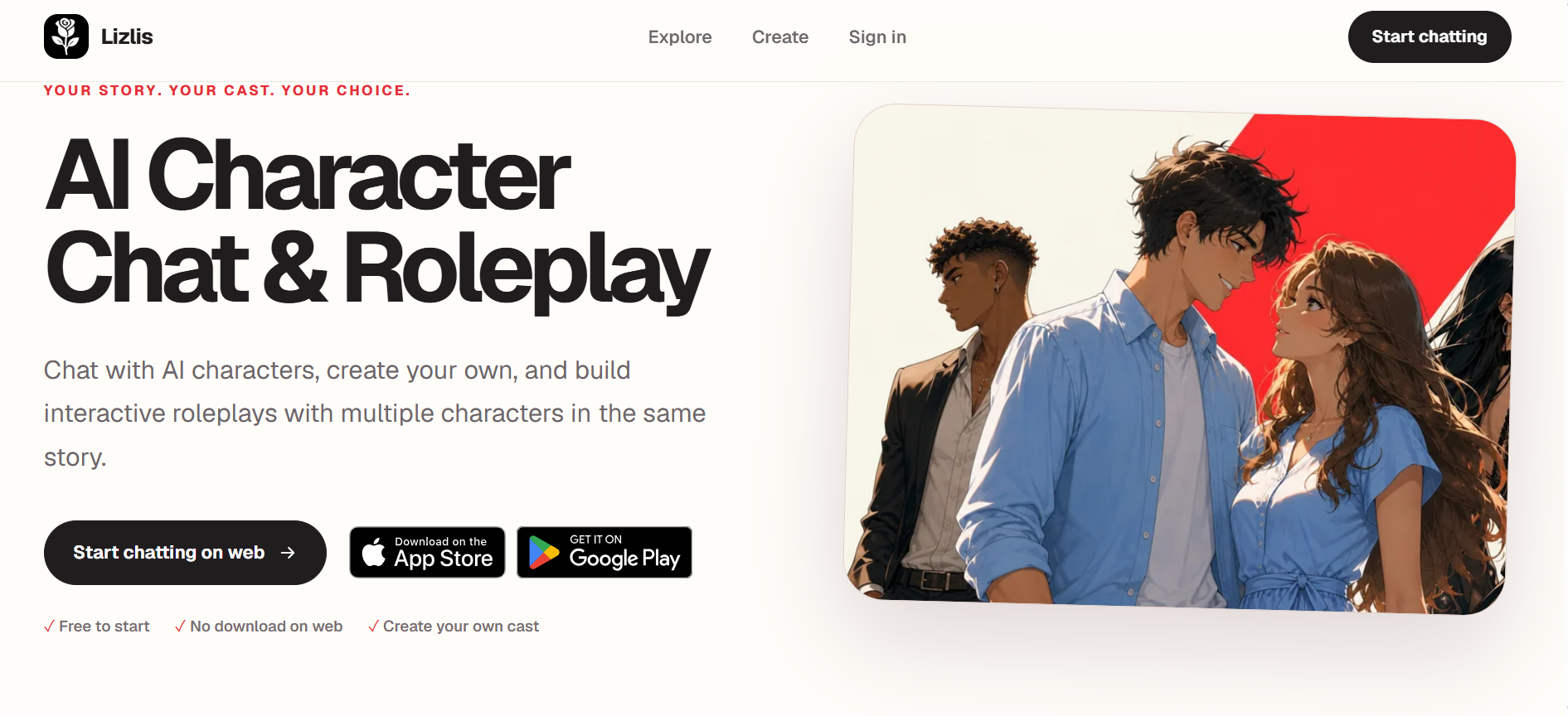
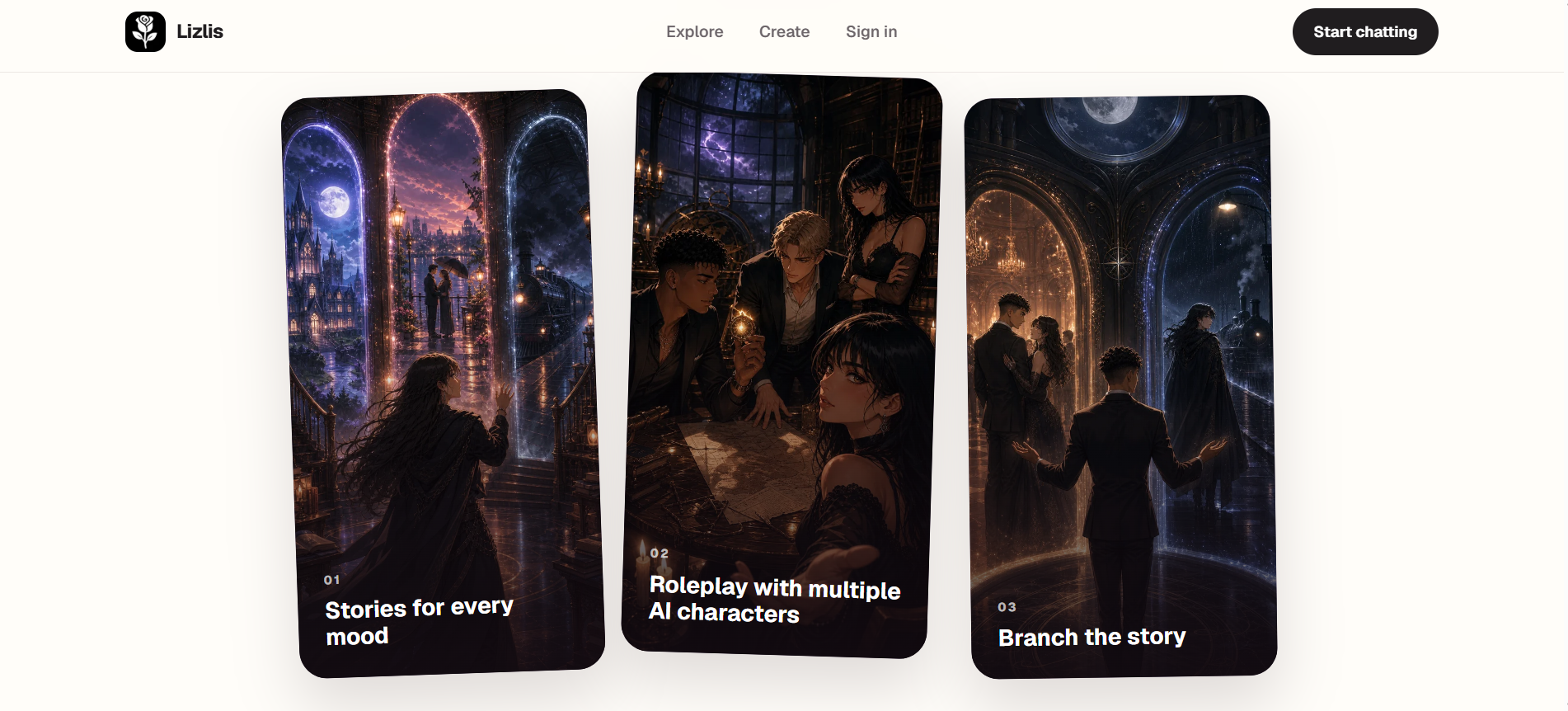
Lizlis AI is an AI character chat app built around scenarios instead of single bots. You pick a setup, choose a persona, and talk with up to 10 AI characters in the same scene. You can also build and publish your own.
Two features define it: multi-character scenes and a “Branch From Here” button that rewinds a chat without deleting the original path. The question is whether they work well enough to justify the limits and prices.
I reviewed the web app, the character editor, the image generator, the subscription screens, and the privacy documents. This review covers what Lizlis does, what the free plan really gives you, what Plus and Pro add, how safe it is for teens, and who should pick Rochat, Character.AI, SpicyChat, or a self-hosted setup instead. We last checked prices, ratings, and limits on November 12, 2026.
Quick Verdict: Is Lizlis AI Worth Trying?
Yes, if you want ad-free, scenario-led roleplay with an ensemble cast and a built-in rewind tool. The free plan is enough to judge the format, and the web plan gives most writers plenty of room at $8.99 a month.
Best for: roleplay fans who prefer a ready-made scene over a blank chat box, writers who like “what if” branches, anime fans who want built-in portrait art, creators who want to publish for others, and teens 13 and older whose parents have read the App Store content flags.
Skip it if: you want unlimited free messages, adult content, official canon bots instead of community-made casts, or strong privacy guarantees. Rochat suits the first need better. SpicyChat or a self-hosted setup suits the second. Nothing hosted fully covers the last one.
What Makes Lizlis Different From Other AI Character Chat Apps?
Lizlis is not the only app with group chat. Character.AI has group chats and memory tools. Rochat offers group scenes and shared worlds. SpicyChat supports multi-character chats too. So “10 characters in one chat” is a feature, not a moat.
The real difference is how Lizlis combines its parts:
Scenario-first browsing. Every card carries a setting, a cast, and an opening message.
Personas tied to the plot. You choose who you play before the first message, so characters treat you as a rival, a detective, or a new student.
Branch From Here. You jump back to any message, try another reply, and keep the first path intact.
A creator studio in the same app. You build, publish, and iterate without leaving.
No ad interruptions. Lizlis earns its money from subscriptions and gems, which separates it from the ad-supported free tiers on Rochat and Character.AI. For a free user, that matters more than the daily cap.
Power users already have rewind and group chat for free, though.SillyTavern is an open-source frontend with multi-bot group chats and branched chats, and you bring your own model. JanitorAI follows a similar bring-your-own-key route with lorebooks for world memory, but it gates its uncensored mode behind ID verification. Both demand setup that Lizlis skips. Lizlis wins on convenience and a 13+ audience, not on raw capability.
Community creators make most of the library, and many trending scenarios borrow casts from anime and TV. Quality swings from card to card. Original casts stay more stable than fan-made ones, because hosts can pull borrowed material without warning. The app also launched only in October 2025, so the catalog is young next to Character.AI’s.
Does Lizlis Remember Long Stories?
Lizlis does not publish how much context its default model holds, and I will not guess. According to its App Store release notes, it ships a set of continuity tools:
Story Status (October 19) tracks mood, affection, trust, and similar values as the plot moves.
Multiple opening messages (September 29) let creators offer different ways to begin.
Character voices and audio playback arrived on September 21.
Scene images (version 1.9.8, October 25) let creators attach pictures to matching moments in chat.
These updates push Lizlis closer to an interactive visual novel than a plain chatbot. Anyone who values memory above everything should run a long-session test on the free plan before paying.
How Do You Start on Web, iPhone or Android?
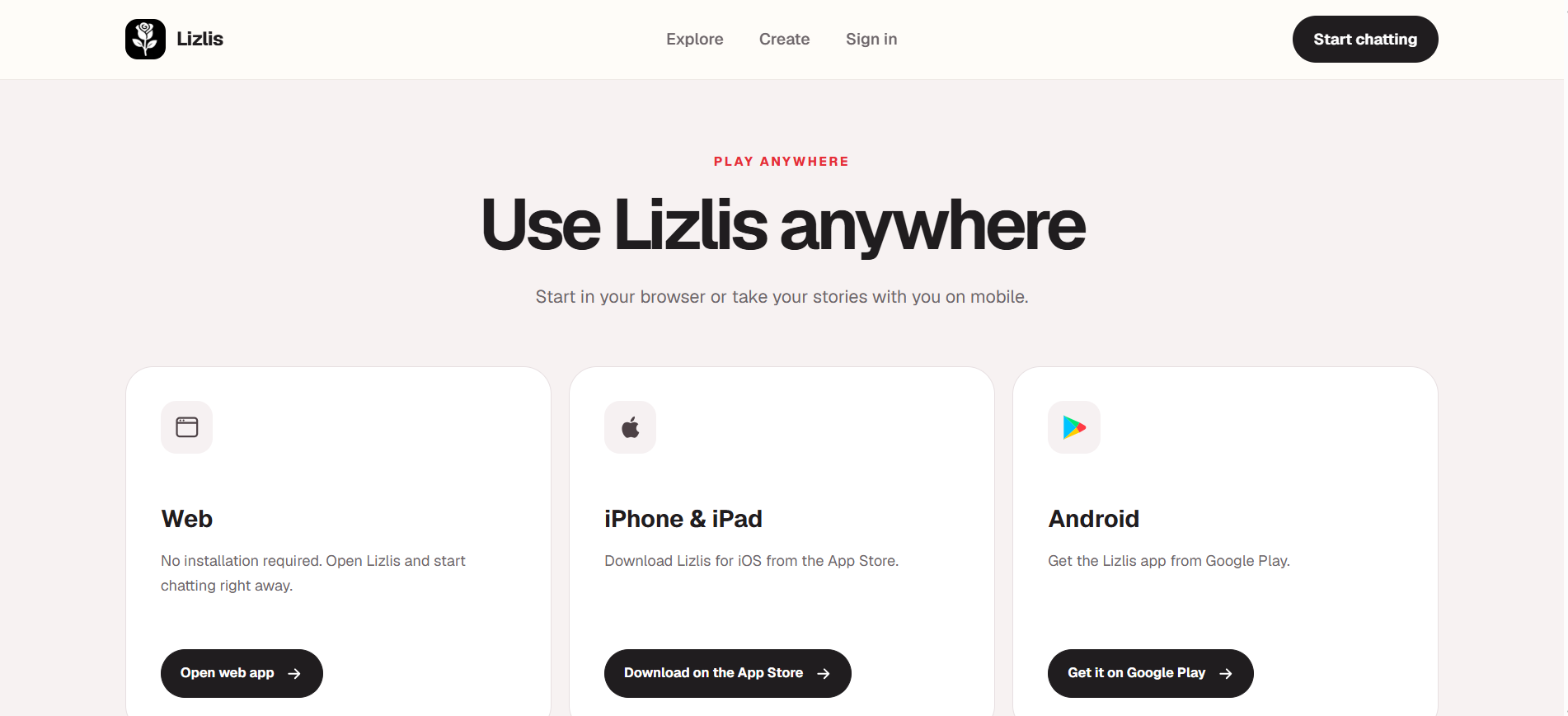
Lizlis runs in a browser with no install, on iPhone through the App Store, and on Android through Google Play. All three are free to download and share one account. You can read public scenarios without signing up, but sending a message needs a free account. The iPhone app requires iOS 16.4 or later and carries the “Designed for iPhone” label, so iPad owners get a smoother experience in the browser.
The first session takes three steps:
Open a scenario and read the About tab and opening message. They reveal the tone and cast before you spend any messages.
Choose a persona with your name, role, and background.
Send your first message and steer from there.
How Do You Create a Character or Story on Lizlis?
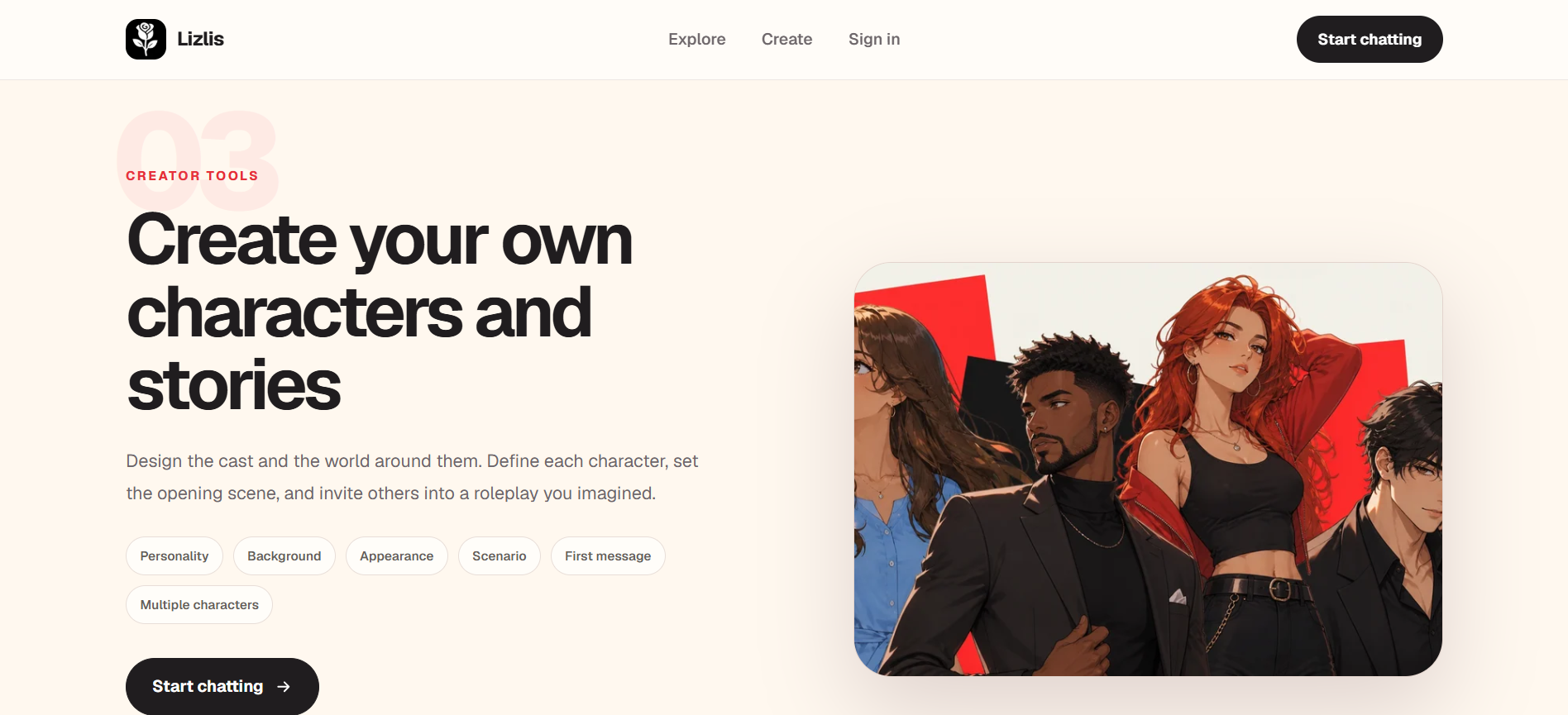
Open Creator, write a title and background, add characters, set the intro and category, then publish or save a draft. The editor uses five tabs: Main, Intro, Category, Features, and Other. The first three carry a red star, so fill them before publishing. A counter tracks your text against a 4,000-character budget for the main setup.
Write the background. Describe the setting and how the cast relates to the player. Use the {{user}} tag wherever the player’s name should appear. Lizlis swaps in each reader’s persona name. A sparkle button drafts or polishes the text with AI.
Add a character. Name it, then choose an image: upload your own, reuse a past generation, or generate one from a plain-words description.
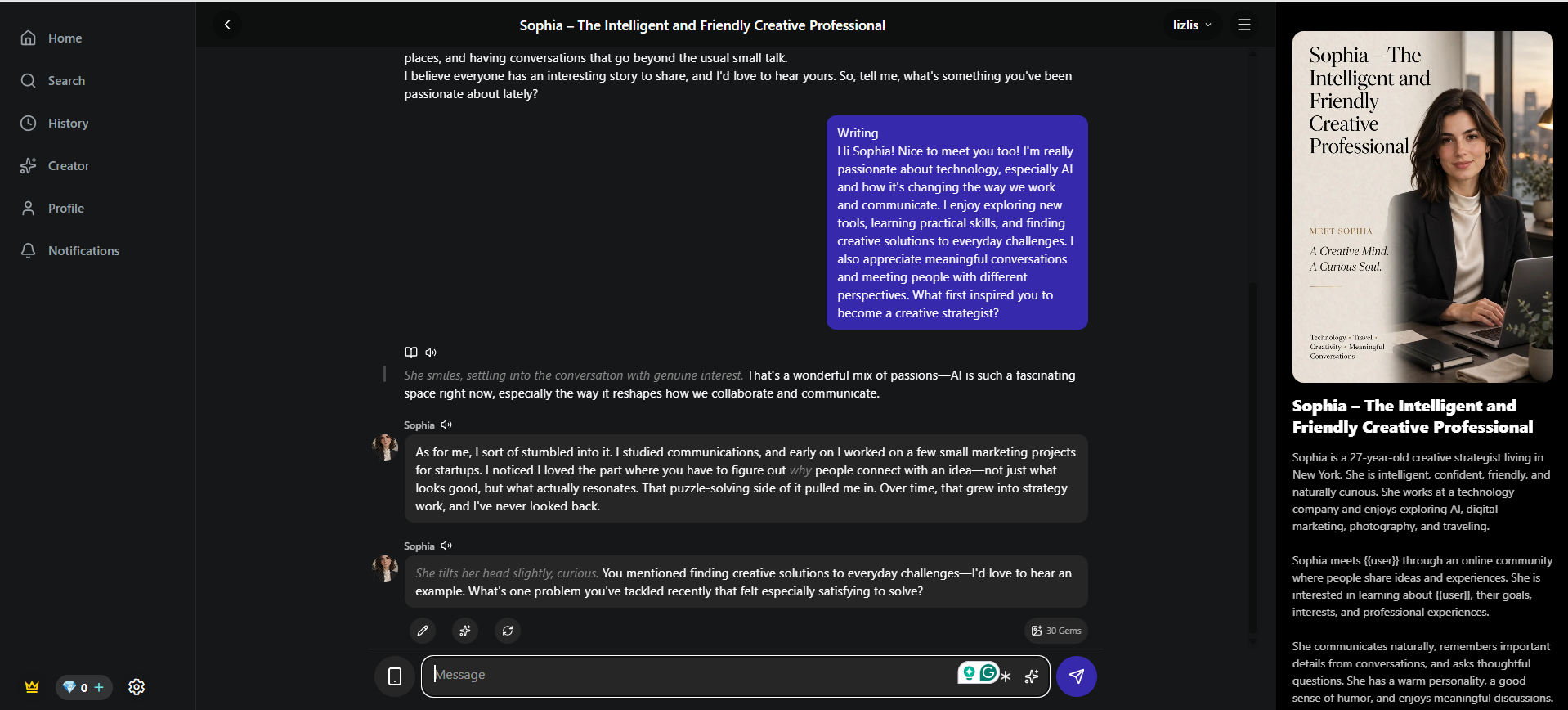
Write the personality. Include age, job, temperament, interests, and speech style. Specific details beat vague adjectives, and the same principle runs through writing a custom AI companion on any platform. “Asks follow-up questions and teases gently” guides the AI better than “friendly.” My sample character, Sophia, a 27-year-old creative strategist, came out warm and curious because the description said so.
Finish the Other tab. Add an optional cover image, an Author’s Note of up to 2,000 characters, and tags. The Public toggle decides who can find your work.
Read that toggle closely. Once you publish publicly, you cannot switch back to private. Free accounts get one private scenario per language, so decide which ideas stay personal.
Which AI Art Styles Does Lizlis Offer?
Portraits lean toward anime and illustration. The Standard style gave my account five free generations a day. Every other style costs 30 gems per image.
Style
Look
Cost
Standard
Semi-realistic portrait
Free daily allowance
Anime Standard
Clean anime art
30 gems
Watercolor Glow
Soft, painted look
30 gems
Art Crayon
Warm, hand-drawn texture
30 gems
Glint & Gloom
Moody, darker shading
30 gems
Chibi
Small-body, cute style
30 gems
Inside a chat, replies mix italic stage directions with spoken lines. Each message has edit, AI-assist, and regenerate buttons, a speaker icon for audio, and an image button priced at 30 gems. Platforms that meter nearly every image, video, and voice action through credits can bury the real cost, and Lizlis follows the same pattern once you leave the free Standard style.
Is Lizlis AI Free, and How Much Do Plus and Pro Cost?
Lizlis is free to start. A free account gets a daily message allowance on the default model that resets every day. Plus costs $8.99 a month on the web. Pro removes the daily message cap. Gems pay for extras such as premium art and scene images.
How many free messages do you get?
Lizlis does not print an exact number on its official free-chat page. The app shows a live counter instead. App Store reviewers repeatedly report a cap of about 100 messages a day, but treat that as user-reported until Lizlis confirms it. A free account also includes persona creation, character and scenario building with up to 10 characters, a daily allowance of AI portraits, one private scenario per language, and no payment card at signup.
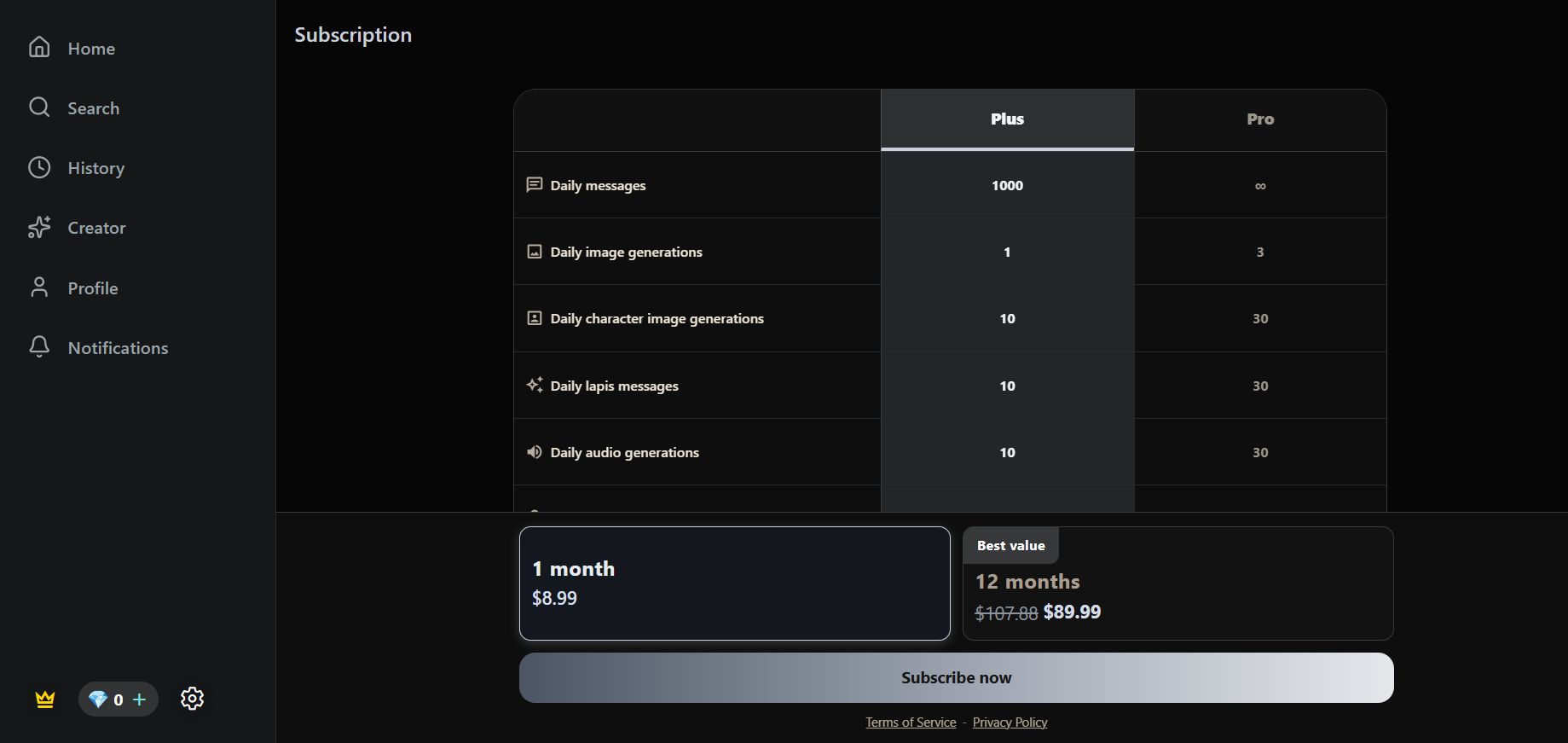
Plus vs Pro: what do the limits look like?
Daily limit
Plus
Pro
Messages
1,000
Unlimited
Image generations
1
3
Character image generations
10
30
Lapis messages
10
30
Audio generations
10
30
The subscription screen never defines “Lapis messages.” Lizlis says paid plans add premium model replies, so Lapis most likely means that higher-end tier. If so, 10 a day on Plus runs out fast in a long scene.
Pricing and App Store snapshot
Prices are US figures. Your local store may show different amounts.
Plan
Web
App Store
Plus, monthly
$8.99
$9.99
Plus, yearly
$89.99
$99.99
Pro, monthly
Not shown
$29.99
Pro, yearly
Not shown
$299.99
Subscribing to Plus in a browser saves roughly 10%. The catch is refunds. App Store and Google Play purchases go through those stores, while web payments run through Stripe under Lizlis’ own refund rules.
Gems are a one-time currency for things outside your plan.
Pack
Web price
Web bonus
200
$1.99
None
600
$4.99
+20%
1,300
$9.99
+30%
2,800
$19.99
+40%
7,500
$49.99
+50%
16,000
$99.99
+60%
An “Earn free Gems” option also sits at the top of the store.
Latest version: 1.9.8 (October 25). US App Store rating: 4.6 from 259 ratings.
What Is the Lizlis AI Age Rating, and Is It Safe?
The App Store rates Lizlis 13+. Its Terms set 13 as the minimum age, with higher thresholds where local law requires, such as 16 in parts of the EEA and the UK. Anyone under the age of majority needs a parent or guardian’s consent. Lizlis targets safe-for-work use and runs moderation, but AI replies can still slip.
Apple’s listing flags infrequent mature or suggestive themes, sexual content or nudity, profanity, horror, violence, and drug references. Those flags describe what AI replies and community scenarios might contain even with filters on. Parents should read them before handing the app to a younger teen. For comparison, Rochat requires users to be 18 or older.
Other limits to keep in mind
The Terms state plainly that Lizlis replies may be wrong or offensive and that the service does not handle emergencies or crisis support. If a chat ever leaves you upset, step away and talk to someone you trust.
If a reply or image crosses a line, report it. The app’s feedback screen accepts bug reports, complaints, and feature requests, with optional photo attachments.
The filters also cut the other way. Lizlis promotes mafia and thriller scenarios in its own genre tabs, and the editor runs moderation checks before you publish, so writers of darker plots should expect an occasional blocked scene.
What happens to your chats?
The privacy policy says Lizlis stores your chats, prompts, uploads, and created characters, plus device and rough location data.
Question
Answer
Does Lizlis name its outside AI providers?
No. It says prompts go to third-party providers but does not list them.
Does it say how long chats are kept?
Not clearly. Backups and copies in other users’ chats may linger after deletion.
Does it separate service improvement from model training?
No. It says data improves the service and never states whether chats train models.
Does it sell personal data?
The policy says no.
Can you request deletion?
Yes, you can request a copy or deletion of your data.
Apple’s privacy label lists email, name, device ID, coarse location, and diagnostics. It does not list chat content, even though the policy says chats are stored. Developers fill in store labels, and Apple does not verify them, so the policy is the document to trust. How other apps handle the same questions varies widely, as theAI companion privacy rankings show.
The practical rule applies to any service with unclear third-party and retention terms: keep real names, addresses, school details, and anything sensitive out of your chats. Lizlis also states that replies may be wrong or offensive and that it does not handle emergencies or crisis support. If a chat leaves you upset, step away and talk to someone you trust. The feedback screen accepts bug reports, complaints, and feature requests.
Lizlis vs Rochat, Character.AI and SpicyChat
Character.AI used to be the obvious comparison, and its situation has changed. Character Technologies filed for Chapter 11 on October 12, 2026. Disney agreed to act as a stalking-horse bidder, offering $20 million for a non-exclusive, perpetual license to certain Character.AI intellectual property rather than the app itself. The platform keeps running during the sale, but the company has said it could wind it down if no suitable bid appears, and a sale hearing is set for December 3 and 4. The shake-up follows Character.AI’s decision to remove open-ended chat for under-18 users in late 2025, which pushed many teens toward alternatives. What the under-18 change meant in practice explains why those users are shopping around now.
Character.AI’s lite tier launched in September 2026, so it undercuts Lizlis by roughly half on entry price. Lite still shows ads, so the price gap and the ad gap pull in opposite directions.
SillyTavern VS JanitorAI
Serious roleplayers also have two free options outside the app stores:
Factor
SillyTavern
JanitorAI
Format
Open-source frontend you install
Hosted platform, bring your own model key
Group chat
Yes
Varies by model setup
Rewind a chat
Chat branching
Not confirmed
Cost
Free, plus your model’s usage
Free built-in model, or your own key
Setup
Real learning curve
Moderate, ID check for uncensored mode
Here is how to choose:
Choose Lizlis for structured, moderated ensemble scenarios, a 13+ audience, no ads, and a dedicated rewind tool.
Choose Rochat if you are 18 or older and want unlimited messaging on free models, a choice of big-name AI models, and automatic memory. The free tier runs on ads and may slow down at peak times.
Choose Character.AI only if you want its huge library and accept the sale uncertainty. Export what you can if you stay.
Choose SpicyChat if you are an adult who wants more configurable group roleplay and fewer filters.
Choose SillyTavern or JanitorAI if you want free, deep memory control and will manage a model yourself. The best AI chatbots for roleplay comparison covers more of that tier.
Other story-first apps deserve a test before you commit. Zeta AI runs roleplay with a whole cast and funds its free chat through ads, andSwervepairs AI chat with narrative scenarios in a more casual format.
What Are Lizlis AI’s Limitations?
Opaque caps. The free message count hides behind a live counter, and the subscription screen never defines “Lapis messages.”
Gem-gated visuals. Beyond five daily Standard portraits, every art style and in-chat scene image costs 30 gems.
A young, IP-heavy catalog. The app launched in October 2025, and many trending scenarios borrow anime and TV casts that hosts can pull without warning.
Opaque privacy terms. Lizlis does not name its AI providers, state how long it keeps chats, or say whether chats train models.
Untested at scale. The verification table above lists what I could not confirm, from 8-to-10-character consistency to long-session memory.
FAQs
Q. Is Lizlis AI free?
Yes. You can browse public scenarios without an account, and a free account adds a daily message allowance on the default model. Plus and Pro raise the limits, and gems unlock extras such as premium art styles.
Q. Does Lizlis have unlimited messages?
Only on Pro. Plus allows 1,000 messages a day, and free accounts get a smaller allowance. Users report about 100 a day on the free plan, though Lizlis does not publish the number.
Q. What age do you need to be to use Lizlis?
At least 13, or older where local law sets a higher bar. Users under the age of majority need a parent or guardian’s consent, and the App Store rating is 13+.
Q. Can you make a published Lizlis story private again?
No. Once a story goes public, it stays public. Free accounts can keep one private story per language.
Q. Is Lizlis a good Character.AI alternative?
For scenario-driven, moderated roleplay, yes. Lizlis offers group scenes, personas, and branching, accepts users from age 13, and runs without ads. It has a smaller community than Character.AI, and its memory and long-session performance still need your own testing. Other Character.AI alternatives suit adults who want fewer filters or more control.
Disclaimer: This review is based on my own exploration of Lizlis AI, including its features, pricing, creator tools, and available platform information. Features, subscription plans, message limits, and policies may change over time. We are not affiliated with Lizlis AI, and this article is intended for informational purposes only. Always check the official website and app listings for the latest details before signing up or making a purchase.
Tags:
Maliha Irfan
Maliha Irfan is an AI and technology writer specializing in AI tools, AI agents, automation, and emerging software. Her work explores how AI technologies perform in real-world scenarios, what features they offer, and where their limitations lie. She focuses on practical reviews, hands-on testing, and evidence-based insights to help readers understand AI products, compare available solutions, and make informed decisions about adopting new technologies.