What Is the Biggest Wearable AI Agent killer use case Breakthrough of 2025–2026?
Counterpoint Research counted the AI glasses shipped in the first half of 2026 and found a 263% jump. Almost all of them, 96%, had no display at all. Buyers picked a camera, a microphone and a voice in their ear over a screen in the lens.
Shipments track purchases, though. They can’t tell you what owners still reach for six months later. That gap sits at the heart of the wearable AI agent killer use case debate in 2026.
Humane learned this the hard way. Its AI Pin tried to stand in for the phone, and the company switched it off in February 2025.
So what does earn a spot on your body? Below, the use cases are ranked by evidence. You’ll also find a clear split between gadgets that record and software that acts, plus a comparison that includes the watch you may already own. The HANDS test gives you a quick way to judge any device. Dates and prices reflect what companies had confirmed by early November 2026.
Record, Answer, Act: Where the Agent Really Lives
A wearable AI agent pairs body-worn sensors with software that finishes multi-step tasks once you sign off. The glasses or pin capture sight and sound. Most reasoning still happens on a paired handset or a server, though new chips now move some of it onto the frame.
Tier
What happens
Where it usually runs
Example
Record
Speech turns into searchable text
Audio stored on the device, transcribed in the cloud
Plaud NotePin S, Bee wristband
Answer
An assistant replies about what you see or hear
Handset or cloud, with small on-glass models arriving
Ray-Ban Meta, Brilliant Labs Halo
Act
Software uses other apps to complete a task
Cloud services and automation tools
Zapier workflows, agents linked through Model Context Protocol (MCP)
That boundary keeps moving. Qualcomm’s Snapdragon AR1+ Gen 1 chip can run small language models directly on glasses, with no handset or cloud link, according to Qualcomm. Brilliant Labs’ Halo runs its assistant on a low-power chip in the frame. Local processing trims lag and keeps more data on the device. Heavier jobs still head to a server.
Apple and Google also set the rules. iOS and Android decide how often a companion app syncs in the background and which permissions it gets. A small brand’s pin works inside those limits, while first-party accessories often get deeper access.
How 2025 and 2026 Reshaped the Category
Makers stopped building phone replacements and started building light sensors that lean on a phone. Big platforms then bought the startups that proved the idea.
Date
Event
What it signals
Oct 2026
A Samsung official tells The Korea Herald its first AI glasses, shown at Galaxy Unpacked in July, will launch in November
Google’s Android XR joins Meta in the race
Sep 2026
Counterpoint data puts Meta at about 94% of display-less AI glasses shipped in H1 2026
One brand owns the mainstream market
Jan 2026
Plaud launches the NotePin S at $179.
Clip-on recorders mature into work tools
Dec 2025
Meta buys Limitless, maker of a conversation pendant
Big Tech wants your conversation history
Oct 2025
JAMA Network Open publishes a six-system study of AI scribes
Hard data on listening software at work
Sep 2025
Meta ships Ray-Ban Meta Gen 2 and the Ray-Ban Display with its Neural Band
Battery life doubles; silent gestures arrive
Jul 2025
Amazon announces a deal to buy Bee, maker of a $49.99 wristband
Cheap recorders get a giant behind them
Feb 2025
Humane kills the AI Pin after HP buys its assets for $116 million
The stand-alone gadget model collapses
One entry deserves a closer look. Meta’s Neural Band reads electrical signals from your wrist muscles, a method called electromyography (EMG). A tiny pinch scrolls or selects. Talking to your glasses in a quiet office always felt odd, and a silent gesture solves much of that.
The Wearable AI Agent Killer Use Case for 2026, Ranked
Our pick: conversation recall. Devices that capture talks and turn them into searchable notes and tasks have the strongest evidence, mostly from work settings. Live translation comes second.
Sales show who tried a gadget. They reveal little about who kept wearing it. So this ranking weighs three other factors: the strength of the evidence, how often the moment arises and whether the wearable beats pulling out a handset.
1. Conversation recall
Professionals already pay for this. Clinicians, lawyers and sales reps need accurate notes while they talk. Casual buyers are another story, since nobody has shown that people will pay monthly to remember everyday chats.
The hardware has caught up. Plaud’s NotePin S captures up to 20 hours, stores 64 GB and supports 112 languages, according to Plaud. A button press flags key moments so the summary opens with them.
Raw transcripts add little on their own. The value comes from distillation: the decision, the owner and the deadline, queued in your calendar or task list.
The clinic evidence. A JAMA Network Open study from October 2025 analyzed 263 outpatient clinicians across six US health systems, each using one AI scribe for 30 days. Reported burnout fell from 51.9% to 38.8%, and after-hours charting dropped. The study had no control group and tested clinic software, not a wearable. Hospitals also wrapped the tool in consent steps, IT approval and links to the health record, support a freelancer with a clip-on pin won’t have.
2. Live translation and clearer speech
Travelers and mixed-language teams face this gap often. Glasses that whisper a translation keep the exchange face to face. With Gen 2, Meta expanded live translation to German and Portuguese and introduced conversation focus, which lifts the voice of the person facing you in a loud room. People with hearing loss may value that second feature most.
3. Visual “what is this?” help
Camera glasses can read a foreign menu, name a plant or decode a warning light. An AppleVis review of the Ray-Ban Display points out its built-in screen reader, a real aid for blind and low-vision users. Most sighted owners call on it only now and then.
4. Proactive nudges and autonomous actions
Small nudges already work: a reminder as you walk into a meeting, a heads-up about a calendar clash. Moments like these may keep people wearing a device more than anything they ask for directly.
Full autonomy lags. A system that books, buys or sends on its own still makes mistakes, and one that asks for confirmation every few minutes breeds notification fatigue. The likely winners will nudge often and act rarely, and only with your OK.
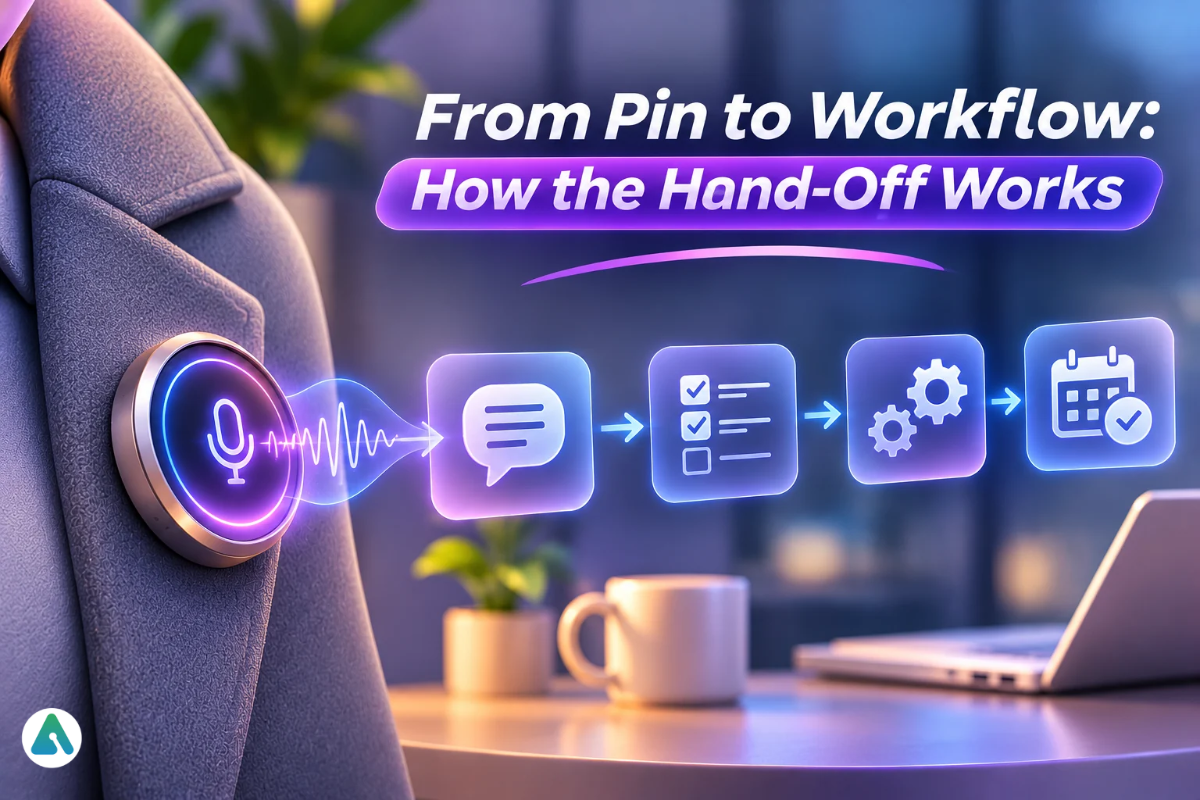
From Pin to Workflow: How the Hand-Off Works
A recording pays off once it reaches the tools you already use. Automation services and agent protocols handle that hand-off today.
Plaud offers a clear example. Its Zapier integration fires when a transcript or summary is ready, then pushes it into apps such as Notion, Gmail or Salesforce, per Plaud’s help center. The link runs one way for now. Plaud can trigger other apps, but other apps can’t trigger Plaud. Developers can go further through Plaud’s SDK and MCP access, which let AI agents read recordings directly.
The receiving end deserves equal care. Notes pushed into a CRM only help when the Salesforce setup behind them is sound.
Timing shapes the experience too. Cloud transcription takes longer than a quick answer from an on-glass model. Translation needs that speed. A meeting summary can wait a few minutes.
A made-up morning with a clip-on recorder
Priya is invented, but her routine is common. She sells industrial equipment and visits client plants most mornings.
At 9:00, she tells the plant manager she’s taking notes with the pin, and he agrees.
At 9:40, he mentions a budget cap and a March deadline. She taps the pin to flag it.
By 10:15, a summary opens with those two details, and a Zap has filed it in Salesforce.
At 10:20, she edits a drafted follow-up and confirms two CRM tasks.
She barely types. She still reads every line before it goes out, since transcripts mangle names and numbers. Knowing when AI is wrong stays her job, whatever the device.
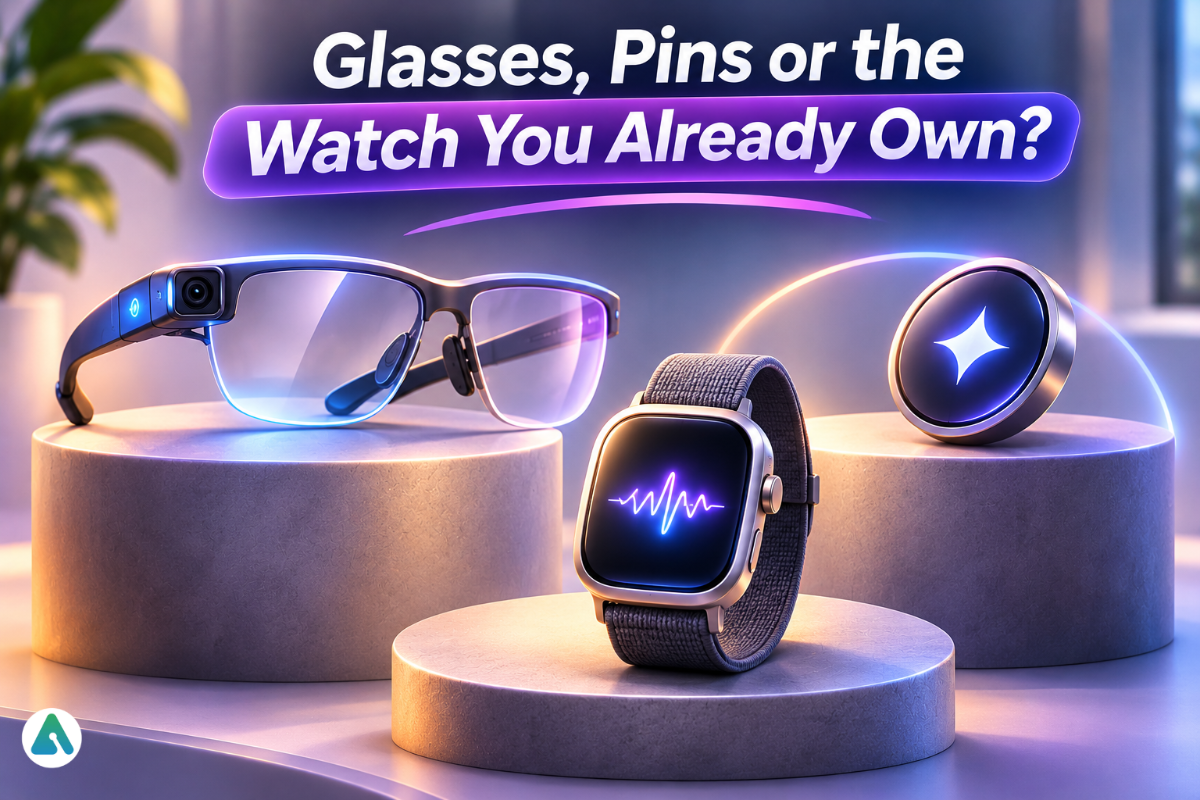
Glasses, Pins or the Watch You Already Own?
Camera glasses suit visual questions and translation. Display-only glasses suit discreet notes and captions. Pins suit long meetings. Your watch may cover the rest.
Device (US price)
Type
Strength
Drawback
Ray-Ban Meta Gen 2 (from $379)
Camera glasses, no screen
Translation, hands-free photos, Live AI; up to 8 hours per charge
Some venues ban camera eyewear
Meta Ray-Ban Display ($799 with Neural Band)
Camera glasses with a 600 x 600 in-lens screen
Messages, captions, turn-by-turn directions
CNET rated it less useful than a smartwatch for now
Even Realities G2 ($599)
Display glasses, no camera
Discreet notifications, translation, teleprompter
No camera means no visual AI
Brilliant Labs Halo (listed at $349)
Open-source display glasses
On-frame AI chip, hackable apps
Shipping slipped several times
Samsung AI glasses (price TBA)
Android XR glasses, no screen
Gemini answers, translation, navigation
Price and full handset support unconfirmed
Plaud NotePin S ($179)
Pin, clip, band or lanyard
Meeting notes with flagged moments
In-person talks only; no call capture
Bee wristband (launched at $49.99)
Wristband
Reminders and to-dos from your day
Amazon now owns the service
Prices shift often in this market, so confirm them with the retailer.
The case for the watch
A smartwatch already sits on your wrist with a mic, a speaker and an assistant. For timers, texts and quick questions, it usually wins. Bee even offered an Apple Watch app beside its band, a hint that dedicated hardware and watches are converging. For mainstream buyers, watches could absorb much of what pins do, the way phones absorbed point-and-shoot cameras.
For now, pins keep one edge: hours-long meetings. A pin sits close to the speaker, carries its own battery and storage, and leaves your watch free.
Rings play a different role. Oura and its rivals center on sleep and health data, though Even Realities lets its G2 glasses take input from a smart ring. Expect rings to matter more as controllers than as recorders.
The HANDS Test for Any AI Wearable
The HANDS test asks five yes-or-no questions about a use case. Pass most of them, and a device stands a fair chance of staying on.
Hands busy: does it help when your hands or eyes are occupied?
Always worn: can you wear it through a full workday?
No-phone faster: does it beat unlocking your handset?
Daily: does the moment come up every day?
Socially safe: can you use it around people without friction?
Use case
H
A
N
D
S
Score
Sticking point
Conversation recall
✓
✓
✓
✓
–
4/5
Bystanders may object
Live translation
✓
✓
✓
–
✓
4/5
Many people need it only on trips
Proactive nudges
✓
✓
✓
✓
–
4/5
Too many prompts cause fatigue
Autonomous actions
✓
✓
–
✓
–
3/5
Errors send you back to check
Visual help
✓
–
✓
–
–
2/5
Cameras draw stares; demand comes and goes
Phone replacement
–
–
–
✓
–
1/5
Slower and weaker than the handset itself
How we scored it: a check means the evidence here supports a pass for most users. A dash means the answer depends on the person, the setting or local law. These are editorial calls based on published data and reviews, without lab tests.
The S column tells the story. Social comfort drags down every use case that involves a microphone or camera. Camera-free display glasses, like Even Realities’ line, exist largely to dodge that problem.
Privacy, Consent and Who Owns Your Recordings
An always-on wearable stores other people’s words. Before buying, learn the consent rules where you live, then find out where recordings live and what happens if the company folds.
The legal basics
One-party consent: in many US states, you may record a conversation you take part in.
All-party consent: in states such as California, everyone in a private conversation must agree first.
EU and UK: GDPR governs how companies process the personal data inside a recording, from storage to deletion.
US healthcare: a vendor that handles patient data for a clinic must sign a business associate agreement under HIPAA.
Rules vary widely, so confirm yours with a lawyer. This article isn’t legal advice.
Trust and hardware safeguards
Counterpoint flags public unease about cameras as a major risk for AI glasses. Samsung says its glasses will shut off the camera if someone covers the outer recording light. Trust can still crack fast. A 2026 US lawsuit claims contract workers reviewed sensitive footage from Meta’s AI glasses, which Meta marketed as built for privacy, as Mondaq’s legal summary explains.
Six questions for any seller
Where does processing happen? On the device, your handset or a server?
Does the company keep raw audio? TechCrunch reported in January 2026 that Bee transcribes speech and then deletes the audio.
Can it train models on your data? Look for an opt-out in settings and in the privacy policy.
Can you export everything? Limitless added an export tool when Meta bought the company and stopped selling the Pendant.
Can you delete it all? Deletion should cover transcripts and summaries, too.
What happens at shutdown? Humane gave AI Pin owners only days to download their photos and notes.
A stash of recorded conversations also makes a tempting target, now that AI agents are changing cybercrime. Encryption and short retention windows deserve as much attention as features.
At work, compliance badges help. Plaud lists SOC 2, HIPAA and GDPR compliance for its pins, claims you should treat as company-reported. Teams that start by mapping data flows early avoid most approval delays, and the habit transfers well to wearables. Bring in IT or legal before anyone records client meetings.
Buying Mistakes and Who Should Skip
Most regrets start with a keynote demo. The subscription, the battery and the silence in a meeting arrive later.
Treating it as a phone substitute. Every wearable that sells in 2026 leans on a handset. Buy one to extend your phone and you’ll judge it fairly.
Ignoring the subscription. Plaud’s Pro plan costs $99.99 a year and Unlimited runs $239.99. Bee launched with a $19.99 monthly plan. Over two years, fees often top the hardware price.
Letting the software run unchecked. A summary can drop nuance or misquote a price. Agents that fail silently do the most damage, since nobody spots the wrong email until a client replies. Keep an approval step for anything that sends, books or spends.
Who should wait
You rarely sit through in-person meetings or long talks.
Your phone’s transcription app already does the job.
Recording people makes you, or them, uneasy.
A yearly plan doesn’t fit your budget.
You want errands handled with no supervision. No device on sale does that yet.
What to Expect in 2027
Expect 2027 wearables to start acting on what they hear, with Apple likely joining the field.
Glasses that act. Counterpoint expects the next wave to rely on better voice control and ultra-low-power sensors.
Apple’s entry. Bloomberg’s Mark Gurman reported that Apple is building display-free AI glasses, an AI pendant and AirPods with cameras. Glasses production could start in December 2026 for a 2027 release (Technobezz). Apple hasn’t confirmed any of it.
Screens later. Smart Analytics Global expects glasses with head-up displays to outsell audio-only models from 2028.
Bigger volume. The same firm forecast AI glasses sales climbing from about 6 million units in 2025 to 20 million in 2026.
Platform owners hold the advantage. They run the phone, the browser and the assistant, which is where the AI agent war will likely be settled. A wearable that plugs into that stack can trigger real work. One that can’t will mostly take notes.
The next leap may need no new hardware at all. A software update could let the glasses or pin you own finish a task instead of just logging it.
Conclusion
The wearable AI agent killer use case in 2026 looks modest on paper. A device listens, keeps the record and passes the follow-up to software you control. Gentle nudges help it stick. Full autonomy still needs better accuracy.
Pick one daily moment where details slip away. Run it through the HANDS test, then put the six privacy questions to the seller. If both checks hold up, a clip-on recorder or a pair of AI glasses will likely fit your routine. If not, your watch and handset can carry the load until 2027.
FAQs
Q. What is the killer use case for wearable AI agents in 2026?
Conversation recall. A pin, pendant or pair of glasses captures talks, and software turns them into searchable notes and tasks. Live translation ranks second.
Q. Is a wearable itself an AI agent?
Mostly no. The wearable gathers sight and sound, and the agent usually runs on a handset or server. Chips like Qualcomm’s AR1+ Gen 1 now let small models run on the glasses themselves.
Q. Can AI glasses work without a phone?
Some features can. Glasses with on-device chips can handle quick answers or translation offline, while bigger tasks still need a connection.
Q. Which AI glasses have no camera?
Even Realities’ G1 and G2 skip the camera and show text on the lens instead. The design aims to sidestep the privacy worries cameras raise.
Q. Can a smartwatch replace an AI pin?
For quick voice requests, yes, and watches may absorb more over time. For hours of meeting audio, a pin still works better because it sits closer to the speaker.
Q. Is it legal to wear a device that records conversations?
That depends on location. One-party consent places let you record talks you join, while all-party places like California require everyone’s agreement.
Q. Do AI wearables need a subscription?
Most need one for full features. Plaud charges $99.99 to $239.99 a year, and Bee launched at $19.99 a month.
Q. Can recordings flow into Notion or a CRM?
Yes. Plaud’s Zapier integration sends finished transcripts and summaries to apps like Notion, Gmail and Salesforce.
Disclaimer: This article is for informational and educational purposes only. Product specifications, pricing, market statistics, and industry developments are based on available sources and may change. We are not affiliated with the brands mentioned, and readers should verify product details before making purchasing decisions.
Tags:
Sebastian Vale
Sebastian Vale reviews the latest AI tools and tech innovations, breaking down complex concepts into clear, actionable insights. He also creates step-by-step guides, helping readers make smarter decisions and stay ahead in a fast-moving digital world.