8 Best Wiz Code Alternatives for AI-Powered Code Security in 2026
Wiz Code scans a team’s own code, open-source dependencies, infrastructure-as-code (IaC) files and hardcoded secrets, and it can trace a risky cloud resource back to the line of code that created it. Since March 11, 2026, it has also been part of Google Cloud, after Google closed its $32 billion acquisition of Wiz. Wiz says it still supports every major cloud, but an ownership change like that is a natural moment for teams to reassess their options.
There’s a second reason to look around. Code isn’t only written by people anymore. AI coding agents generate code, pull in dependencies, and open pull requests, sometimes faster than anyone reviews them. A scanner that only speaks up at the pull request is now arriving late to a decision the agent made minutes earlier.
The eight tools below all bring security checks into the places developers already work: the IDE, the pull or merge request, and the CI pipeline. They differ most in whether they also sit inside the AI agent’s loop. Aikido, for example, plugs into AI coding tools through MCP so generated code gets scanned before it’s committed. Others stop at the IDE or the pipeline.
How we compiled this list: we compared each vendor’s published product pages and documentation, checked in November 2026, against developer-first criteria (in-workflow findings, fix help, and AI coding agent support). We didn’t run hands-on benchmarks, and vendor performance figures below are the vendors’ own claims.
Why developer-first security matters now
Security findings that land in the IDE or a merge request reach developers while the context is still fresh, so fixes take minutes instead of a ticket and a meeting. In practice, that shows up in four ways.
Developers don’t have to leave their tools to see a problem, because findings appear in the editor and in code review.
Secrets can be stopped before they ever land. GitHub’s push protection, for instance, blocks detected credentials at the push.
Pipelines can enforce a bar. A CI gate can block a merge when a finding is critical and let lower-severity issues through.
And AI-written code gets the same checks as human-written code. That’s the newest requirement and the one that separates these tools most. Agents that install packages are an obvious target: Endor Labs, citing its own research, says 92% of all npm maintainer account takeovers ever recorded happened in 2025. Like other AI agents that fail quietly, a coding agent that pulls in a poisoned package won’t announce it.
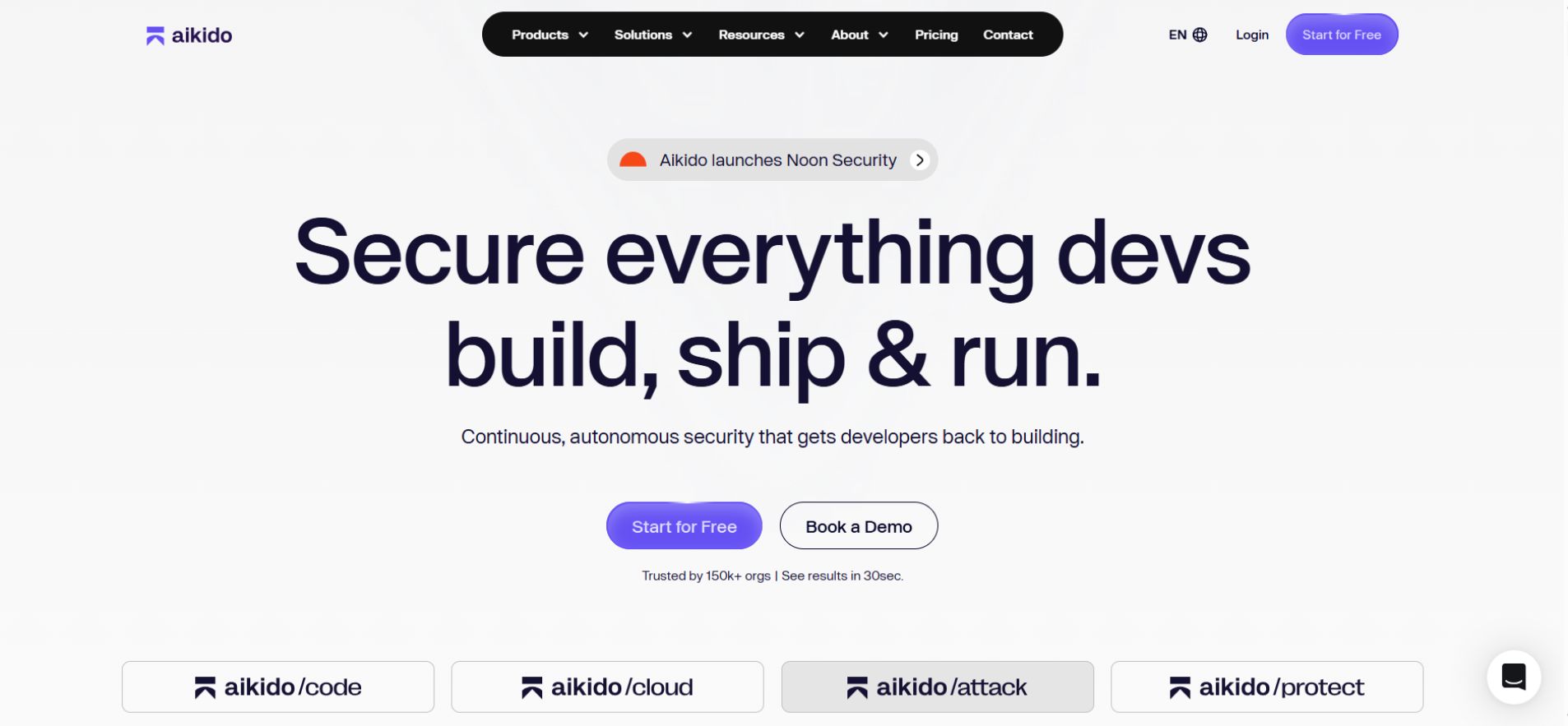
Aikido Code puts SCA, SAST, IaC, container image, secrets, license, and malware scanning into one platform. Developers see findings in their IDE (VS Code, Cursor, JetBrains, Windsurf and others), in pull request checks, and at CI gates that block risky changes before they merge.
What makes it relevant to the AI shift is the Aikido MCP plugin. Connected to tools such as Claude Code, Cursor, Codex CLI or GitHub Copilot, it scans AI-generated code for vulnerabilities and hardcoded secrets as soon as it’s created. A Cursor plugin can even run the scan automatically before the agent finishes a task. Aikido’s Safe Chain blocks malicious packages during install via npm, yarn, and pnpm, and it’s free to use.
Aikido also filters findings by reachability, exploitability, and exposure, so a vulnerability buried in unreachable code doesn’t compete for attention with one on an internet-facing service. AI AutoFix offers one-click fixes for SAST, IaC, SCA, and container issues. The platform connects to GitHub, GitLab, Bitbucket, and major CI systems with read-only access.
Best for: Teams that want code, dependency, secrets, and IaC scanning in one place, with checks that reach into AI coding agents as well as the IDE and pipeline.
2. Snyk
Snyk splits its developer security platform into products for source code, open-source dependencies, container images, and IaC. Its IDE plugins run in VS Code, JetBrains IDEs such as IntelliJ and PyCharm, and Eclipse, scanning in real time as developers write.
Snyk Code scans every pull request and repository and produces a status report teams can use to prioritize. Snyk Agent Fix generates AI fixes developers can apply with one click in the editor or the PR, and Snyk says its fixes are about 80% accurate.
Best for: Teams working in JetBrains IDEs, Eclipse or VS Code who want separate, mature scanners for code, packages, containers, and cloud configuration.
3. Semgrep
Semgrep brings SAST, SCA, secrets detection, and malicious-package protection together. Its standout is Semgrep Multimodal, which pairs deterministic rules (good at classics like SQL injection and XSS) with AI reasoning for logic flaws such as IDOR. In a June 2026 benchmark it published, Semgrep reported Multimodal found 3.5 times more true positives than a tuned prompt running the same AI model, at a lower cost per true positive.
Developers can run Semgrep in VS Code and IntelliJ, as a pre-commit hook, or in CI. Semgrep Secrets checks whether discovered credentials are still valid and puts live ones first. Semgrep Supply Chain adds reachability analysis and upgrade guidance for open-source dependencies.
Best for: Teams that want rule-based and AI-powered code scanning in one engine, plus secrets and dependency checks.
4. GitHub Advanced Security
GitHub Advanced Security (GHAS) combines two products: Code Security and Secret Protection. Code Security runs CodeQL, which follows how data moves through an application to find flaws, and dependency review flags vulnerable packages in each pull request before merge. Copilot Autofix proposes an explained fix for CodeQL alerts that developers review and apply.
Secret Protection’s push protection blocks known-provider secrets before they reach a repository, and validity checks show whether a detected secret still works. GitHub describes its false positive rate as remarkably low. GHAS is also offered for Azure DevOps.
Best for: Teams whose code already lives on GitHub and who want code, dependency, and secret checks inside GitHub pull requests.
5. GitLab Ultimate
GitLab Ultimate is the tier that adds built-in security testing to GitLab. Scans run in CI/CD pipelines on commit or when a merge request opens, and findings appear in the merge request and IDE. Coverage spans source code, dependencies, container images, and secrets, including secret push protection. GitLab Advanced SAST traces data across functions and files to find complex issues with fewer false positives.
The AI piece is the GitLab Duo Agent Platform. Its SAST false positive detection flow (generally available since GitLab 18.10) scores how likely a finding is to be noise. Its agentic SAST vulnerability resolution flow (beta, introduced in GitLab 18.9) reasons through high and critical findings and opens a merge request with a proposed fix. Both are recommendations that a person reviews before merging.
GitLab’s security testing is available on GitLab.com, GitLab Self-Managed and GitLab Dedicated.
Best for: Teams that already build and ship in GitLab and want security in the same pipelines and merge requests.
6. Checkmarx One
Checkmarx One correlates risk signals across code, packages, containers, and runtime context into one ranked view. For developers, the main entry point is Checkmarx Developer Assist, an IDE-native assistant that also works inside AI coding workflows. It connects to Checkmarx remediation intelligence through MCP, so tools like Copilot or Cursor can draw on it.
Developer Assist covers code flaws, vulnerable and malicious open-source packages, exposed secrets, IaC misconfigurations, and container risks. Two features stand out. It rescans changed code to confirm a fix actually removed the issue, and Safe Refactor maps everywhere a dependency is used so an upgrade doesn’t break the build.
Best for: Teams that want developer and AI agent fixes tied to one ranked view of application risk.
7. Endor Labs
Endor Labs focuses on code written by developers and AI coding agents. Its SCA with reachability checks at the function level determines whether a vulnerable function in a package is actually called by your code, then ranks fixes using exploit likelihood and fix availability. It also lists direct, transitive, and “phantom” dependencies.
The AI angle is AURI. Its free Developer Edition runs an MCP server locally inside Cursor, VS Code, Windsurf, Claude Code, and other MCP clients, covering SAST, SCA, secrets, and malicious-package detection, and source code stays on the developer’s machine. Endor Labs has added Agent Governance and a Package Firewall that blocks malicious packages before agents pull them into a workstation or CI.
Best for: Teams that need to know which open-source vulnerabilities their code can actually reach, and want guardrails on what AI agents install.
8. Cycode
Cycode calls itself an agentic development security platform, bringing application security testing, software supply chain security, and posture management together. Its Context Intelligence Graph pulls signals across code, pipelines, and cloud into one model, shrinking noisy alerts to the risks that matter.
Cycode Maestro orchestrates AI agents that assess exposure, analyze exploitability, generate fixes, and open pull requests. Cycode AI Guardrails work at the IDE boundary, intercepting secrets, file context, prompts, and tool calls before sensitive data reaches outside AI services. That’s a different take on agent security, focused on what leaves the machine rather than what gets installed. Cycode integrates with more than 120 third-party tools.
Best for: Teams that want code, pipeline, and secrets risks ranked in one graph, with AI agents drafting fixes and guardrails on AI tool use.
How to choose
Start with where your code lives. Teams fully on GitHub or GitLab get a lot from GHAS or GitLab Ultimate without adding another vendor. Mixed environments usually suit a platform that connects to several source control systems.
Next, look at how your team writes code today. If AI agents are already generating meaningful amounts of it, check how each tool reaches into the agent: an MCP server, a plugin, guardrails, or nothing. Security tooling is only one layer here. Recent incidents have shown that AI safety boundaries can faileven at labs designed around containment, so permissions on what agents can install and push matter too.
Finally, test on a real repository. Run two or three candidates against the same codebase for a couple of weeks. Count the findings developers actually fixed, not the total number of alerts.
FAQs
Q.1 What does Wiz Code do?
Wiz Code scans source code (including SAST, added in late 2025), open-source dependencies, IaC and secrets, and it connects code findings to cloud context so teams can trace a cloud risk back to the code that created it.
Q.2 Did Google buy Wiz?
Yes. Google closed its $32 billion acquisition on March 11, 2026. Wiz kept its brand and says it continues to support all major clouds.
Q.3 Which alternatives work inside AI coding agents?
Aikido, Checkmarx One and Endor Labs connect through MCP. GitHub (Copilot) and GitLab (Duo Agent Platform) build AI into their own platforms, and Cycode adds guardrails at the IDE boundary.
Q.4 Should I pick an all-in-one platform or separate scanners?
All-in-one platforms reduce tool sprawl and make prioritizing across finding types easier. Separate scanners can go deeper in one area. Run a trial on your own code before deciding.
Disclaimer: This article was submitted by a guest contributor. The views, opinions, and information presented are solely those of the author and do not necessarily reflect the views of AIInsightsNews. The content is provided for informational and educational purposes only and should not be considered professional cybersecurity advice.
Tags:
AIInsights News Editorial Team
The AIInsights Editorial Team manages contributed content, industry insights, and editorial features published on AIInsights News. Articles appearing under this byline may include submissions from external contributors that have been reviewed for relevance, quality, and compliance with the publication's editorial guidelines.