will AI Replace in Accountants in 2026? The Truth Behind the latest Data
No. AI is not replacing accountants as a profession in 2026, but it has already replaced specific tasks inside the job. The more useful question is how much of a task list is now AI’s job, and what that frees a person up to do instead.
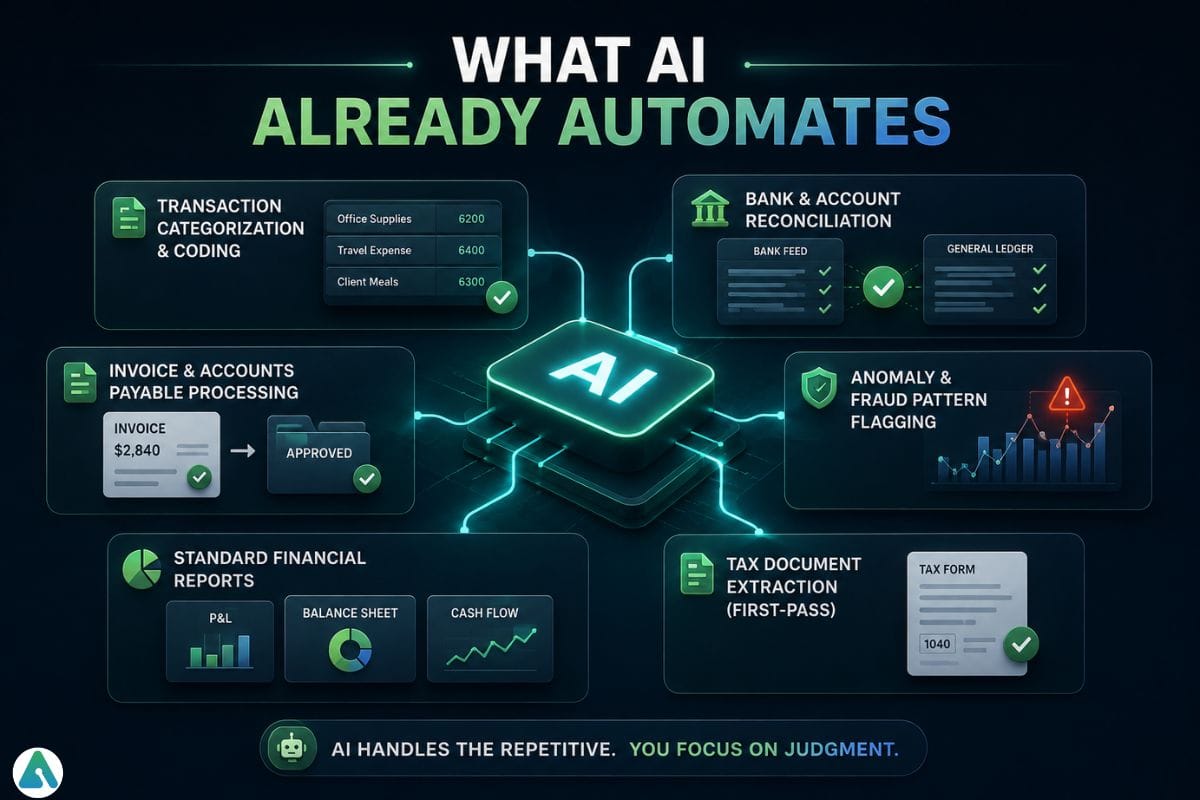
What AI Already Automates
AI handles structured, repetitive work well:
Transaction categorization and coding
Bank and account reconciliation — data matching and exception flagging
Invoice and accounts payable processing
Anomaly and fraud-pattern flagging
Standard financial reports (P&L, balance sheet, cash flow)
First-pass tax document extraction
One nuance carries through the rest of this piece: routine reconciliation is largely automated, but a discrepancy that needs investigation still goes to a person.
Month-End Close: Before and After
Traditional close: an accountant downloads statements by hand, matches them line by line against the ledger, chases unmatched items over email, and writes journal entries manually. At a small firm, this often eats several days.
AI-assisted close: software imports and matches routine transactions in minutes and surfaces only what it couldn’t confidently match. A person works the exceptions and signs off on the package.
How Accurate Is AI at Accounting Tasks?
DualEntry Labs built a benchmark for accounting work specifically — 101 questions across transaction classification, journal entries, AP, and reconciliation, each graded against a deterministic answer.
March 2026 run: GPT-5.4 led 19 models at 77.3% accuracy.
August 2026 run:Grok 4.5 topped 42 models at 84.2%. No model has cleared 85%, and the spread between the top model and the field stays wide.
DualEntry co-founder Santiago Nestares told Accounting Today that large language models draft well, but finance runs on validated records, not drafts. Errors clustered most in reconciliation and month-end close — exactly where a small mistake compounds before anyone notices.
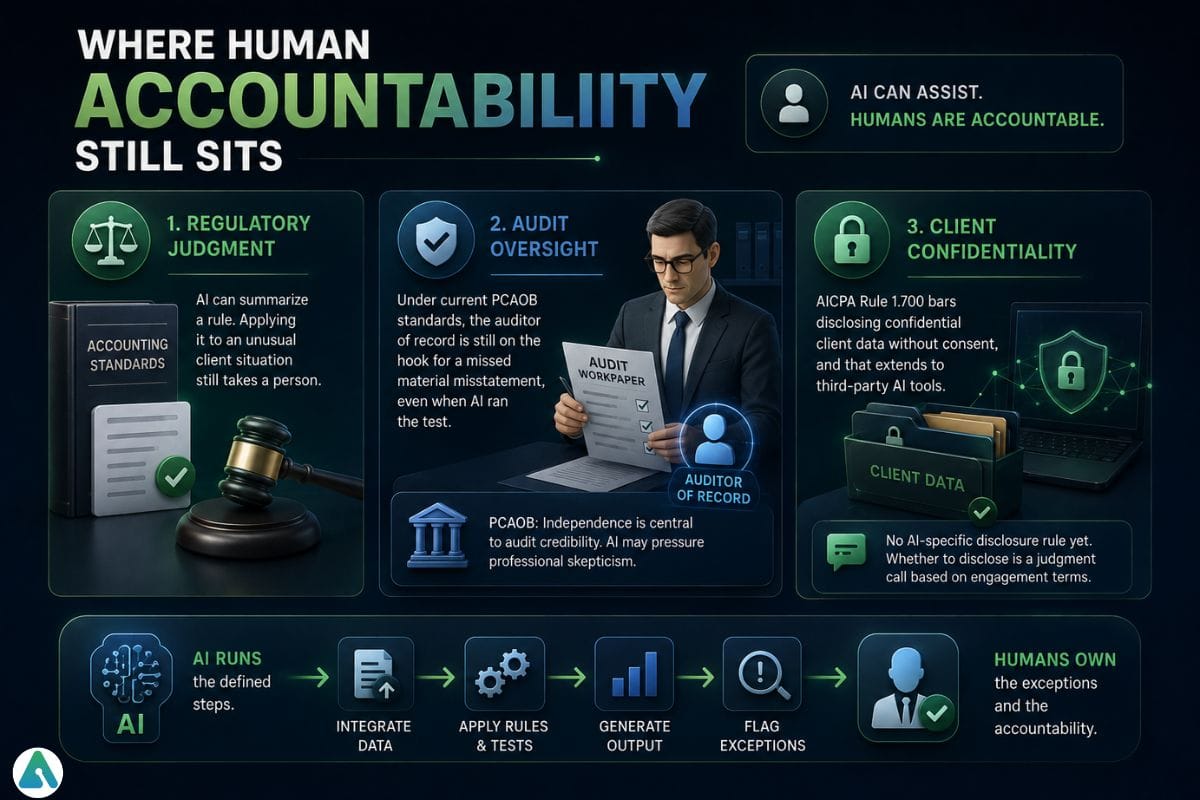
Where Human Accountability Still Sits
This is the one section that spells out who stays accountable and why. Three structures currently keep the final call with a person.
Regulatory judgment. AI can summarize a rule. Applying it to an unusual client situation still takes a person.
Audit oversight.PCAOB Acting Chair George Botic told the AICPA Conference in December 2025 that independence is central to audit credibility, and that AI may pressure auditors’ professional skepticism. Under current PCAOB standards, the auditor of record is still on the hook for a missed material misstatement, even when an AI agent ran the test and a person only checked the output.
Client confidentiality. AICPA Rule 1.700 bars disclosing confidential client data without consent, and that extends to third-party AI tools. There’s no AI-specific disclosure rule yet, so whether a firm tells a client it used AI on their file is a judgment call shaped by the confidentiality terms in the engagement letter, not a blanket requirement either way.
Together, these three describe human-in-the-loop accounting: AI runs defined steps; a qualified accountant owns the exceptions and the accountability.
Cost, ROI, and What Slows Adoption
Costs scale with firm size and how broadly a firm deploys AI. The most under-quoted cost isn’t the software subscription — it’s integration and change management, which almost always runs longer than a vendor’s initial estimate.
ROI numbers circulating in the industry mostly come from vendor-adjacent sources, not independent research. Calculate ROI against actual transaction volume rather than a generic industry figure.
What slows rollouts:
Data quality. AI is only as good as the chart of accounts it’s matching against.
Integration. Connecting AI to an existing ERP is rarely plug-and-play.
Staff resistance. Accountants who built expertise on manual reconciliation don’t automatically trust AI output.
Shadow AI. Staff pasting client data into consumer chatbots is a live risk, policy or not.
Bank reconciliation and AP are the workflows firms most often pick to automate first — high volume, rules-based, and the fastest path to a defensible payback before expanding further.
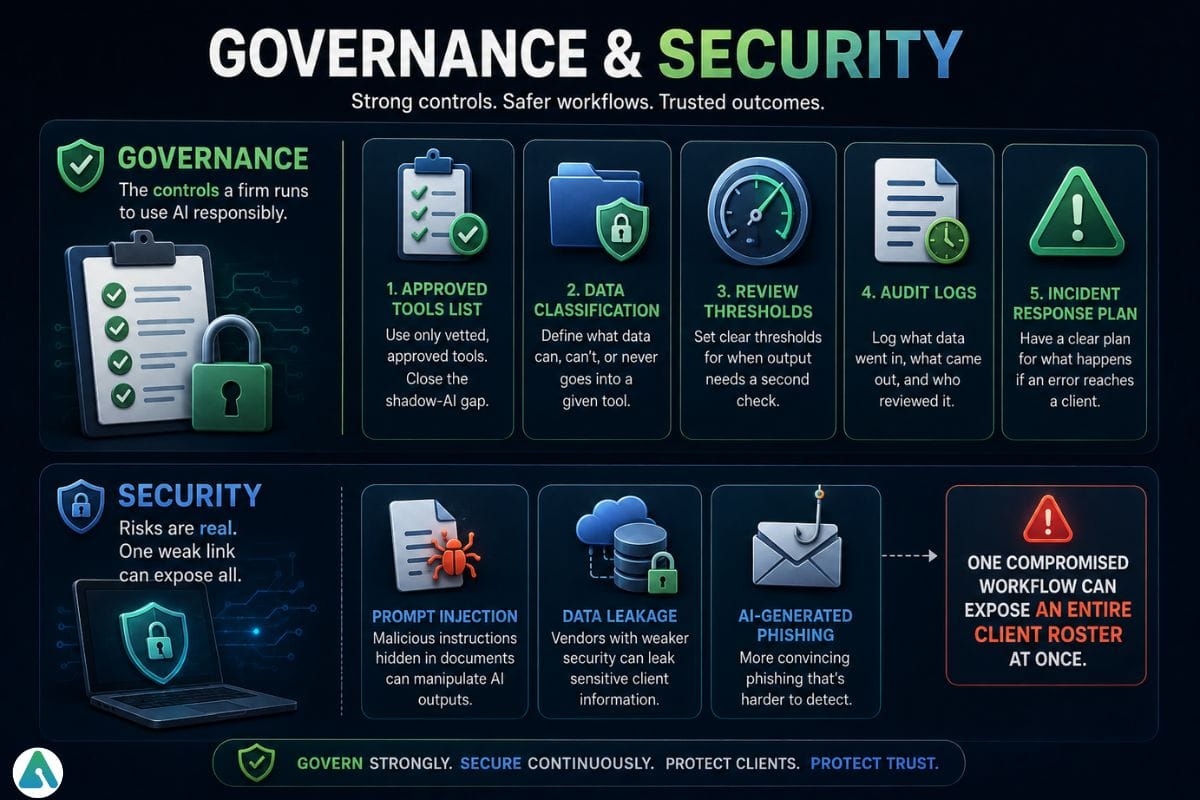
Governance and Security
Governance here means the controls a firm runs, not who’s legally accountable — that’s covered above. A workable setup needs:
Data classification rules for what never goes into a given tool
Defined thresholds for when output needs a second check before it reaches a client or a filing
Audit logs showing what data went in, what came out, and who checked it
A plan for what happens if an error reaches a client before anyone catches it
Security risks specific to AI workflows include prompt injection hidden in documents a tool processes, data leakage through vendors with weaker security than the firm itself, and AI-generated phishing that’s harder to spot than older templates. One compromised workflow can expose an entire client roster at once.
Which Accounting Roles Are Most Exposed?
Role
AI Exposure
Where Human Value Remains
Bookkeeping
High
Exception handling, client communication
Accounts Payable
High
Disputes, unusual vendor situations
Payroll
High
Compliance oversight, edge cases
Tax Prep (simple returns)
Medium–High
Complex returns, audit representation
Staff Accountant
Medium
Analysis, exception investigation
Auditor
Medium
Professional judgment, sign-off
Controller
Low–Medium
Governance, internal controls
CFO / Advisory Partner
Low
Strategy, client trust
The pattern: the more repeatable the role, the higher the exposure.
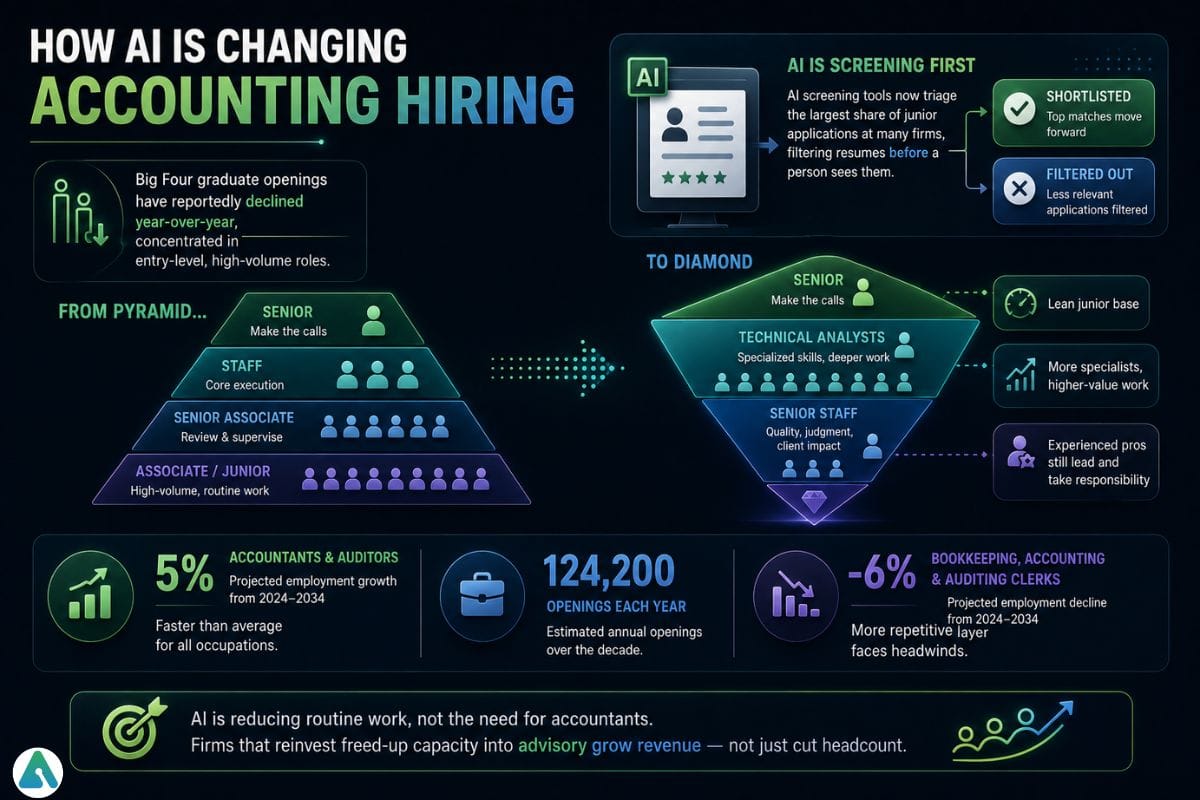
How AI Is Changing Accounting Hiring
Big Four graduate openings have reportedly declined year-over-year, concentrated in entry-level, high-volume roles. Firms are shifting from a “pyramid” model toward a “diamond” one — a leaner junior base, a wider layer of technical analysts, senior staff still making the calls.
Official projections don’t show a shrinking profession, though. The U.S. Bureau of Labor Statistics projects 5% employment growth for accountants and auditors from 2024 to 2034, faster than average for all occupations, with roughly 124,200 openings a year — while bookkeeping, accounting, and auditing clerks, the more repetitive layer, are projected to decline 6% over the same period. One accountant producing what used to take three doesn’t automatically mean two-thirds of jobs vanish; firms that reinvest freed-up capacity into advisory work tend to grow revenue rather than cut headcount.
Salary Impact: What Firms Pay For
Robert Half’s 2026 Salary Guide projected accounting salaries to rise about 2.1% year-over-year, down from 3.6% the year before. Tax, audit, and assurance roles rose faster than that average, and 87% of finance leaders reported paying more for specialized skills.
New titles like “AI governance and risk officer” are appearing alongside existing roles. Firms are paying a premium specifically for AI-adjacent skills, on top of a labor market where experienced accountants are already scarce.
Beyond the U.S.: How Other Regulators Are Responding
Licensure and legal accountability for accountants and auditors are set nationally, not globally — check local rules before assuming a U.S.-style standard applies elsewhere.
In the EU, AI systems used for credit scoring and similar financial decisions fall under the high-risk category of the EU AI Act, layering obligations for risk management, human oversight, and audit logging on top of existing rules like GDPR and DORA. The compliance timeline for high-risk systems has shifted more than once as the EU works through a “Digital Omnibus” simplification package, so confirm the current deadline before relying on an earlier one.
The Junior Experience Gap
This is unresolved in the profession right now. The traditional path to judgment — years of manual reconciliation and categorization — is exactly the work AI now does fastest. If a junior skips that grind, where does the pattern recognition that makes a senior accountant come from?
Firms are experimenting with structured training: juniors catching deliberately planted AI errors, simulation exercises built on historical data with known answers. None of this is settled best practice yet. The AICPA’s Profession Ready Initiative, launched February 2026, is the most direct institutional response so far — a research effort, not a finished framework, with results expected in late 2027.
How to Future-Proof Your Career
Use the AI already in your firm’s stack instead of working around it.
Lean into advisory work over transaction processing.
Build data literacy over coding skills — knowing how to question AI output matters more than building the system that produced it.
Ask for review-based training explicitly; it won’t happen automatically just because a firm adopted AI tools.
Track continuing-education requirements as they update — state boards are gradually folding AI-tool competency into CPE expectations, so confirm your board’s current list rather than assuming last year’s.
Will AI Replace Accountants by 2030, 2040, or 2060?
Each horizon depends on a different bottleneck, not just “more capable models.” Here’s what would actually have to change:
Timeframe
Confidence
What Would Have to Change First
By 2030
Moderate
Model accuracy would need to clear the high-90s on deterministic tasks (versus 84.2% today), and firms would need integration and data-quality problems solved at scale, not just a leading model
By 2040
Low
Licensure statutes would need to name AI systems as eligible preparers or reviewers, PCAOB-style standards would need to define AI-specific audit accountability, and malpractice insurance markets would need products that price that risk
By 2060
Very low
No credible forecast reasonably extends this far — the honest answer is nobody knows, and treating any 2060 projection as data is a mistake
Three leading indicators are worth watching instead of the calendar itself: whether any jurisdiction changes licensure law to name an AI system as an eligible preparer or reviewer, whether malpractice insurers start pricing AI-assisted work differently from human-only work, and whether benchmark accuracy on deterministic tasks closes the gap with human error rates on the same tasks. None of the three has happened yet.
FAQs
Q. Why aren’t accountants being replaced by AI?
Accounting involves regulatory judgment, ethical responsibility under rules like AICPA 1.700, and client trust that AI can’t legally take on.
Q. Will AI replace accounts payable jobs?
Much of AP is already automated. Oversight and complex exceptions stay human, but manual AP volume keeps shrinking.
Q. Will AI replace tax preparers?
Simple, standard-form tax prep keeps automating. Complex returns and audit representation still need a licensed professional.
Q. Is AI worth the cost for a small firm?
Often yes, when targeted at one high-volume workflow like reconciliation or AP, rather than a firm-wide rollout at once.
Q. Can AI replace Chartered Accountants?
Not in the foreseeable future. Licensure and legal accountability differ by country, so confirm your own jurisdiction’s rules rather than assuming U.S. norms apply.
The Bottom Line
AI has changed the task list faster than it’s changed headcount. Pick one high-volume workflow to automate first, put governance in place before a shadow-AI incident forces the issue, and ask for review-based training rather than waiting for it.
Disclaimer; This article is provided for informational and educational purposes only. It discusses how AI is affecting accounting tasks, hiring, salaries, automation, and the future of the accounting profession.
Tags:
Sebastian Vale
Sebastian Vale reviews the latest AI tools and tech innovations, breaking down complex concepts into clear, actionable insights. He also creates step-by-step guides, helping readers make smarter decisions and stay ahead in a fast-moving digital world.