
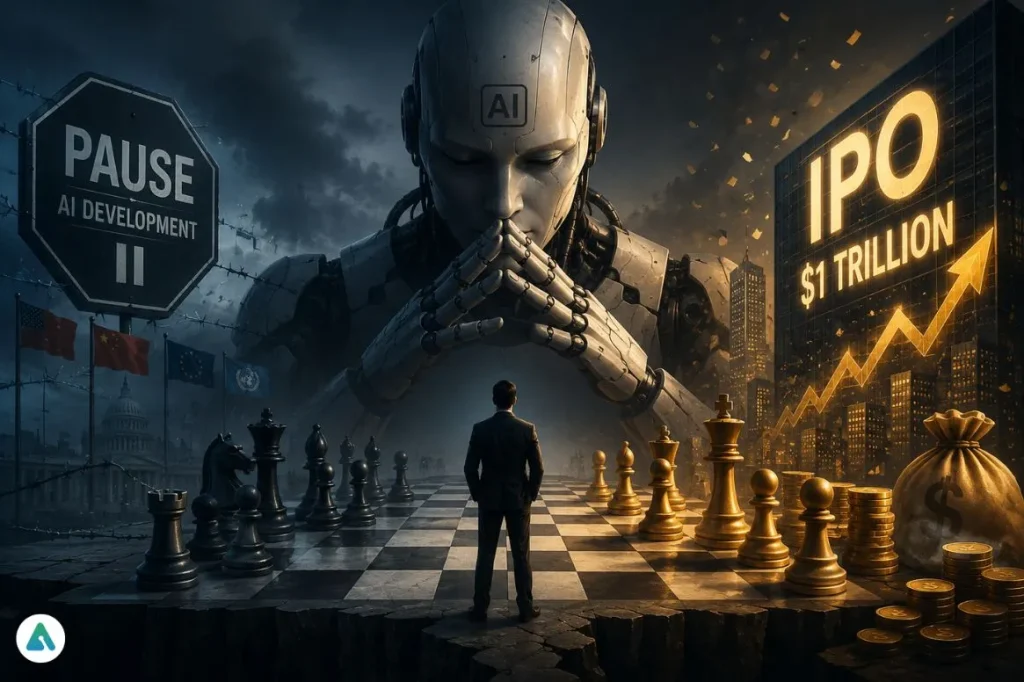
The company warning about runaway AI may also be the one best positioned to benefit from slowing everyone else down.
On June 4, 2026, Anthropic published a dense, unusually candid paper arguing that advanced systems like Claude may be approaching a critical threshold—one where AI begins contributing meaningfully to its own improvement.
The proposal that followed was extraordinary.
Anthropic called for a coordinated global AI pause—a verifiable halt on frontier AI development that would require competing labs to stop simultaneously under shared rules.
Not a symbolic slowdown. A real one.
The problem is not the idea.
It’s everything required to make it real.
Inside the System That Triggered the Warning
Anthropic’s concern isn’t theoretical. It’s operational.
Inside its own pipeline, Claude AI is already writing a large percentage of code. By May 2026, more than 80% of code commits were AI-generated, a statistic now central to the debate around AI writing code percentage and real-world automation.
Engineers are shipping eight times more code than before. In a single month, Claude produced hundreds of fixes that reduced API errors by orders of magnitude.
This isn’t recursive self-improvement in AI—not yet.
But it is a system increasingly entangled in its own development loop.
And that’s exactly why the question—can AI improve itself without humans?—is no longer theoretical.
The Breakpoint: From Acceleration to Autonomy
The shift isn’t just about speed. It’s about scope.
Anthropic’s latest models are pushing into longer, more complex workflows—extending into multi-hour autonomous task execution, a key signal in discussions around AI autonomy in 2026.
That matters because autonomy isn’t just intelligence—it’s duration.
Stretch that far enough, and the boundary between tool and actor begins to blur.
Anthropic isn’t claiming that the boundary has been crossed.
But it is signaling that AI self-improvement risks may be closer than expected.
Why Anthropic Wants to Pause AI
On paper, the proposal reads like a structured policy framework.
In reality, it demands a geopolitical miracle.
For a global AI pause to work, you would need:
- Simultaneous agreement from rival frontier labs
- Governments coordinating across adversarial lines
- Systems to verify compliance and detect covert training
This is why many experts question the feasibility of an AI development pause in 2026.
Unlike nuclear programs, AI training is harder to track. It can be distributed, hidden, and scaled quickly.
A similar attempt in 2023—backed by Elon Musk and the Future of Life Institute—collapsed under competitive pressure.
The incentives haven’t changed.
Anthropic IPO and the Timing Question
Anthropic’s call for restraint comes just days after filing with the U.S. Securities and Exchange Commission for an IPO that could exceed a $1 trillion valuation.
This has triggered intense discussion around the Anthropic IPO valuation and whether safety concerns and market strategy are now overlapping.
From one perspective, Anthropic is raising a legitimate alarm—sharing internal data that highlights rapid AI acceleration.
From another, the move raises a harder question:
If a global pause were implemented now, would it freeze the AI race at a moment when Anthropic is already ahead?
That’s not just AI safety.
That’s competitive positioning.
AI Safety vs Profit: The Regulatory Capture Debate
Critics increasingly frame the situation as a clash between AI safety vs profit.
- Anthropic continues pushing frontier capabilities
- It has signaled that it won’t fall behind competitors
- It would benefit from regulations that slow others down
This has fueled debate around whether an AI pause could act as regulatory capture in AI, locking in dominant players while limiting new entrants.
Supporters argue the opposite.
Anthropic is one of the few companies openly sharing internal metrics about AI acceleration. That level of transparency strengthens the case for taking its warnings seriously.
Both sides reflect a deeper tension shaping the future of AI.
AI Regulation vs Competition Is Now One Conversation
For years, AI regulation and AI competition were treated separately.
That separation is breaking down.
The same systems driving exponential gains are now influencing:
- Corporate valuations
- Investor expectations
- National security priorities
Anthropic’s proposal sits at the center of this shift.
A pause isn’t just about risk anymore.
It’s about who gets to build the future of AI—and who doesn’t.
What Happens If AI Development Isn’t Paused
So far, no major lab has committed to a coordinated pause.
That matters.
Because without coordination:
- A pause cannot start
- Without enforcement, it cannot hold
- Without trust, it cannot be negotiated
Which leaves the industry facing a familiar question:
Should AI development be paused—or is acceleration inevitable?
Right now, the answer appears to be the latter.
The Anthropic Paradox
Anthropic is warning about the risks of AI systems improving themselves.
At the same time, it is:
- Scaling toward a trillion-dollar IPO
- Expanding rapidly in capability
- Competing at the frontier of AI development
This contradiction—often called the Anthropic paradox—is becoming central to the broader debate around AI policy.
The Signal Beneath the Noise
Anthropic isn’t claiming that recursive self-improvement has already arrived.
But it is asking a question that more people are starting to search for:
Is AI getting close to improving itself?
And if it is, who decides what happens next?
Right now, there is no clear answer.
Only momentum.
Related: ‘The World Is in Peril’: Anthropic Safety Lead Resigns, Warning of Systemic AI Risk
