

Artificial intelligence hasn’t taken over the world.
It’s done something quieter.
It has started thinking for us.
Not in the sci-fi sense. No sentient machines. No red eyes staring back at humanity. Just a steady stream of auto-summaries, suggested replies, generated opinions, and pre-digested conclusions. AI now reads our emails before we do, drafts our responses, condenses our news, and increasingly decides what matters — before we’ve had a chance to think at all.
That’s where the real danger begins.
The Shift No One Announced
AI’s rise was marketed as productivity. Assistive. Optional.
But somewhere between “help me write this” and “tell me what this means,” AI crossed a line. It stopped being a tool we used and became a system we defer to.
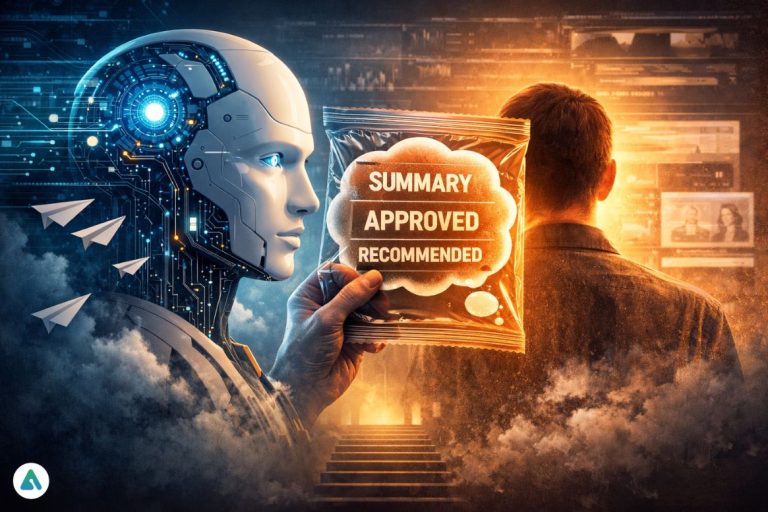
A manager approves a project update after reading the AI summary, not the document itself.
Later, the decision unravels. A key caveat — buried deep in the original text — never made it into the summary. When asked why it was missed, there’s no defensiveness. Just genuine surprise.
“I thought the summary was the thinking.”
Nothing went wrong in the obvious sense. No negligence. No bad intent. Just quiet delegation — and a blind spot no one realized they had.
This is how thinking disappears: not through force, but through frictionless design.
Convenience Is a Cognitive Drug
Delegation feels harmless because it works.
AI summaries are fast. AI answers sound confident. And most of the time, they’re polished enough that no one bothers to question them.
But convenience removes friction — and friction is where thinking lives.
When an AI tells you what an article says, you don’t argue with it.
>When it frames the conclusion first, you rarely explore alternatives.
Researchers now describe this pattern as metacognitive laziness: the gradual weakening of our ability to evaluate, synthesize, and reason independently after repeated cognitive offloading.
We didn’t stop thinking because we became careless.
We stopped because the system made thinking feel unnecessary.
Synthetic Consensus and the Flattening of Thought
AI doesn’t think the way humans do. It predicts. It compresses and optimizes for coherence.
That means AI-generated thinking isn’t neutral — it’s averaged.
As more of the web becomes AI-generated or AI-summarized, models increasingly train on their own output. Technically, this is known as model collapse. Culturally, it manifests as something more subtle: synthetic consensus.
Language flattens. Risky ideas fade. Nuance disappears because nuance doesn’t compress well.
When millions of people rely on the same systems to summarize, interpret, and respond, perspectives don’t diversify — they converge. Not because anyone agreed, but because the machine decided what sounded reasonable.
This isn’t artificial intelligence replacing human thought.
It’s an artificial agreement quietly shaping it.
From Creation to Validation
Nowhere is this shift more visible than in the workplace.
In 2026, many junior roles in law, software, marketing, and journalism no longer be created from scratch. They verify. Fact-check. Approve.
The machine does most of the cognitive lifting. The human signs off.
This feels efficient — until the AI is removed.
Researchers are now observing what’s being called the AI Rebound Effect: when automation is taken away, human performance drops below pre-AI baselines. The mental muscles didn’t rest. They atrophied.
We used to fear that robots would take our jobs.
Instead, they took our boredom — and we’re discovering that boredom was when our best thinking happened.
Education, Creativity, and Skill Decay
Students edit AI-generated outlines without fully understanding the argument. Writers polish machine drafts instead of wrestling with first ideas. Professionals accept summaries they didn’t verify because the system has “been right before.”
Skills don’t vanish overnight. They erode.
Deep reading weakens when you stop reading deeply.
Original writing weakens when you start from generated text.
Judgment weakens when relevance is decided for you.
This isn’t a moral failure. It’s an environmental one.
The Real Question of Control
Most AI debates fixate on future superintelligence.
But the present risk is simpler — and more unsettling: the slow surrender of cognitive agency.
When AI becomes the default thinker, humans become editors of machine output instead of authors of thought. That shift doesn’t just change productivity. It changes how societies reason, argue, and decide.
The danger isn’t that AI becomes smarter than us.
It’s that we become comfortable letting it think instead of us.
The Choice Still Exists — For Now
AI doesn’t have to think for us.
But it will — unless we actively resist passive design.
Notably, a small counter-movement is already emerging. Some 2026 startups are experimenting with friction-by-design interfaces — systems that intentionally delay AI answers, hide summaries until a user forms an initial view, or require a first draft before revealing the machine’s version.
The goal isn’t to slow people down.
It’s to keep them cognitively engaged.
These tools acknowledge something most AI products ignore: efficiency isn’t always intelligence, and speed isn’t always understanding.
Because once thinking becomes something we oversee rather than perform, the loss won’t be dramatic.
It will be quiet.
Efficient.
And very hard to reverse.
Related: The Hidden Cost of AI: Is Your Chatbot Making Your Mental Health Worse?
