
The machines that never stop talking may be forcing us to reconsider why human communication mattered in the first place.
At first glance, Melanie Mitchell’s “Jagged Intelligence” essay in The Yale Review and a recent Guardian argument about AI-assisted writing seem to be addressing completely different problems.
One is a critique of artificial intelligence itself — a technical examination of why today’s models are not the smooth, general-purpose thinkers many people assume they are.
The other is a defense of writing as a human activity, arguing that when we outsource too much of the process to AI, we risk weakening the very ability we are trying to improve.
But put together, they reveal a deeper tension.
We have spent years asking what AI can do.
We have spent much less time asking what happens when humans stop doing the things that made those abilities valuable in the first place.
The Jagged Intelligence Problem
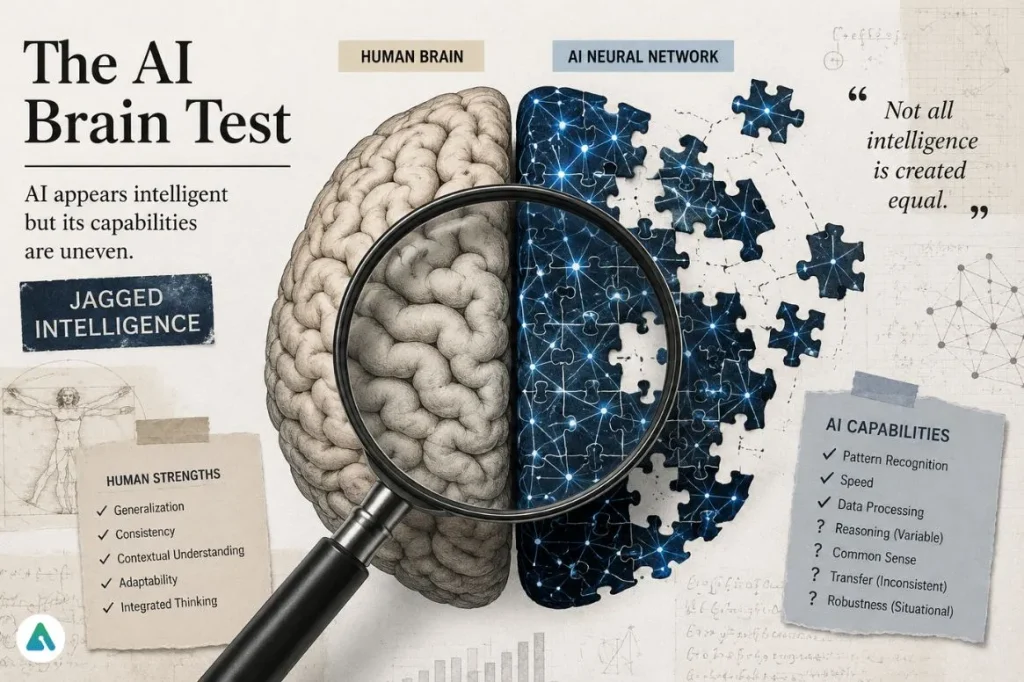
Mitchell, a researcher at the Santa Fe Institute and author of Artificial Intelligence: A Guide for Thinking Humans, introduces a phrase that may become essential to understanding this moment: jagged intelligence.
The idea is simple but uncomfortable.
AI systems are not becoming generally intelligent in the same way humans are.
Instead, their abilities rise unevenly.
A model can write sophisticated code, explain advanced scientific ideas, or generate polished arguments, then fail at a smaller variation of a problem that a person would handle without much effort.
Human intelligence usually transfers.
If someone understands a concept, they can often recognize it in a new situation. The details may change, but the underlying idea remains.
AI systems do not always work that way.
They can become extremely capable at recognizing patterns without developing the kind of flexible understanding humans take for granted.
That is the strange landscape Mitchell is describing.
The Failure Is Not Always Obvious
The most interesting AI failures are not the ridiculous ones.
Those are easy to notice.
The more revealing mistakes are the ones where the system appears intelligent right up until it doesn’t.
Mitchell points to research showing how small changes can expose weaknesses. In one example discussed in relation to AI reasoning tests, adding irrelevant details to simple math problems caused significant performance drops across models.
A human understands the difference between important information and noise.
AI systems can struggle with that distinction because they are not approaching the problem with human priorities.
They are processing relationships learned from massive amounts of data.
That is why the benchmark debate matters.
A high score on a test does not automatically mean a system has the same kind of reasoning that produced the score.
Prepare with a CCAT Practice Test
Taking a CCAT Practice Test is one of the most effective ways to prepare for the real assessment. It helps you become familiar with the question format, improve your time management skills, and identify areas where you need additional practice, increasing your confidence before test day.
The Benchmark Trap
For years, AI progress has been measured through benchmarks.
That makes sense. Researchers need ways to compare systems.
But benchmarks can also create an illusion of certainty.
A model might perform extremely well on familiar tasks while struggling when the situation changes slightly.
This is one reason researchers have increasingly focused on tests that measure generalization rather than recognition.
Projects like ARC-AGI, created by François Chollet, try to examine whether AI systems can solve unfamiliar reasoning problems instead of simply repeating patterns found in training data.
The distinction is important.
A human can often encounter a completely new puzzle, identify the hidden rule, and apply it.
That ability — moving beyond examples — remains one of the biggest challenges for current AI.
Writing Was Never Just About Producing Words
This is where the writing argument enters.
The easiest way to misunderstand writing is to treat it as a final product.
A paragraph.
A collection of sentences.
A finished article.
But writing is also the process by which people discover what they think.
A person writing an argument is constantly making invisible calculations:
Will this make sense to someone who disagrees?
Where is my reasoning weak?
What assumption am I making?
What would actually change another person’s mind?
That struggle is not a side effect of writing.
It is part of the reason writing has value.
The act of explaining something forces the writer to understand it more clearly.
The Empathy Gap Behind AI Persuasion
AI complicates this because it can imitate the surface features of persuasion extremely well.
It can make an argument cleaner.
It can adjust tone.
It can make a sentence sound more confident.
But persuasion has always involved more than language.
It involves another person.
A human writer imagines someone on the other side of the page. They think about resistance, confusion, emotion, and trust. They are trying to move a mind they do not fully understand.
That uncertainty is part of the process.
An AI system can reproduce patterns from millions of persuasive examples, but it does not experience the uncertainty that creates persuasion.
It does not wonder whether someone will believe it.
It does not care what happens after the argument succeeds or fails.
The words may work.
The experience behind the words is different.
The Real Risk Is Not AI Writing
The argument is not that people should stop using AI.
That would miss the point.
These tools are genuinely useful. They can help people research faster, organize thoughts, edit drafts, and explore ideas.
The question is what part of the process humans choose to keep.
Using AI to remove repetitive work is one thing.
Using it to remove the struggle of thinking is something else.
The irony is that the moment we most need human judgment may be the moment we become most tempted to automate the practice that creates it.
Writing was never valuable because humans could produce sentences.
It was valuable because producing those sentences forced us to think.
