

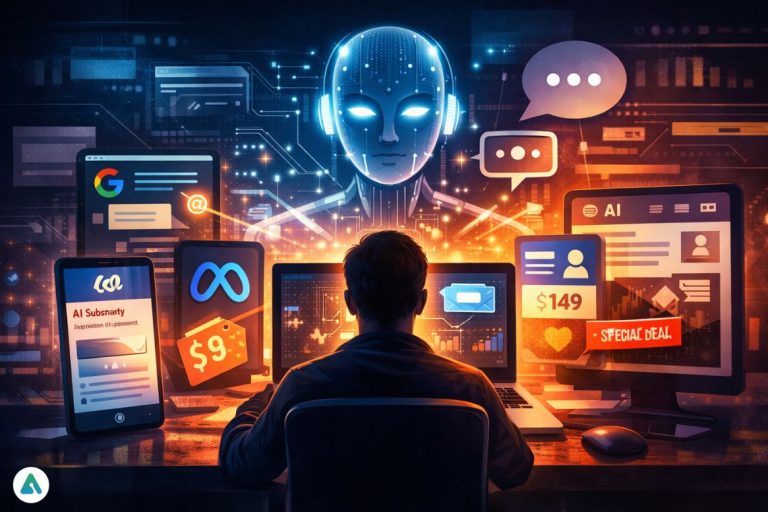
At some point this year, the internet stopped asking.
Millions of people opened Gmail in January and found something new waiting for them: Gemini, Google’s AI assistant, calmly summarizing private emails it had never been invited to read. There was no onboarding ritual, no meaningful consent moment, no big red toggle labeled “No, thanks.” It was simply there—already working, already interpreting.
This wasn’t an accident. It was the latest move in a quiet but decisive shift underway across consumer technology: artificial intelligence is no longer being added as a feature. It’s being installed as infrastructure.
Two years earlier, Google did something similar with AI Overviews in search—machine-generated answers injected at the top of results pages, reshaping how information is surfaced and monetized, again without a universal opt-out. Meta followed the same playbook. Meta AI appeared inside Instagram, WhatsApp, and Messenger as a permanent resident, not an optional guest.
Different companies. Same pattern.
AI arrives first. Choice comes later—if at all.
A Personalized Internet You Don’t Control
What’s emerging is not just smarter software, but a fundamentally different internet. One where no two people see the same version of reality.
Ads adjust themselves in real time based on how you talk to a chatbot. Product prices quietly shift depending on inferred intent, mood, or spending power. Advice, recommendations, and even search results are shaped by invisible models that learn continuously but explain almost nothing.
Personalization used to mean better recommendations. In 2026, it means bespoke economics.
And the off switch? It’s either buried several menus deep, fragmented across settings pages, or missing entirely.
“These tools are sold to us as more powerful, but we have less say in things,” said Sasha Luccioni, an AI ethics researcher at Hugging Face. The burden, she notes, is flipped: users must actively opt out—often without understanding what they’re opting out of.
This inversion matters. Because the real product here isn’t convenience. Its influence.
Why Advertising Is the Real Battleground
At the center of this AI expansion isn’t productivity or creativity. It’s advertising—the internet’s financial bloodstream.
For decades, digital ads were optimized using clicks, cookies, and crude behavioral signals. AI changes that equation. Large language models don’t just track what you do; they interpret what you mean. They infer intent, hesitation, urgency, and desire from casual conversation.
That makes them extraordinarily valuable to advertisers—and extraordinarily powerful as intermediaries.
If search engines once answered questions, AI assistants now frame decisions. They don’t just show products; they contextualize them. And in doing so, they quietly become the most influential layer between consumers and the market.
The danger isn’t that AI is wrong. It’s that it’s persuasive.
And persuasion scales.
Consent as a UX Problem — Solved for Companies, Not Users
Tech companies argue that embedding AI deeply improves user experience. Fewer steps. Faster answers. Less friction.
But friction, historically, is where consent lives.
By removing friction, platforms also remove moments where users can meaningfully object. The result is a default-on internet where participation is assumed, and refusal requires technical literacy, patience, and time—luxuries many people don’t have.
This isn’t coercion in the dramatic sense. It’s normalization. The most effective kind.
Once AI summaries, AI replies, and AI recommendations become baseline expectations, opting out starts to feel like opting backward. You don’t just lose features; you lose parity.
The Long-Term Cost: A Fragmented Public Reality
There’s a deeper consequence lurking beneath ads and settings menus.
When every user receives a personalized version of information—filtered through proprietary models trained on opaque data—the shared public internet begins to fracture. News, prices, advice, and even factual framing drift apart.
What replaces the open web isn’t a single algorithmic feed, but billions of private ones.
This makes accountability harder. Regulation harder. Journalism harder. And manipulation is easier.
If everyone sees something slightly different, who notices when something goes wrong?
The Question Tech Doesn’t Want to Answer
The industry’s favorite framing is inevitability: AI is coming, and resistance is futile. But inevitability is a narrative choice, not a law of nature.
The real question isn’t whether AI should personalize the internet. It’s who gets to decide how—and on what terms.
Right now, that answer is clear: platforms decide first. Users adapt later.
The internet is becoming more personal than ever. But it’s also becoming less participatory, less transparent, and less negotiable.
And for the first time in its history, the web is being rewritten not by what we click—but by what machines infer about us, quietly, constantly, and without asking.
Related: Is AI Ruining Everything in 2026? A Reality Check on Mismanaged Artificial Intelligence
