
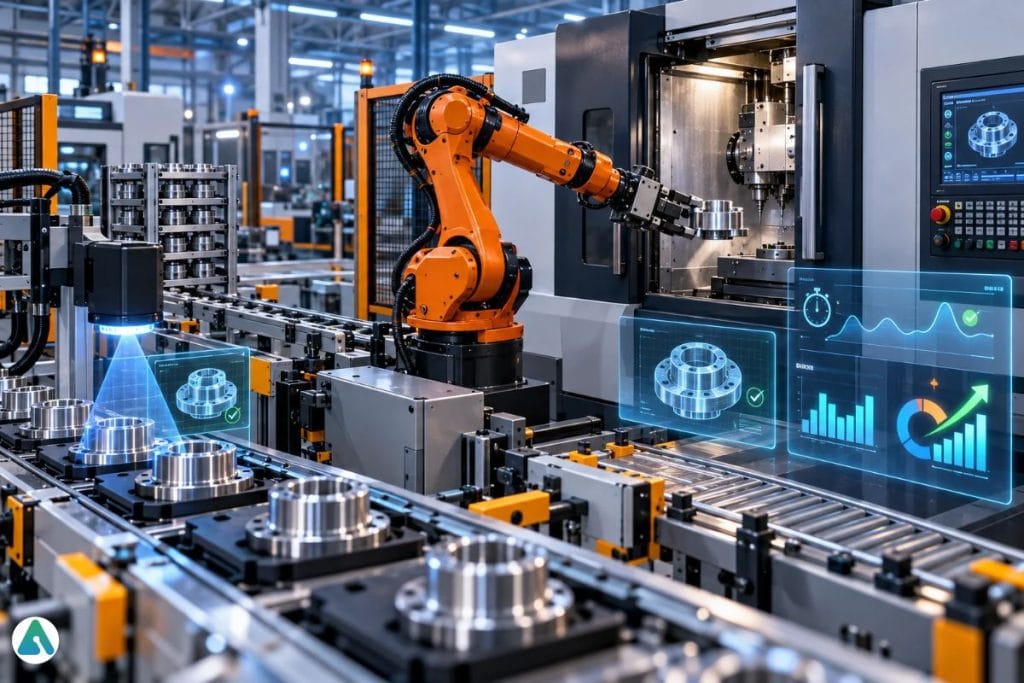
Picture a CNC machine that finishes a part every 40 seconds. The operator needs 55 seconds to unload, inspect, and reload it. The machine waits. Every cycle. Every shift.
Automation solutions close that gap, but only when they target the right constraint. Today that means more than a robot arm. AI vision, edge computing, and simulation now decide whether an automated cell runs smoothly or stalls.
The scale is already large. The number of industrial robots working in factories worldwide rose 9% to 5 million units in 2025, according to the IFR. The harder question is where a single plant should start.
Where Should Manufacturers Start With Automation?
Start with a measurable production problem. Skip the question “Where can we add a robot?”
Ask these instead:
- Where does production regularly slow down?
- Which tasks force workers to handle parts over and over?
- Where do quality variations show up?
- Which machines sit idle while they wait for an operator?
- Which tasks create ergonomic or safety risks?
- Which jobs are hard to staff on every shift?
Each answer points to a specific constraint. A bottleneck, a repetitive task, a quality gap, a safety concern, or a labor shortage. Pick one. Automating five things at once hides which change actually paid off.
What Is a Production Bottleneck, and Can Automation Fix It?
A bottleneck appears when one process caps the output of the whole system. The CNC example above fits. The machine is fast. The handling around it is slow.
Automation attacks bottlenecks through several routes:
- Robotic machine tending
- Automated part transfer
- Conveyor integration
- Inspection systems
- Palletizing
- Assembly automation
The trap is speed without context. Accelerating one task can push the jam downstream. Engineers map the full production sequence first, then automate the constraint itself.
How Does Robotic Machine Tending Work?
Machine tending puts a robot between raw material and a running machine. The robot picks up a raw component, loads the machine, and waits out the cycle. It then removes the finished part, passes it to inspection, and loads the next blank.
Idle time between cycles shrinks. Machine output stops depending on who is free to walk over.
Design depends on five inputs: robot reach, payload, part presentation, tooling, and the controls that talk to existing machinery.
AI earns its place at part presentation. Parts rarely arrive in perfect position. 2D and 3D vision let a robot find a part that sits off-center or rotated, then adjust its grip. The hardware behind that vision matters as much as the camera. Cameras inspect parts at line speed, and industrial computing processes the images in real time. One slow link in that chain stalls the cell.
Which Repetitive Tasks Suit Automation Best?
Repetitive material handling ranks among the most common opportunities. Workers move parts between CNC machines, conveyors, racks, assembly stations, inspection stations, and pallets. A robot repeats each move with the same positioning and the same timing.
Assembly offers a second target. Fastening, pressing, component insertion, dispensing, part positioning, and functional testing all repeat by nature.
One question gates the decision. Is the product repeatable enough to justify the build? Plants that run several variants can still qualify. Programmable robots, flexible tooling, and recipe-based controls let one system build multiple assemblies.
| Process | Typical constraint | Technology layer |
|---|---|---|
| Machine tending | Operator availability | Robot, PLC, part-presentation vision |
| Material handling | Repetitive manual transfer | Robot, conveyors, sensors |
| Assembly | Repeatable small operations | Flexible tooling, recipe controls |
| Inspection | Manual verification of every part | 2D/3D vision, AI classification |
| Palletizing | Ergonomic strain | Robot, safety systems |
How Does AI Vision Improve Quality Inspection?
Automation fixes quality problems as well as labor problems. Manual operations depend on operator technique, and technique drifts over a long shift.
Automated systems lock down the variables: robot position, tool speed, applied force, dispensing volume, and assembly sequence. Vision then verifies that parts are present, positioned correctly, and assembled to spec.
The defect data backs this up. McKinsey’s research on manufacturing “lighthouse” sites found that deployed vision inspection systems cut defect rates by roughly half in documented cases. A breakdown of AI vision inspection on filling lines shows the same pattern. Cameras catch residue and fill-level flaws that tired eyes miss.
Vision also catches problems earlier. A defective component gets flagged at its own station, before it travels through five more operations.
Here is the counterintuitive part. Vision does not remove people from the loop. A Finnish veneer producer found that its machine vision setup kept confusing bark defects with sound knots in birch. Natural materials vary too much for a static model. Vision-based grading works best when trained on labelled images and backed by a human who makes the final call.
Vision inspection can check:
- Part orientation and component presence
- Assembly completeness
- Labels and codes
- Surface features
- Dimensional characteristics
The same cameras can guide robots. One system inspects and directs.
Can Existing Equipment Join an Automated Line?
Yes. Many plants own machines that still cut or form well but rely on manual loading or aging controls. Scrapping them wastes capital.
Modernization usually combines several upgrades:
- Robot integration
- PLC upgrades
- New HMIs
- Conveyor systems
- Sensors and machine vision
- Safety systems
- Data collection
Data collection deserves extra attention. A Deloitte survey of 600 manufacturing executives found that about 46% use IoT solutions for better visibility as they prepare for more automation. Sensors on old equipment produce the data that later models need.
How Does Cycle Time Shape an Automation Design?
Cycle time is the most important input. Take the 40-second machine again. A robot that loads, unloads, inspects, and transfers must finish all four jobs inside that 40-second window. If the robot needs 48 seconds, it becomes the new bottleneck.
Engineers therefore calculate:
- Robot motion and number of handling steps
- Tool changes
- Conveyor timing
- Inspection time
- Machine communication
- Buffer requirements
Simulation tests these sequences before anyone builds hardware. A virtual cell exposes a timing clash in hours. A physical cell exposes it after installation, when fixes cost far more.
Do Humanoids Change the Picture?
Not yet. Headlines favor humanoids, but the numbers favor proven robots. The IFR reports only about 7,000 humanoids sold worldwide last year, and car manufacturers piloting them typically run fewer than ten machines. The Arthur D. Little report cited in the same coverage argues that specialized physical AI will capture the value.
A robot arm with vision and a well-tuned PLC will pay back sooner than a general-purpose walker in most plants. Boring wins.
How Do You Evaluate Automation ROI?
Start with what the current process costs. Add up:
- Direct labor and overtime
- Scrap and rework
- Downtime and lost production
- Ergonomic incidents
- Machine utilization
Then compare that total against the investment and the expected performance of the new system. Expected gains include higher capacity, less repetitive labor, better equipment utilization, steadier quality, lower rework, and safer operators.
Calculate ROI around the actual problem. A generic industry benchmark tells you little about your line.
What Happens in an Automation Feasibility Study?
A feasibility study tests whether a process can be automated at all. Engineers review parts and drawings, current cycle times, production volumes, existing equipment, product variation, and floor space. They also check safety requirements, required quality checks, and upstream and downstream processes.
The output is a concept. It may include robots, tooling, controls, vision, conveyors, or custom machinery.
Why Do Turnkey Projects Reduce Integration Risk?
A complete cell draws on mechanical engineering, electrical engineering, robot programming, PLC programming, machine vision, safety engineering, fabrication, and installation. Split those across separate suppliers, and gaps appear at every handoff.
Turnkey automation solutions remove those gaps. GLOBAL Automation Technologies, for example, runs projects from feasibility and simulation through design, build, installation, commissioning, training, and production support.
When choosing a partner, look for experience in robotic integration, machine tending, material handling, assembly, vision, controls, packaging, inspection, finishing, and existing-line upgrades. The target is a production-ready system. A pile of individual components falls short.
Closing Thoughts
Nobody needs to automate everything at once. Pick the one process where labor, throughput, quality, safety, or machine utilization creates a measurable constraint. Fix that first, measure the result, and let the data choose the next target.
Related: Automated Investing Won’t Beat the Market. Here’s What It Actually Does
