Responsible AI Jobs in 2026: Roles, Salary & How to Start
Only 10 of 671 organizations in an IAPP survey said they would not need more AI governance staff over the next 12 months. That is about 1.5%. The survey ran in spring 2024, so it shows direction, not today’s headcount. The direction is still clear.
It explains why responsible AI jobs now appear under so many titles: AI governance manager, AI risk analyst, AI policy counsel, AI assurance analyst. The work is the same. Someone has to check that AI systems are fair, safe, explainable, and legal.
This guide covers the main roles, what IAPP’s 2025–26 salary data says, where to find openings (including remote ones), and how to move in from a related career. I also checked IAPP’s job board on 30 September 2026 to see which credentials employers named. The results are below.
What are responsible AI jobs?
Responsible AI jobs are roles that keep AI systems fair, safe, transparent, and legally compliant before and after launch.
Employers use several overlapping terms for this work. The table separates them.
Policies, controls, oversight, and who is accountable
AI risk management
Finding, scoring, and reducing harm from AI systems
AI assurance and audit
Testing whether controls work and documenting results
AI ethics
Values and societal impact, often research or advisory work
AI policy and law
Regulation, legal exposure, public policy
Trust and safety
Misuse, harmful content, platform integrity
Postings mix these terms freely. Read the duties, not the title.
Why are AI governance jobs growing in 2026?
AI governance jobs are growing because of three pressures: regulation, internal risk, and a shortage of people who can do the work.
Start with the shortage. In the same IAPP report, 77% of surveyed organizations were working on AI governance, and nearly 90% were already using AI. Nearly a quarter (23.5%) said finding qualified AI professionals was part of their challenge.
Regulation adds pressure. The EU’s AI Omnibus entered into force on 27 July 2026. It moved the start date for high-risk rules to 2 December 2027 for Annex III systems and 2 August 2028 for AI built into physical products.
The dates moved. The rules stayed. Teams still need people to build inventories, testing, and documentation before those dates arrive.
In the US, the NIST AI Risk Management Framework gives companies a voluntary structure for managing AI risk. Many job postings reference it.
Where AI Governance Breaks Down
Smaller companies often feel the gap differently. Staff may adopt AI tools on their own, while no one clearly owns the policies, access controls, or oversight. This can quickly turn into AI sprawl, where an organization has more tools in use than it can effectively manage.
The problem becomes more visible when AI projects fail. Failed implementations often expose weaknesses in planning, ownership, and governance, not just problems with the technology itself. These patterns are explored in more detail in an analysis of why AI buyers returned after an unsuccessful first attempt, which identifies governance as one recurring factor.
But governance can create problems of its own when it becomes little more than paperwork. Excessive approvals can slow experimentation and encourage employees to work around official systems by using unapproved tools. That tension is central to the question of AI transformation as a governance problem. The practical challenge for employers, then, is not simply writing better policies. It is building processes that give teams enough control to manage risk without making responsible AI adoption unnecessarily difficult.
What responsible AI job titles should you search for?
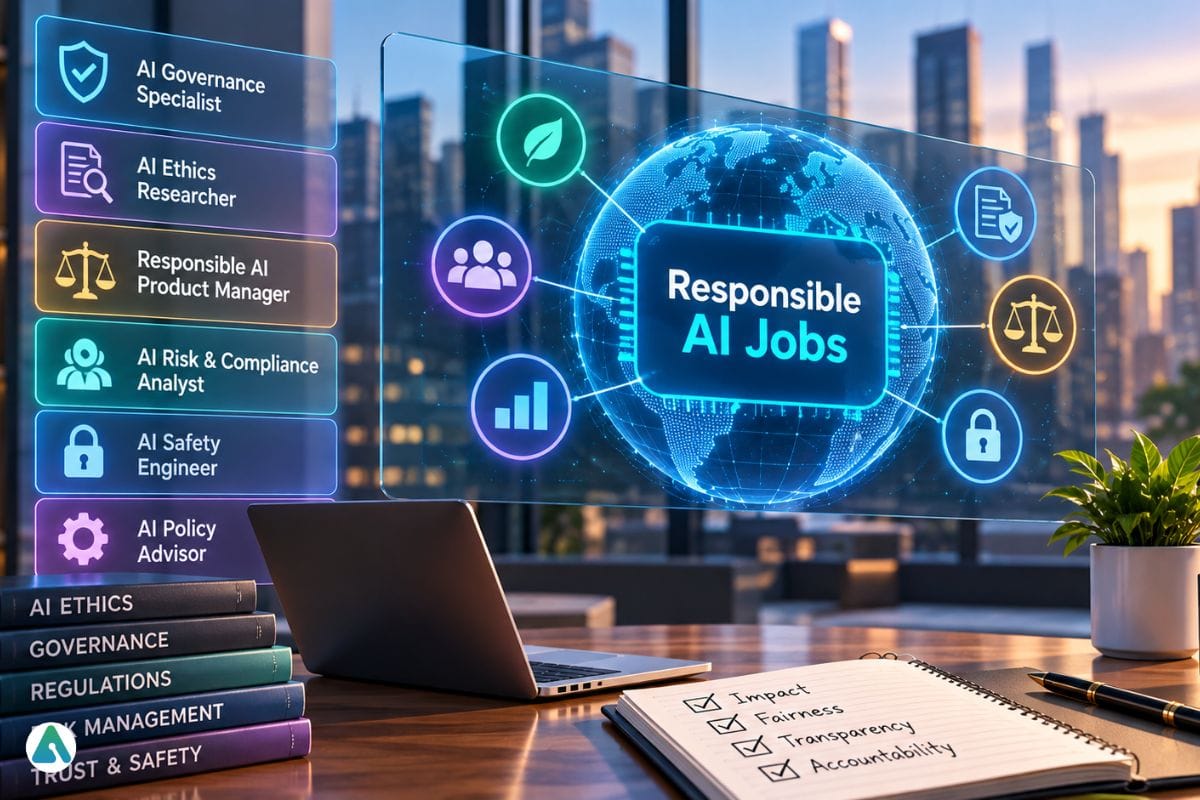
Responsible AI roles fall into six job families, and each family uses different titles.
Job family
Example titles
Typical work
Usual background
Governance and risk
AI governance manager, AI risk manager, AI compliance manager
Write policy, run impact assessments, track risk
Compliance, risk, privacy
Assurance and audit
AI assurance analyst, model risk manager
Test controls, document findings
Internal audit, model validation, IT risk
Technical
Responsible AI engineer, AI safety researcher, privacy and RAI engineer
Fairness testing, red teaming, model evaluation
Computer science, data science
Product
Technical product manager (responsible AI)
Turn policy into product requirements
Product management
Legal and policy
AI policy counsel, AI policy analyst
Track laws, advise on legal exposure
Law, public policy, privacy
Trust and safety
Trust and safety lead
Reduce misuse and harmful output
Operations, policy, security
Technical roles need code. The other families lean on risk, legal, audit, or communication skills.
Titles vary by employer, so search widely. Try AI governance, AI risk, model risk, AI assurance, AI policy, AI compliance, trust and safety, and privacy engineer, alongside “responsible AI.” IAPP’s board listed a “Privacy and RAI Engineer” role when I checked.
How much do responsible AI jobs pay?
IAPP’s 2025–26 survey puts median base pay between $123,000 and $221,000 (USD), depending on the group you belong to.
That range comes from separate survey groups. It is not a salary range for every responsible AI job.
Survey group
Median base salary
Privacy only
$123,000
AI governance only
$151,800
Privacy and AI governance together
$169,700
Tech sector, legal and compliance AI governance
$205,000
Tech sector, technical AI governance
$221,000
Read these figures with three limits in mind:
Sample: More than 1,600 people from over 60 countries responded, mostly from IAPP’s own community. Most hold at least one IAPP certification.
Location: Pay varies by country and city. The summary does not break it out.
Wording: Some third-party pages relabel these medians. Quote IAPP directly.
IAPP also found higher median pay among people holding an IAPP certification. It says the data does not prove the certification causes the difference.
Where can you find responsible AI jobs, including remote roles?
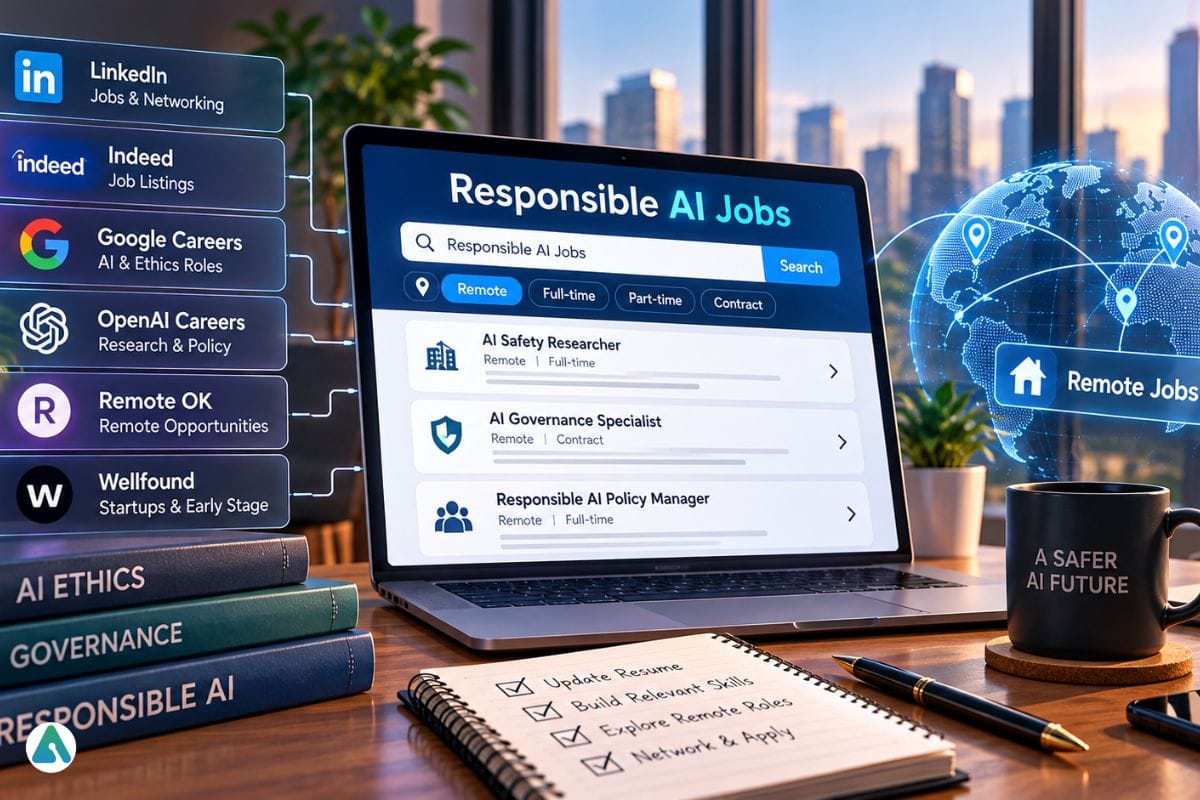
Start with two specialist boards: IAPP Career Central and the All Tech Is Human Responsible Tech Job Board. Then search LinkedIn and Indeed with the title list above.
IAPP Career Central covers privacy, AI governance, and cybersecurity law. The All Tech Is Human board covers responsible AI, trust and safety, and public interest technology. It also lists nonprofit and policy roles.
Here is what Career Central showed on 30 September 2026:
34 open roles in total.
10 remote, 18 hybrid, and 6 in person.
27 in the United States, with the rest in Canada, India, Poland, Spain, and the United Kingdom.
That is a one-day snapshot from a privacy-leaning board, so treat it as a sample. It still shows two things. Remote and hybrid roles exist, and they are not limited to one country.
In IAPP’s salary survey, 61% of respondents worked from home more than from an office. Large tech companies such as Microsoft and Amazon have also run responsible AI teams, so check their career pages directly.
Which certifications and skills help?
The most relevant certification is IAPP’s AIGP (Artificial Intelligence Governance Professional), but hiring data shows privacy credentials still appear more often.
IAPP describes the AIGP as covering AI systems, how laws apply to them, and governance across the AI life cycle. Its body of knowledge and exam blueprint are free.
In that 30 September snapshot, Career Central’s filter showed AIGP named on 2 listings. CIPP/US appeared on 9 and CIPM on 6. Postings can name several credentials, and the board leans toward privacy, so this is a hint, not a market study.
IAPP’s report also lists what employers want. People should understand AI, have governance, risk, and compliance experience, and be able to turn legislation into practical policy. Red teaming is expected to matter more.
Learn the NIST AI RMF and the EU AI Act first. ISO/IEC 42001, the AI management system standard, is worth adding.
My view: a certification shows you studied, and a work sample shows you can do the job. Hiring managers want both, but the sample is what sets you apart.
How do you move into responsible AI from another career?
You move in by starting from your current field and building one work sample that shows AI-specific judgment.
IAPP’s report shows where the entry points are. Privacy and legal and compliance teams each hold primary responsibility for AI governance at 22% of surveyed organizations. IT follows at 17%, then data governance at 10%.
Use this table to pick a route:
Your background
Natural target roles
Work sample to build
Compliance, audit, banking
AI risk analyst, AI assurance analyst
Mock AI risk register for a public AI tool, using the NIST AI RMF
Privacy
AI governance analyst, privacy and AI roles
AI impact assessment added to a privacy review template
Law or public policy
AI policy analyst, AI policy counsel
Two-page memo comparing EU high-risk rules with a US framework
Security or IT
AI security, AI risk
Oversight plan for an AI agent: what needs approval, what gets logged
Data science, engineering
Responsible AI engineer
Bias check on a public dataset, with a written report
Product
Responsible AI product manager
Product requirements doc that turns a policy into features
A hypothetical example: a credit risk analyst at a bank writes a short impact assessment for a loan-scoring model. She uses NIST AI RMF language, posts it as a LinkedIn article, and applies for “model risk” and “AI governance” roles. Her banking background does most of the persuading.
What mistakes slow down a responsible AI job search?
Most mistakes come from vague evidence and outdated assumptions.
Quoting a salary median without naming the survey group.
Writing about ethics in general terms instead of showing tests run, risks found, and controls proposed.
Waiting for the EU deadlines to arrive before building skills.
Assuming the EU’s new bias-detection provision allows free use of sensitive data. The Commission says it permits processing special categories of personal data to detect and correct bias. Read the regulation text for the conditions.
What should you do first if you want a responsible AI job?
Pick one job family, build one work sample, and check both specialist job boards this week.
Responsible AI jobs are growing, but the evidence has limits. The staffing data comes from a 2024 survey. The salary data comes from IAPP’s community. The job-board counts are a one-day snapshot.
Those limits still support a clear plan. Choose the row in the table that matches your background. Publish one sample. Then apply to roles that use several title variants.
FAQs
Q. What degree do you need for responsible AI jobs?
It depends on the track. Legal roles usually expect a law degree, and research roles usually expect advanced technical training. Governance and risk roles often hire from compliance, privacy, or IT. IAPP’s report notes that newer programs often hire managers with experience in a digital governance field such as privacy.
Q. What is the difference between AI governance and responsible AI?
AI governance covers policies, controls, and accountability. Responsible AI is broader and includes fairness, safety, and transparency in how systems are built and used. Job postings often blend the two.
Q. Which AI governance certification should beginners consider?
Start with IAPP’s AIGP. Read its free body of knowledge and exam blueprint first to check whether the content matches your target role.
Q. What should an AI governance portfolio contain?
Two or three work samples are enough. Good options include a risk register, an impact assessment, a policy memo, or a bias check with a short write-up. Explain your method and your limits.
Q. Can privacy professionals move into AI governance?
Yes. IAPP’s data shows privacy teams hold primary responsibility for AI governance at 22% of surveyed organizations. Its report also says many privacy professionals are asked to take on AI work.
Q. Can lawyers work in responsible AI?
Yes. AI policy counsel roles focus on tracking regulation, assessing legal exposure, and advising product teams.
Q. What is the highest-paying responsible AI job in the IAPP data?
Technical AI governance roles in the tech sector had the highest reported median: $221,000. The survey does not cover every AI job, so research roles at labs may pay differently.
Q. Are there remote responsible AI jobs?
Yes. On IAPP’s board, 10 of 34 listings were remote on 30 September 2026, and 18 more were hybrid. Availability changes daily, so check the boards directly.
Disclaimer: We are not affiliated with IAPP or any organization mentioned in this guide. Job counts, salaries, certifications, and regulations can change quickly. This guide uses published data and job-board snapshots checked on September 30, 2026. Treat the figures as a reference, not a guarantee of salary or employment outcomes.
Tags:
Sebastian Vale
Sebastian Vale reviews the latest AI tools and tech innovations, breaking down complex concepts into clear, actionable insights. He also creates step-by-step guides, helping readers make smarter decisions and stay ahead in a fast-moving digital world.