
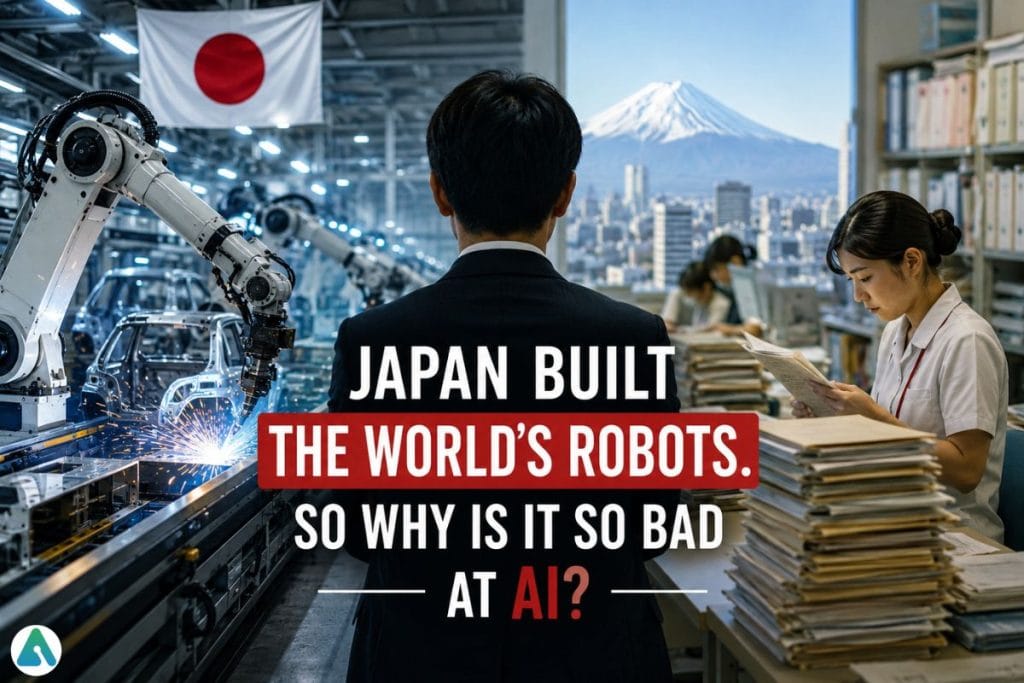
Japan Built the World’s Robots. It Won’t Let AI Near the Office.
Japan automated its factory floors before almost anyone else on Earth. Its industrial robots have welded cars, assembled electronics, and staffed warehouses since the 1980s.
Walk into a Japanese hospital today, though, and nurses still dig through paper folders instead of searching a database. Japan mastered automation for machines and stalled on automation for minds — a gap that shows up starkly wherever AI still can’t replace the judgment calls doctors make under uncertainty.
The numbers make that gap hard to ignore. Only 8.4% of Japanese workers use AI on the job, according to OECD data on Japan’s labour market. The US figure sits at 50%. The UK reaches 32%, and Singapore claims 56% of workers use AI multiple times a week.
Japan isn’t just behind. It’s an outlier among wealthy, tech-fluent economies.
That’s the puzzle worth sitting with. Japan has the labor shortage, the aging workforce, and the productivity crisis that should make it the most eager AI adopter in the developed world.
Instead, it’s the most reluctant.
Robots Follow Rules. AI Doesn’t.
The explanation isn’t unfamiliarity with automation. It’s the kind of automation Japan trusts.
Industrial robots execute exactly what engineers program into them, every time, with no room for improvisation. Generative AI doesn’t work that way — it guesses, and it occasionally gets things wrong in ways nobody can fully predict.
Japanese corporate culture has almost no tolerance for that unpredictability, especially with clients watching. American offices have absorbed a version of that same unpredictability already: teams that leaned on AI drafts without checking them closely enough learned the hard way when half-finished AI output started eating back the productivity gains it was supposed to create.
Austin Xu, co-founder of the AI startup Kuse AI, watched this play out after opening an office in Japan. He describes a workplace culture built on consensus and caution, where some companies would rather leave a job vacant than risk a machine handling it.
Contrast that with the US, where teams often throw AI tools into workflows first and correct mistakes later. Xu calls it a “let it try, then correct it” mentality that Japanese firms rarely embrace.
Parisa Haghirian, a professor of international management at Kyoto University of Advanced Science, frames it as a reliability problem more than a cultural one. Generative AI still isn’t consistent enough, she argues, so Japanese firms confine it to low-stakes work — drafting text, summarizing documents — and keep it away from decisions that carry real consequences.
A Government Cheering From the Sidelines
Tokyo knows the productivity numbers are a problem. Japan trails every other G7 economy on that measure.
The government passed an AI Promotion Act last year to nudge companies toward faster adoption, favoring light-touch rules over mandates. Officials talk about making Japan the friendliest country in the world for AI development.
The Ministry of Finance points to a headline figure as proof it’s working: 75% of Japanese businesses now report using AI in some form, up from just 11% five years earlier. On paper, that looks like a rapid turnaround.
The number hides more than it reveals, though. Critics say only a sliver of employees at most of these companies actually touch the technology, and even they use it in narrow, low-ambition ways — a chatbot draft here, a document summary there.
Adoption on paper isn’t adoption in practice.
The Skills Gap Nobody Wants to Say Out Loud
Part of the slowdown comes down to who’s available to do the work. Yasushi Ogasawara, who studies Japan’s social systems and technology at Meiji University, points out a contradiction: Japanese consumers love gadgets, but that enthusiasm hasn’t translated into broad digital literacy in the workplace.
One recent report projects Japan will be short almost 800,000 IT professionals by 2030. Roughly 60% of corporate computer systems in the country run on infrastructure more than two decades old — a foundation that makes serious AI integration difficult even for companies that genuinely want it.
There’s a quieter, more political reason AI adoption is moving slowly, too. Ogasawara notes that Japanese firms face far more pressure to protect jobs than to chase efficiency gains that might eliminate them.
The government talks about reskilling and digital transformation. Full employment remains the priority that actually shapes corporate decisions, he says.
Where the Shift Is Actually Happening
Change is visible at the edges, mostly among younger workers and the companies chasing them. Uta Yamaguchi, who joined the trading company Kanematsu this spring, says AI already runs through her daily routine — drafting emails, summarizing dense documents, transcribing meetings. Colleagues around her use it just as often.
Even at a company known for forward thinking, though, the technology stays firmly in assistant mode. American firms have started going further, restructuring themselves around what AI can now do rather than just handing it tasks — the same shift behind lean three-person teams replacing entire departments at some US companies, or treating an AI system less like a chatbot and more like a junior hire capable of running its own multi-step workflow.
Nothing like that exists in Japan yet. AI drafts the email; a person still decides what it says.
The Real Barrier Isn’t Technology
Ogasawara’s closing point cuts to the heart of it: Japanese society expects reform without pain, and that expectation makes any genuinely disruptive change difficult to pull off.
Japan didn’t hesitate to hand its factories to machines decades ago. What it’s hesitating over now is handing over judgment — the exact terrain where AI still runs into the limits of human discretion and soft skills that a welding robot never had to navigate.
Unlike that welding robot, AI asks companies to trust something they can’t fully predict. Until that trust builds, the productivity gains Japan badly needs will likely keep arriving somewhere else first.
Related: AI Chatbots Can Finally Do More Than Talk—Here’s What’s Changed
