
At Google I/O 2026, the company tried to send a message to the AI industry:
AI is becoming too expensive, and Google wants to be the company that fixes it.
On stage, CEO Sundar Pichai framed Google’s latest Gemini rollout as a cost-saving alternative to competitors like OpenAI and Anthropic. The headline claim was designed to grab attention: enterprises could potentially save more than $1 billion annually by shifting the majority of their workloads onto Google’s AI stack. Markets liked the narrative. Analysts amplified it. Google looked like it was launching a full-scale AI price war.
Then people looked at the token prices.
The “Cheap AI” Narrative Starts To Crack
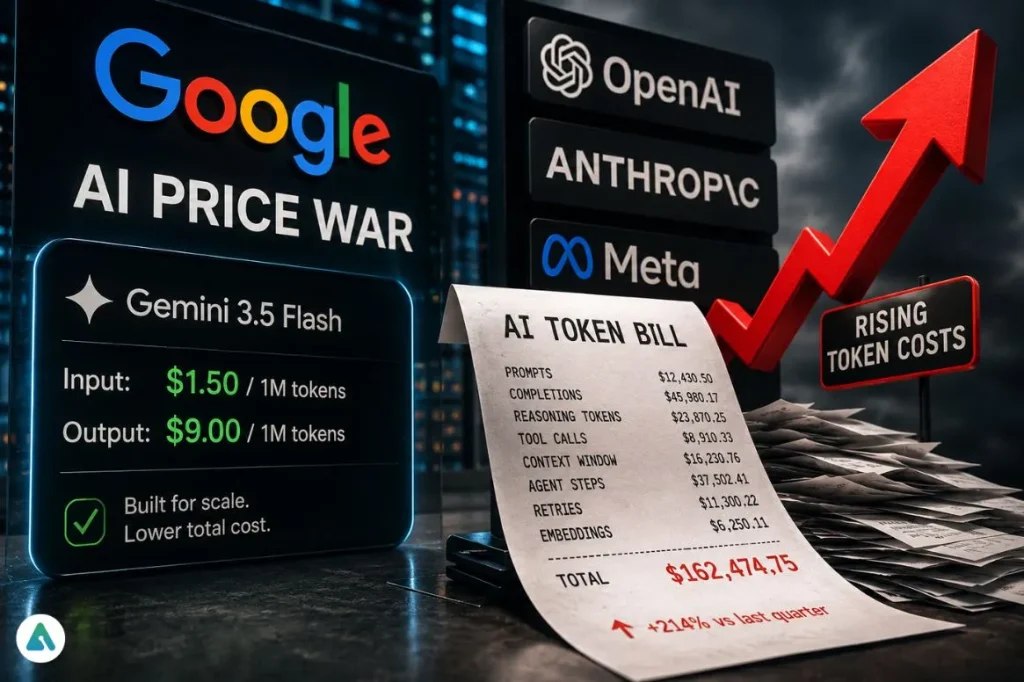
Google’s new Gemini 3.5 Flash is not cheaper than the model it replaces.
The pricing structure reportedly jumped from roughly $0.50 per million input tokens and $3 per million output tokens under Gemini 3 Flash to approximately $1.50 and $9 under Gemini 3.5 Flash — a threefold increase in list pricing. The model is more capable, but calling it a price cut requires a very specific interpretation of cost.
And Google is hardly alone.
Across the frontier model market, companies are introducing increasingly powerful systems while quietly pushing up effective usage costs. The AI race is no longer just about benchmark scores, coding performance, or reasoning quality. It is increasingly becoming a battle over who can convince customers that higher costs are actually lower costs.
That sounds contradictory because it is.
The industry’s favorite metric — token pricing — is becoming less useful on its own.
The Metric That Actually Matters
For most of the AI boom, companies compared models using simple numbers:
- Cost per token
- Speed
- Benchmark rankings
But enterprises do not buy tokens.
They buy outcomes.
A legal team cares about the cost of reviewing contracts.
A software company cares about the cost of shipping code.
A customer support organization cares about the cost of resolving tickets.
That means the metric that matters is not cost per token.
It is the cost per completed task.
A model that costs three times more per token but solves a problem in one interaction may ultimately be cheaper than a model that requires multiple turns, retries, and larger context windows.
The problem is that almost nobody publishes those numbers.
As a result, enterprises are often making purchasing decisions using measurements that do not directly reflect business value.
Why Google’s Position Is Different
Despite the marketing spin, Google does possess one genuine advantage that competitors cannot easily replicate.
Infrastructure.
Unlike OpenAI and Anthropic, Google owns nearly every layer of the AI stack:
- Custom TPUs
- Data centers
- Networking infrastructure
- Cloud services
- Distribution through Workspace
- Massive internal AI deployment
That vertical integration matters.
Every token processed by Anthropic or OpenAI depends heavily on external infrastructure economics. Google’s TPU investments reduce dependence on third-party hardware suppliers and give the company greater control over inference costs. Analysts increasingly view that infrastructure advantage as one of Google’s strongest weapons in the AI race.
The company is not just selling AI.
It is operating AI at a scale that few competitors can approach.
The Budget Problem Nobody Wants To Talk About
While AI companies fight over pricing narratives, enterprise customers are discovering something uncomfortable:
AI spending can spiral much faster than expected.
The more useful these systems become, the more employees use them.
The more employees use them, the larger the token bill becomes.
This creates a paradox.
AI is getting better.
But for many organizations, AI is also getting more expensive.
The assumption that AI would inevitably become cheaper every year is starting to collide with reality. Modern models often perform longer reasoning chains, generate larger outputs, and support increasingly agentic workflows. Even when hardware improves, total consumption can rise faster than efficiency gains.
The result is that costs can increase even while the underlying technology becomes more efficient.
The Real Story Beneath Google’s Announcement
The most important part of Google’s I/O presentation was not Gemini 3.5 Flash.
It was not the benchmark charts.
It was not the billion-dollar savings claim.
It was the recognition that AI is becoming an infrastructure business.
For years, the technology industry assumed the winner would be the company with the smartest model.
That may still matter.
But as enterprise AI adoption accelerates, another factor is becoming just as important:
Who can deliver frontier-level intelligence at the lowest marginal cost?
That question points directly toward Google’s biggest strength.
The company’s billion-dollar savings projection may or may not survive real-world enterprise workloads. The assumptions behind that figure remain largely undisclosed. But the infrastructure advantage underneath the claim is real.
And that is the number worth watching.
Because the next phase of the AI war may not be decided by intelligence alone.
It may be decided by whoever can afford to generate it the cheapest.
Related: Anthropic Is Paying Its Rival $1.25B a Month for GPUs — Here’s Why It Had No Choice
